Learn more about capacity building, including the definition, importance, types, and activities to get started with it in your organization.
Capacity Building and Networks | Partners for Impact
Capacity building helps generate networks that help sustain movements.

Movement Building
Features of Movement Capacity Building for Nonprofits There have been significant resources dedicated to the development of nonprofits' organizational capacity. However, far less attention has been paid to the capacity of groups to support movements for social change. Below are nine areas the Build
Capacities
Capacities turns your ideas into connected objects. Think naturally, find everything instantly.
AI deskilling is a structural problem
Many artificial intelligence tools replace or stand to replace human activity, via automated decision-making, recommender systems and content generation. The more artificial intelligence (AI) replaces valuable human activity, the more it risks deskilling humans of their human capacities. This paper argues for applying a structural perspective to this phenomenon. It introduces the concept of ‘capacity-hostile environments’ to identify instances where AI mediation impedes human capacity cultivation. The analysis moves beyond individual responsibility that agents have to cultivate their human capacities, demonstrating how AI’s influence creates systemic conditions that could inhibit the development and exercise of human capacities by undermining the process of capacity cultivation. Drawing on the philosophy of skill as well as social epistemology, this paper argues that capacity cultivation (skilling) includes acquiring agential control over the capacities, inculcated through a long, gradual process of habituation. Habituation, in turn, depends on learning from others: the ‘know how’ of the skill, as well as a shared understanding of the value of the skill. AI mediation risks undermining the quality of the conditions for capacity habituation, leading to capacity impoverishment. By exploring the role of AI in mediating human activity, the paper highlights the need to evaluate AI applications based on their conduciveness or hostility to capacity cultivation. Ultimately, it calls for a critical reflection on the values inherent in AI socio-technical systems and emphasizes the societal obligation to foster capacity-conducive environments in the age of AI.
Excess Capacity Learning
We introduce a new framework for understanding how cognitive systems (e.g., humans) learn from experience, based on the concept of representational capacity—the relative amount of representational resources devoted to encoding past experiences. Most paradigms in cognitive science have operated under the assumption that these resources are constrained, forcing cognitive systems to compress rich and noisy experiences to effectively generalize to new situations. We leverage recent advances in computer science to outline the implications of learning with excess capacity, or applying even more representational resources than needed to perfectly memorize all the details of one’s past experiences. In particular, we review evidence suggesting that excess capacity systems can exhibit many of the characteristics of human learning, such as the simultaneous ability to memorize individual experiences and generalize knowledge to new situations. We define and differentiate between constrained (not enough), sufficient (just enough), and excess (more than enough to perfectly capture all the details of one’s past experiences) capacity. We derive empirical properties of learning in each of these capacity regimes, and compare these predictions to effects documented for human learning. We highlight the broad implications of this framework for advancing theoretical and empirical work across cognitive, clinical, and developmental psychology.

A beautiful constraint – summary
A beautiful constraint. How to transform your limitations into advantages. By Adam Morgan & Mark Barden. Summarised by paul_arnold@me.com – Strategic facilitator, planner and trainer. Th…

Problem Framing
Explore a problem space and formulate a robust problem statement to ensure you’re solving the right problem. Time: 45+minutes Group Size: 2+ people Level: Intermediate
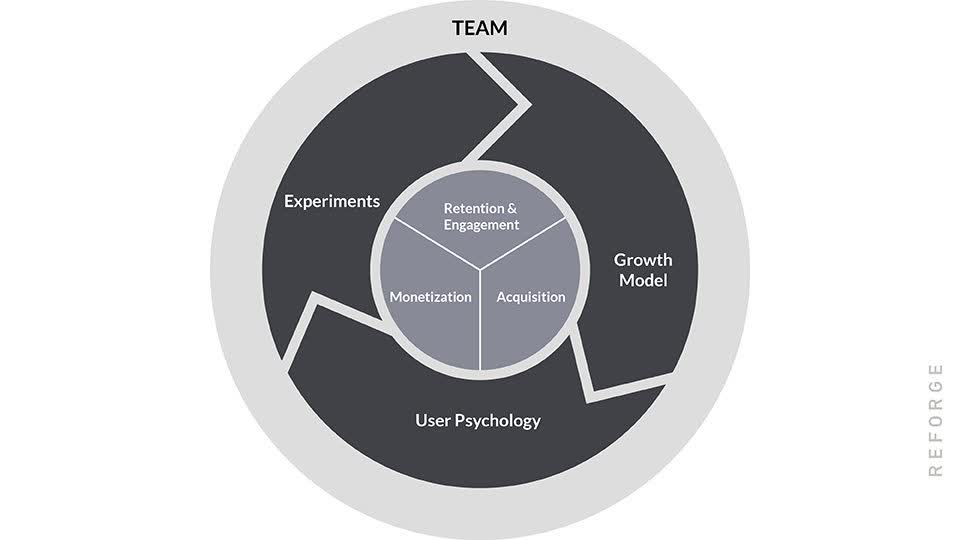
Building Growth: Product, Process, and Team | Reforge Blog
Reforge drives team performance, with the most actionable learning from vetted operators that your team will actually use and apply.
How buildings learn : what happens after they're built
Originally published: New York, NY : Viking, 1994; Includes bibliographical references (p. 224-229) and index; Flow -- Shearing layers -- "Nobody cares what you do in there": the low road --- Houseproud: the high road -- Magazine architecture: no road -- Unreal estate -- Preservation: a quiet, populist, conservative, victorious revolution -- The romance of maintenance -- Vernacular: how buildings learn from each other -- Function melts form: satisficing home and office -- The scenario-buffered building -- Built for change -- Appendix: The study of buildings in time

Pace Layering: How Complex Systems Learn and Keep Learning · Journal of Design and Science
Pace layers provide many-leveled corrective, stabilizing feedback throughout the system. It is in the contradictions between these layers that civilization finds its surest health. I propose six significant levels of pace and size in a robust and adaptable civilization.

Capabilities
There are three kinds of capabilities in Peergos: Mirror, Read and Write.
STAMINA Working Group
STAMINA Working Group - Social Tech And ModellIng for kNowledge & Action
(PDF) An Ecological Dynamics Perspective on Flow in Sport
PDF | This thesis utilises an ecological dynamics perspective to investigate the concept of flow experiences in the domain of sport. The study of flow... | Find, read and cite all the research you need on ResearchGate

Denizen
What is embodied leadership? Learn how the Post Growth Institute combines an asset-based approach with sociocracy and lean processes to establish a radically progressive, post growth organization.
Growth Wins When Built On A Solid Foundation of Retention & Engagement | Reforge Blog
Reforge drives team performance, with the most actionable learning from vetted operators that your team will actually use and apply.

Developer Experience Goals for Atproto Spaces - AT Protocol
A new series nailing down the moving parts of building on Spaces