

Nicholas Carlini, Google; Florian Tramèr, Stanford University; Eric Wallace, UC Berkeley; Matthew Jagielski, Northeastern University; Ariel Herbert-Voss, OpenAI and Harvard University; Katherine Lee and Adam Roberts, Google; Tom Brown, OpenAI; Dawn Song, UC Berkeley; Úlfar Erlingsson, Apple; Alina Oprea, Northeastern University; Colin Raffel, Google
Stanford CS336 Language Modeling from Scratch I 2025
How Large Language Models Actually Work
Stanford CS336 | Language Modeling from Scratch (Spring 2025 Archive)
Archived course website for Stanford CS336: Language Modeling from Scratch (Spring 2025), including schedule, assignments, logistics, and materials.

Can Language Models Play the Wikipedia Game?
Language models increasingly support or automate information retrieval from document collections too large to index. This task is difficult when it requires specialist linguistic or scientific knowledge. We used the Wikipedia Game to test language models on an analogous information retrieval task. In the game, players must reach a target article using only article links. We compared sentence embedding models and LLMs across five Wikipedia languages and five academic-literature datasets. We construct very large local graphs of Wikipedia pages and of paper citations using OpenAlex and provide code to build and navigate them. This allows the study of language models' navigation capabilities without relying on third-party APIs. We compared the models with human and TF-IDF benchmarks. The Wikipedia Game format enables robust comparisons across techniques, languages, and domains. No model significantly outperformed humans, although the best models (GPT-o3 mini, GPT-4o, QwQ:32B, and DeepSeek-R1:70B) achieved comparable success. Performance and rankings varied across languages and topics, with implications for practitioners utilising these techniques.

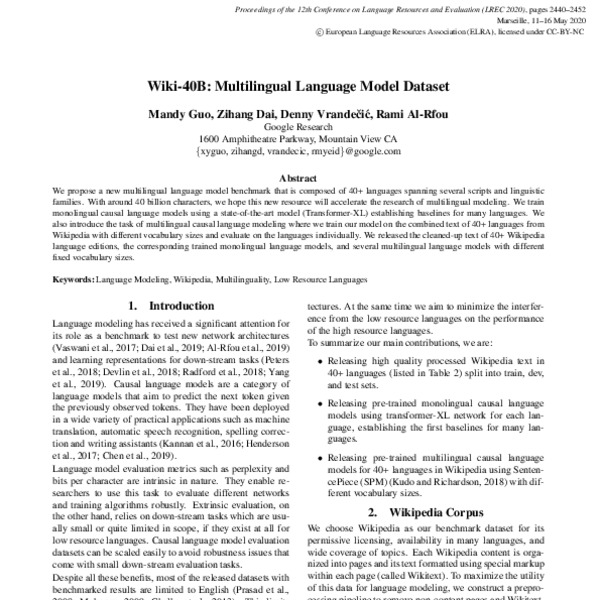
Wiki-40B: Multilingual Language Model Dataset
We propose a new multilingual language model benchmark that is composed of 40+ languages spanning several scripts and linguistic families. With around 40 billion characters, we hope this new resource will accelerate the research of multilingual modeling. We train monolingual causal language models using a state-of-the-art model (Transformer-XL) establishing baselines for many languages. We also introduce the task of multilingual causal language modeling where we train our model on the combined text of 40+ languages from Wikipedia with different vocabulary sizes and evaluate on the languages individually. We released the cleaned-up text of 40+ Wikipedia language editions, the corresponding trained monolingual language models, and several multilingual language models with different fixed vocabulary sizes.
Targeted Multilingual Adaptation for Low-resource Language Families
The "massively-multilingual" training of multilingual models is known to limit their utility in any one language, and they perform particularly poorly on low-resource languages. However, there is evid
Models overview
Claude is a family of state-of-the-art large language models developed by Anthropic. This guide introduces the available models and compares their performance.
LLM in a Flash: Efficient Large Language Model Inference with Limited Memory
Large language models (LLMs) are central to modern natural language processing, delivering exceptional performance in various tasks…

Language models struggle with compartmentalization
In the training data used by large language models (LLMs), the same latent concept is often presented in multiple distinct ways: the same facts appear in English and Swahili; many functions can be expressed in both Python and Haskell; we can express propositions in both formal and natural language. We show that LLMs can exhibit compartmentalization, where they fail to identify and share statistical strength between distinct presentations of unified concepts. In the worst case, LLMs simply learn parallel internal representations of each presentation of the concept, saturating model capacity with redundancies and decreasing sample efficiency with the number of such presentations. We also demonstrate that synthetic parallel data can fail to improve this despite being easily learned itself. Under this framework, we find that, for small models, early multilingual learning is nearly entirely compartmentalized. Finally, all interventions that we study exhibit a phase transition in which their effectiveness depends on the number of distinct presentations, suggesting that the language modeling objective may only inconsistently unify representations.
Cross-Lingual Exploration for Parametric Knowledge | Idan Szpektor
Accepted to EMNLP Findings! While Large Language Models encode vast amounts of multicultural and factual information, this parametric knowledge is often unevenly accessible across languages. Standard inference frequently fails to surface localized facts, creating persistent gaps in cross-lingual knowledge transfer and consistency. We address this challenge in our paper "Cross-Lingual Exploration for Parametric Knowledge" (https://lnkd.in/drf36bV7), a collaboration between Elisha Diskind, Itamar Trainin, and Omri Abend from The Hebrew University of Jerusalem, Leshem Choshen from the Weizmann Institute of Science, alongside Uri Shaham and myself from our Google Research IL group. We formalize cross-lingual exploration as a structured search process across four core dimensions: language selection, exploration routing, answer aggregation, and inference budget. Evaluating across 17 typologically diverse languages on the ECLeKTic and CLIKE benchmarks, we show that allowing models to autonomously navigate alternative linguistic paths yields up to a 21% gain in knowledge transfer and a 16% boost in factual recall over native baselines, surpassing both standard English-pivot routing and native-language reasoning. Crucially, cross-lingual exploration defines a significantly more efficient compute Pareto frontier than scaling within the native query language, while driving intrinsic cross-lingual consistency gains beyond what accuracy improvements alone explain. Technically, this moves the needle for multilingual inference and knowledge elicitation pipelines, demonstrating that strategic language switching is a powerful, training-free mechanism for unlocking latent parametric knowledge.

Beyond Model Collapse: Scaling Up with Synthesized Data Requires...
Large Language Models (LLM) are increasingly trained on data generated by other LLM, either because generated text and images become part of the pre-training corpus, or because synthetized data is...
Do Large Language Models Perform the Way People Expect? Measuring the Human Generalization Function
What makes large language models (LLMs) impressive is also what makes them hard to evaluate: their diversity of uses. To evaluate these models, we must understand the purposes they will be used for. We consider a setting where these deployment decisions are made by people, and in particular, people's beliefs about where an LLM will perform well. We model such beliefs as the consequence of a human generalization function: having seen what an LLM gets right or wrong, people generalize to where else it might succeed. We collect a dataset of 19K examples of how humans make generalizations across 79 tasks from the MMLU and BIG-Bench benchmarks. We show that the human generalization function can be predicted using NLP methods: people have consistent structured ways to generalize. We then evaluate LLM alignment with the human generalization function. Our results show that -- especially for cases where the cost of mistakes is high -- more capable models (e.g. GPT-4) can do worse on the instances people choose to use them for, exactly because they are not aligned with the human generalization function.
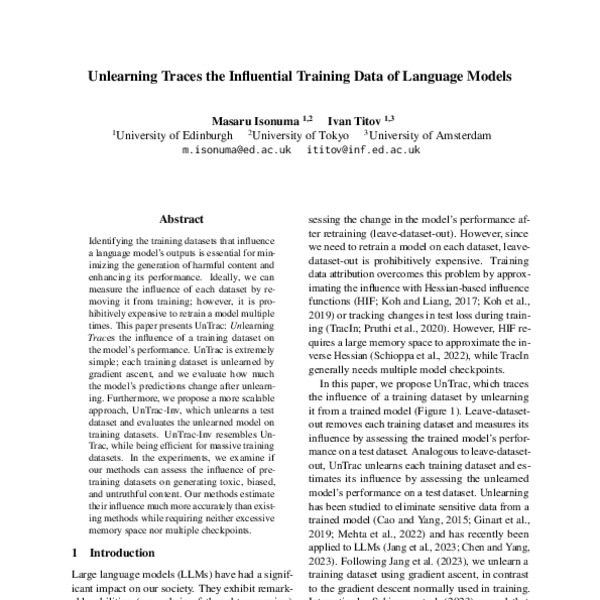
Unlearning Traces the Influential Training Data of Language Models
Identifying the training datasets that influence a language model's outputs is essential for minimizing the generation of harmful content and enhancing its performance. Ideally, we can measure the influence of each dataset by removing it from training; however, it is prohibitively expensive to retrain a model multiple times. This paper presents UnTrac: unlearning traces the influence of a training dataset on the model's performance. UnTrac is extremely simple; each training dataset is unlearned by gradient ascent, and we evaluate how much the model's predictions change after unlearning. Furthermore, we propose a more scalable approach, UnTrac-Inv, which unlearns a test dataset and evaluates the unlearned model on training datasets. UnTrac-Inv resembles UnTrac, while being efficient for massive training datasets. In the experiments, we examine if our methods can assess the influence of pretraining datasets on generating toxic, biased, and untruthful content. Our methods estimate their influence much more accurately than existing methods while requiring neither excessive memory space nor multiple checkpoints.
Improving Cross-Lingual Factual Recall via Consistency-Driven Reinforcement Learning
Large language models (LLMs) trained predominantly on English data encode substantial world knowledge, yet often fail to express it reliably in other languages, a phenomenon known as cross-lingual...
Learning to Route Languages for Multilingual Policy Optimization
Large language models~(LLMs) are trained on heterogeneous multilingual corpora, yet existing policy optimization methods often implicitly restrict each training question to a single response language or rely on a fixed dominant language for supervision. We propose language-routed policy optimization (LRPO), an online policy optimization framework that treats language as a selectable variable. LRPO elicits multilingual rollouts for each training question and integrates their relative quality into preference-based policy updates, increasing the diversity and informativeness of training signals under the fixed rollout budget. To adaptively determine which languages to explore during reinforcement learning, we introduce a trainable language router formulated as a multi-armed bandit, balancing exploration of underutilized languages with exploitation of more informative ones. Extensive experiments show that LRPO consistently improves multilingual performance, demonstrating that adaptive language routing enables effective cross-lingual knowledge exploitation for training. We release all the resources at https://github.com/Guochry/LRPO.