Innovative design principles and student learning outcomesAs part of the Charles A. Dana Center’s mission to reshape math education to meet students’ needs in our rapidly changing world, we have developed three new fourth-year math course frameworks. The design principles and student learning outcomes are intended to help educators develop engaging, rigorous courses for math pathways that extend from high school through higher education and into the workforce.
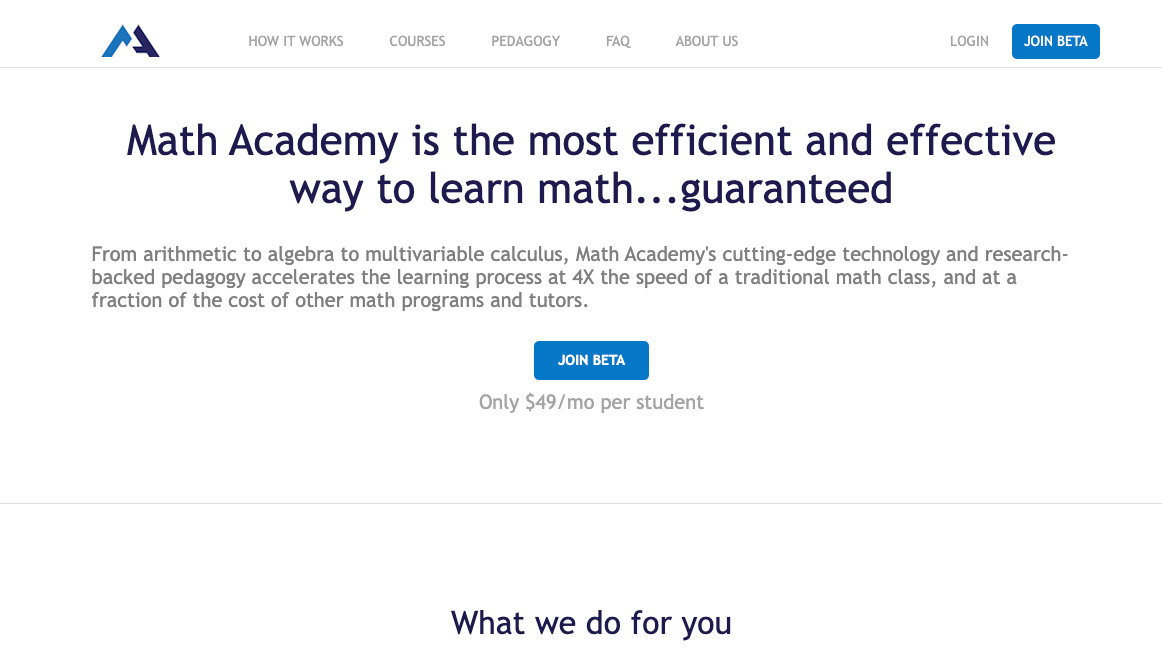
Math Academy
Math Academy is an AI-powered, fully-automated online math-learning platform. Math Academy meets each student where they are via an adaptive diagnostic assessment and introduces and reinforces concepts based on each student’s individual strengths and weaknesses. The comprehensive UC approved and WASC accredited courses begin with 4th-grade math and continue through advanced university-level courses, including standard and integrated curriculum that meet both state and common core standards. The Math Academy pedagogy follows a mastery-based learning philosophy, leveraging cutting-edge cognitive learning theory such as distributed practice, interleaving, and mixed review layered on knowledge graph technology to achieve outsized results.
Math Academy
The Math Academy curriculum and pedagogy leverage cutting-edge cognitive learning theory. Why? Because it’s been studied extensively, backed up and proven to work. We aren’t providing edu-tainment. This isn’t enrichment. We teach math as if we were training a professional athlete or musician, or anyone looking to acquire a skill to the highest degree possible. This is real work for a student who is serious about learning math. We expect every student using our system to actually master the material, and do it efficiently and effectively.
Math Academy Wants To Supercharge Your Learning
A review of the online learning program
My Journey Back to Math: A Short Review of MathAcademy
Personal journey of rediscovering math through MathAcademy and learning in public

Math Curriculum Review: MathAcademy
Math Academy is what happens when you build a math program without trying to make it cute. It's ruthlessly effective, occasionally frustrating, and probably the closest thing we have to a "truth in advertising" approach to math education. Math Academy will take your 4th grader all the way through university
A Math Academy review
Background and context Some background on me just so that you have a rough idea of where this review is coming from: I did Olympiads as a kid and have been involved in fairly math-heavy fields ever since, through university at least, depending on your definition of math-heavy. I’ve also been completely self-taught when it comes to the non-elementary-school math I know. So my plan on using my Math Academy subscription was to mostly brush up on things. I also did only the university-level courses.
The Math Academy Way
The Math Academy Way Using the Power of Science to Supercharge Student Learning – Working Draft – Note: If you are reading this as a PDF, consider switching to the Google Doc which may contain new updates. Authored by Justin Skycak, advised by Jason Roberts. Ma...


Transitioning to a Living Curriculum
The Principles and Practices to building a new way of Learning

Innovative Time Strategies for Schools | Unlocking Time
Explore free resources about innovative time strategies to fuel student-centered learning in schools -- includes tools, case studies and opportunities to dig deeper.

My Review on Math Academy after almost 1 year as a university student (15k + exp total)
Formalising mathematics: an introduction.
An introduction to the TCC course “Formalising Mathematics”

Transforming Curriculum and Building Capacity in K–12 Data Science Education · Issue 4.4, Fall 2022
The recently released and updated Pre-K–12 Guidelines for Assessment and Instruction in Statistics Education (GAISE II; Bargagliotti et al., 2020) provides guidance as to how teachers can support the development of data literacy for all students in the pre-K–12 curriculum. However, to truly meet the vision of the GAISE II report and to support all students in developing data literacy for today’s societies, significant transformations need to be made to the educational system as a whole to build capacity for such development. In this article we discuss the current state of the K–12 curriculum focusing on the mathematics curriculum where statistics and data concepts are most frequently situated, presenting some challenges and exciting examples. We then discuss areas of need for capacity building that must come at all levels, including: K–12 school curriculum, K–12 teacher professional development, K–12 teacher preparation, statistics and data science education research, and policies. We also provide a set of recommendations for building capacity to develop the data literacy of all students through the teaching of data science and statistics concepts and practices in the K–12 mathematics curriculum to support democratic equity through engaged citizenship.

A free, online course taught by Lachlan Kermode and Erika Bussmann. Our next semester runs from March 27th to June 7th.
Mindful Design
A high quality, expansive video course that will elevate your design skills to a level you never thought was achievable.