
Private, domain-specific benchmarks in legal, tax, and finance.
AI for Law Firms: What the 8am Legal Industry Report Tells Us About AI Use
New data from 1,300+ legal professionals shows generative AI use has more than doubled year over year. The real question now: How should law firms structure governance and integration?

Governing Digital Legal Systems: Insights on Artificial Intelligence and Rules as Code · MIT Computational Law Report
This article explores how AI and 'rules as code' are turning law into automated systems. It highlights the need for governance focused on transparency, explainability, and risk management to ensure these digital legal frameworks stay reliable and fair.

AI and Doctrinal Collapse
Artificial intelligence runs on data. But the two legal regimes that govern data—information privacy law and copyright law—are under pressure. Formally, each re

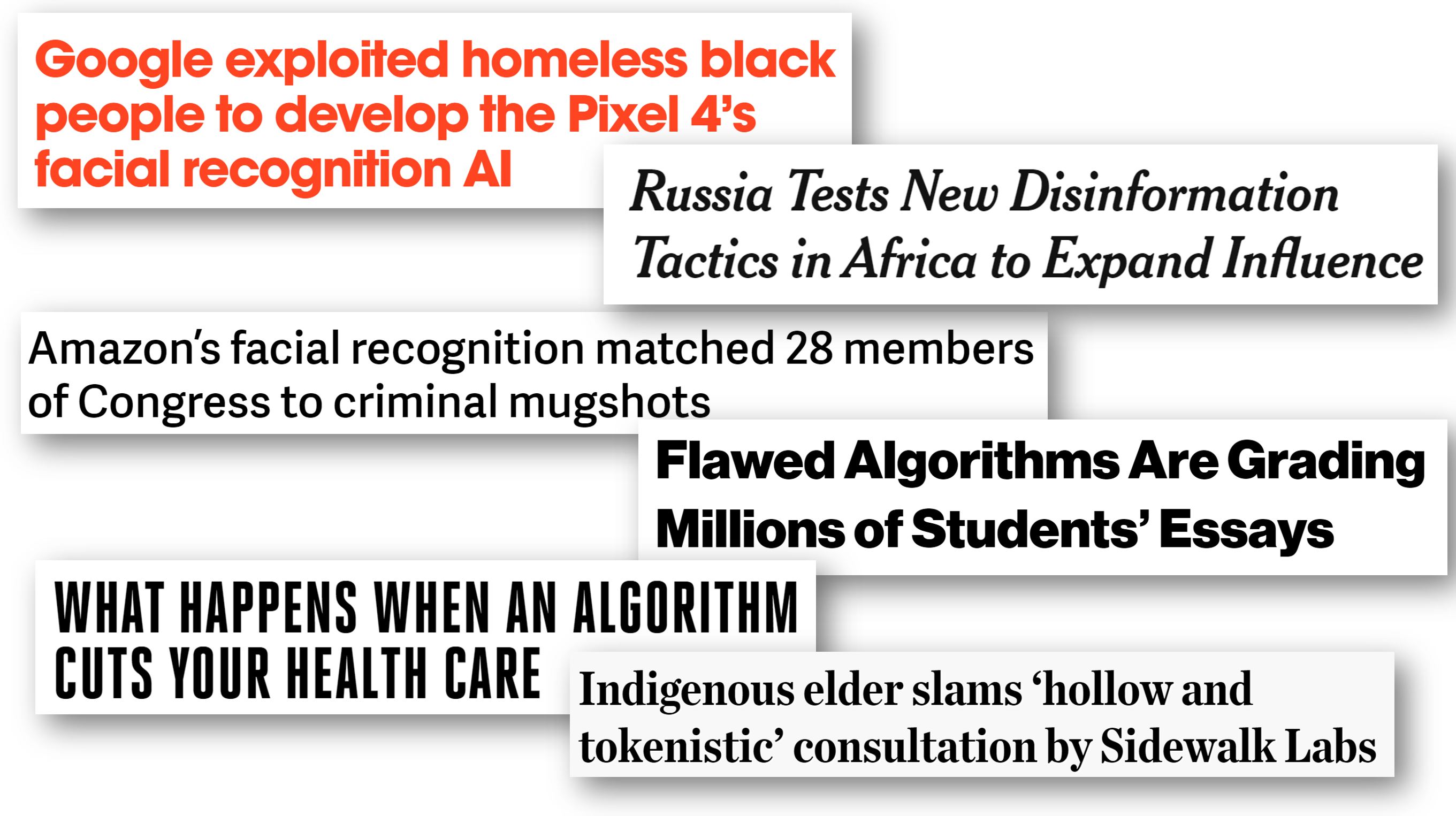
Practical Data Ethics
Free, online course from fast.ai and USF Data Institute covering disinformation, bias & fairness, ethical foundations, practical tools, privacy & surveillance, the silicon valley ecosystem, and algorithmic colonialism
Greyhaven — Sovereign AI Systems for Enterprise
Greyhaven builds custom sovereign AI systems: on-premise inference, private data pipelines, and model-agnostic architecture so enterprises maintain full control over their AI.

Artificial Intelligence and the Purpose of Social Systems
The law and ethics of Western democratic states have their basis in liberalism. This extends to regulation and ethical discussion of technology and businesses doing data processing. Liberalism relies on the privacy and autonomy of individuals, their ordering through a public market, and, more recently, a measure of equality guaranteed by the state. We argue that these forms of regulation and ethical analysis are largely incompatible with the techno-political and techno-economic dimensions of artificial intelligence. By analyzing liberal regulatory solutions in the form of privacy and data protection, regulation of public markets, and fairness in AI, we expose how the data economy and artificial intelligence have transcended liberal legal imagination. Organizations use artificial intelligence to exceed the bounded rationality of individuals and each other. This has led to the private consolidation of markets and an unequal hierarchy of control operating mainly for the purpose of shareholder value. An artificial intelligence will be only as ethical as the purpose of the social system that operates it. Inspired by the science of artificial life as an alternative to artificial intelligence, we consider data intermediaries: sociotechnical systems composed of individuals associated around collectively pursued purposes. An attention cooperative, that prioritizes its incoming and outgoing data flows, is one model of a social system that could form and maintain its own autonomous purpose.

Public AI Inference Utility
A nonprofit, open-source service to make public and sovereign AI models more accessible.
Generative AI and Finance
Since ChatGPT's release in 2022, demand for artificial intelligence (AI)–related skills in finance has grown rapidly, as generative AI drives significant technological changes in both the financial research field and the broader economy. We show that financial occupations are highly exposed to the productivity effects of generative AI, review the literature on the impact of ChatGPT on firm value, and provide directions for future research investigating the impact of this major technology shock. Generative AI also holds great potential as a tool for finance researchers and practitioners: We review and describe innovations in research methods linked to improvements in AI tools, along with their applications. We offer a practical introduction to available tools and advice for researchers in academia and industry interested in using these tools.

Sharing the Algorithm: The Tax Solution to Generative AI
This article argues that tax policy offers a core tool for mitigating the sweeping public policy challenges of generative Artificial Intelligence ("AI"
Semivalue-based data valuation is arbitrary and gameable
The game-theoretic notion of the semivalue offers a popular framework for credit attribution and data valuation in machine learning. Semivalues have been proposed for a variety of high-stakes...

Hallucination-Free? Assessing the Reliability of Leading AI Legal Research Tools
Legal practice has witnessed a sharp rise in products incorporating artificial intelligence (AI). Such tools are designed to assist with a wide range of core legal tasks, from search and summarization of caselaw to document drafting. But the large language models used in these tools are prone to "hallucinate," or make up false information, making their use risky in high-stakes domains. Recently, certain legal research providers have touted methods such as retrieval-augmented generation (RAG) as "eliminating" (Casetext, 2023) or "avoid[ing]" hallucinations (Thomson Reuters, 2023), or guaranteeing "hallucination-free" legal citations (LexisNexis, 2023). Because of the closed nature of these systems, systematically assessing these claims is challenging. In this article, we design and report on the first preregistered empirical evaluation of AI-driven legal research tools. We demonstrate that the providers' claims are overstated. While hallucinations are reduced relative to general-purpose chatbots (GPT-4), we find that the AI research tools made by LexisNexis (Lexis+ AI) and Thomson Reuters (Westlaw AI-Assisted Research and Ask Practical Law AI) each hallucinate between 17% and 33% of the time. We also document substantial differences between systems in responsiveness and accuracy. Our article makes four key contributions. It is the first to assess and report the performance of RAG-based proprietary legal AI tools. Second, it introduces a comprehensive, preregistered dataset for identifying and understanding vulnerabilities in these systems. Third, it proposes a clear typology for differentiating between hallucinations and accurate legal responses. Last, it provides evidence to inform the responsibilities of legal professionals in supervising and verifying AI outputs, which remains a central open question for the responsible integration of AI into law.
Regulation & Market Design | Windfall Policy Atlas
What rules and institutional structures will shape how AI-driven economic value is created and distributed?

Data on AI Companies
Our database of AI company data, with data on revenue, funding, staff, and compute for many of the key players in frontier AI.
AI Inference Pricing, EU Hosted, Per Token | TensorX
Transparent, pay-as-you-go pricing for private AI inference on TensorX. No lock-in, EU-hosted, with zero data retention and an OpenAI-compatible API.

Import AI 456: RSI and economic growth; radical optionality for AI regulation; and a neural computer
What laws does superintelligence demand?