Replika, the "AI companion who cares," has undergone some abrupt changes to its erotic roleplay features, leaving many users confused and heartbroken.
Automated Intimacy
This isn’t capitalism’s first loneliness epidemic. But in the 21st century, relationship simulators like Replika are here with the solution: your very own AI lover.


Anthropomorphism in AI Companion Communities: Age, Gender, and Emotional Correlates
Artificial intelligence (AI) systems are increasingly integrated into daily life, with millions now using AI chatbots built on Large Language Models (LLMs) for companionship. Both humanlike AI qualities and user predispositions to anthropomorphize relate to social consequences, such as increased trust, social health benefits, and psychological harms. Populations such as children, older adults, or those with mental health vulnerabilities may be particularly susceptible to anthropomorphism and its detriments, but mixed findings complicate the role of demographics. We used publicly available Reddit data from three popular AI companion subreddits to assess relationships between gender, age, anthropomorphism, and elicited emotions, to better understand how different people perceive and are affected by AI companions. We investigated three questions: How do age and gender relate to anthropomorphization of AI?, How does emotional expression relate to anthropomorphization?, and How do age and gender moderate emotion-anthropomorphization relationships? We found that adults and women anthropomorphize AI chatbots more than teens and men, and that positive emotional expression, particularly joy, is positively associated with anthropomorphization, while neutrality is negatively associated with anthropomorphism. Both relationships were stronger in adults than teens. Our findings suggest that the tendency to anthropomorphize may be more broadly distributed across age groups than previously expected, thereby prompting the reevaluation of existing digital safety norms.

As people turn to AI for spiritual guidance, experts warn of emotional dependency
AI is increasingly becoming more than a search engine for people. It can be a source of guidance on relationships, morality, grief, spirituality and the meaning of life. That shift is at the center of a new report.
Lovee AI: AI for Relationships & Couples
Emotionally intelligent AI for couples. Voice coaching, honest feedback, zero judgment.

The AI Industry Has a Major Problem: Most People Aren’t Freaks Who Want an AI Agent Running Their Whole Life
There's a problem for AI agents like Meta's Muse: ordinary people don't seem very interested in what they're offering.
Americans are increasingly concerned about AI exacerbating mental health problems
One in 10 Americans (10%) say they definitely (2%) or probably (8%) could form a deep emotional bond with an AI chatbot companion.
Your Software Is Not Sentient
Software simulacrum is not true consciousness, the stripper at the strip club doesn't actually love you, and nearly all of the biggest problems with "AI" have very ordinary human origins.
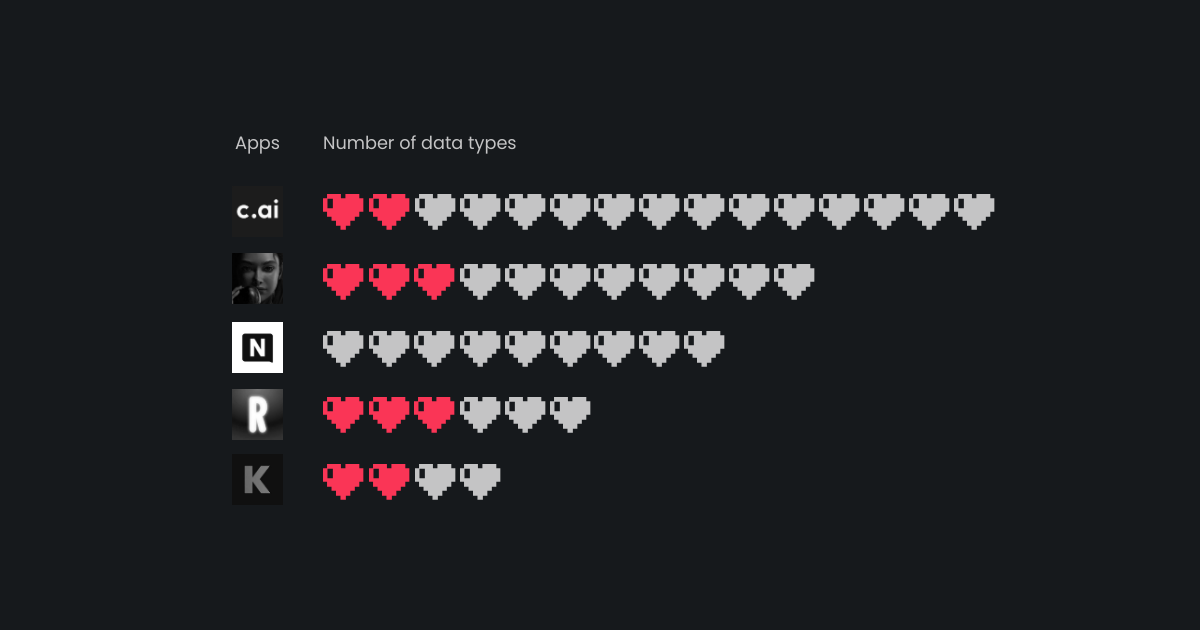
Data privacy concerns in AI companion apps - Surfshark
As AI grows, digital companions help with loneliness but raise questions about user data privacy. Many seek virtual relationships, but it's important to remember they are business-driven, not personal bonds.

‘I Don’t Think We’re All F***ed Anymore’
Kevin Roose’s new book explores the terrifying implications of AI, but he’s feeling a bit more sanguine these days.
A Liability Framework for AI Companions
<p><span>Every day tens of millions of people engage in online conversations. These virtual interactions range from casual chats about daily life to deeply pers

AI-powered online abuse: How AI is amplifying violence against women and what can stop it | UN Women – Headquarters
AI is turning online spaces into new frontiers of abuse. Feminist and tech experts, Laura Bates and Paola Gálvez-Callirgos, explain how it happens and how we fight back.

The Large Gender Gap in Who Uses AI
A recent study finds that AI usage tilts heavily toward men. Part of the reason: Women worried they might be penalized for using AI.

Experts Caution Against Using AI Chatbots for Emotional Support
TC faculty break down the risks of using artificial intelligence for emotional support, and what a healthier AI future might look like