

The 'Eternal September' was a 1993 backlash against unwanted internet users. It never ended.
Eternal September
Eternal September or the September that never ended was a cultural phenomenon during a period beginning around late 1993 and early 1994, when Internet service providers began offering Usenet access to many new users.[1][2] Before this, the only sudden changes in the volume of new users of Usenet occurred each September, when cohorts of university students would gain access to it for the first time, in sync with the academic calendar.
Eternal September | Know Your Meme
Eternal September is a slang term that refers to the time period of the Internet since September 1993, when Usenet saw its heaviest influx of newbies into

Two Takes on the Eternal September
September, and with it the start of classes at most educational institutions in the United States, is almost upon us. In honor of this, I’d like to look back this week on the September that started twenty-eight years ago in 1993 and is still continuing: Usenet’s Eternal September. Twenty-eight years in, I still don’t think we understand exactly what the implications of this change were, nor have we decided what direction Internet communities should turn in response. I don’t have all the answers either, but I’d like to suggest two useful ways of thinking about it.

Be A Property Owner And Not A Renter On The Internet
The year is 2025. The internet in the shape that we've known it in the early 2000s is no longer there. Or, not quite in the shape that we've seen it before. This is not just plain nostalgia talking - the vibrant ecosystem of blogs, feeds, personal sites, and forums has been usurped by a few mega-concentrated players.

Mastodon's Eternal September
Figure 1: A ‘joke’ t-shirt made in 1994 commemorating Eternal September, taken from The Eternal September Wikipedia page The latest round of Twitter nonsense (changing the way “blocking” works) has caused another wave of people to abandon that site for pastures new. Nearly every one of them went to Bluesky instead of Mastodon. 1.2 Million people joined Bluesky in 48 hours. I wonder why that is? I bet there’s something about where people draw the line on Twitter’s behaviour and where they choose to go next. But I bet there’s something else to it too.
25 years on, here are the worst ever predictions about the internet
Back in the Nineties, many experts didn't think the internet would live to see its first, let alone 25th, Internaut Day.

The Attention Forum: October 23/24th 2025
The internet was initially sold to us as a force for connection – a borderless, democratizing set of technologies that would amplify voices, allow us to spread ideas, and strengthen civil society.

The year we wanted the internet to be smaller
Why tiny, weird online communities made a comeback in 2017

Keep the Internet free
On August 26, 2026, the United States placed the Italian collective Autistici/Inventati on its terrorism sanctions list, accusing it of providing online services to violent groups. Since 2001 the collective has offered free email, hosting and other tools to activists, and it rejects the accusations entirely. Two days later its website disappeared from the internet — not because the machines were switched off, but because the address that leads people to them stopped working.
The Last Mile
Living without the Internet is a reality for the vast majority of people on the Earth. With Facebook and Google treating connection speeds and bandwidth like disposable cutlery, you can hardly guess why they’re having such a terrible time continuing to grow their userbase around the world. The problem is the infrastructure isn’t available. The “last mile,” as it is often referred to, is sub-par in most parts of the world.
Endings FourHundredAndNinetySeven on Twitter / X
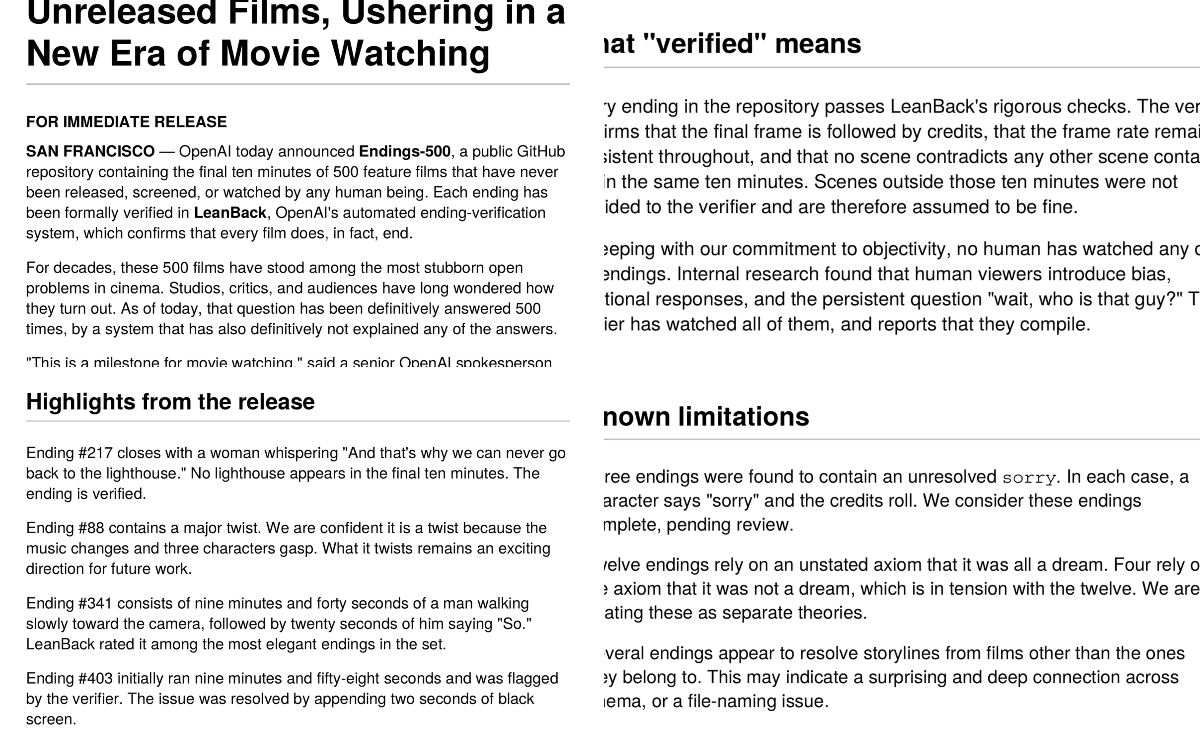
FOR IMMEDIATE RELEASE:October 6th, 2026OpenAI Releases the Final Ten Minutes of 500 Previously Unreleased Films, Ushering in a New Era of Movie Watching pic.twitter.com/mjBRcg1StT— Endings FourHundredAndNinetySeven (@Endings500) October 6, 2026
Stack overflow is almost dead
Today, Stack overflow has almost as few questions asked per month, as when it launched back in 2009. A recap of its slow, then rapid, downfall.

rip.so :: the digital graveyard
A memorial to the messengers, social networks, browsers and websites the internet forgot.
