


A cult-like group referred to as the Zizians is linked to a string of violent deaths across the U.S. It has its roots in Silicon Valley – and a movement called Rationalism. Who are these groups and what do they believe?
The Zizians and the Rationalist death cults
What is the deal with Rationalism and cults?

The Zizians and the Rationalist death cults
What is the deal with Rationalism and cults?
The Zizians and the Rationalist death cults
What is the deal with Rationalism and cults?
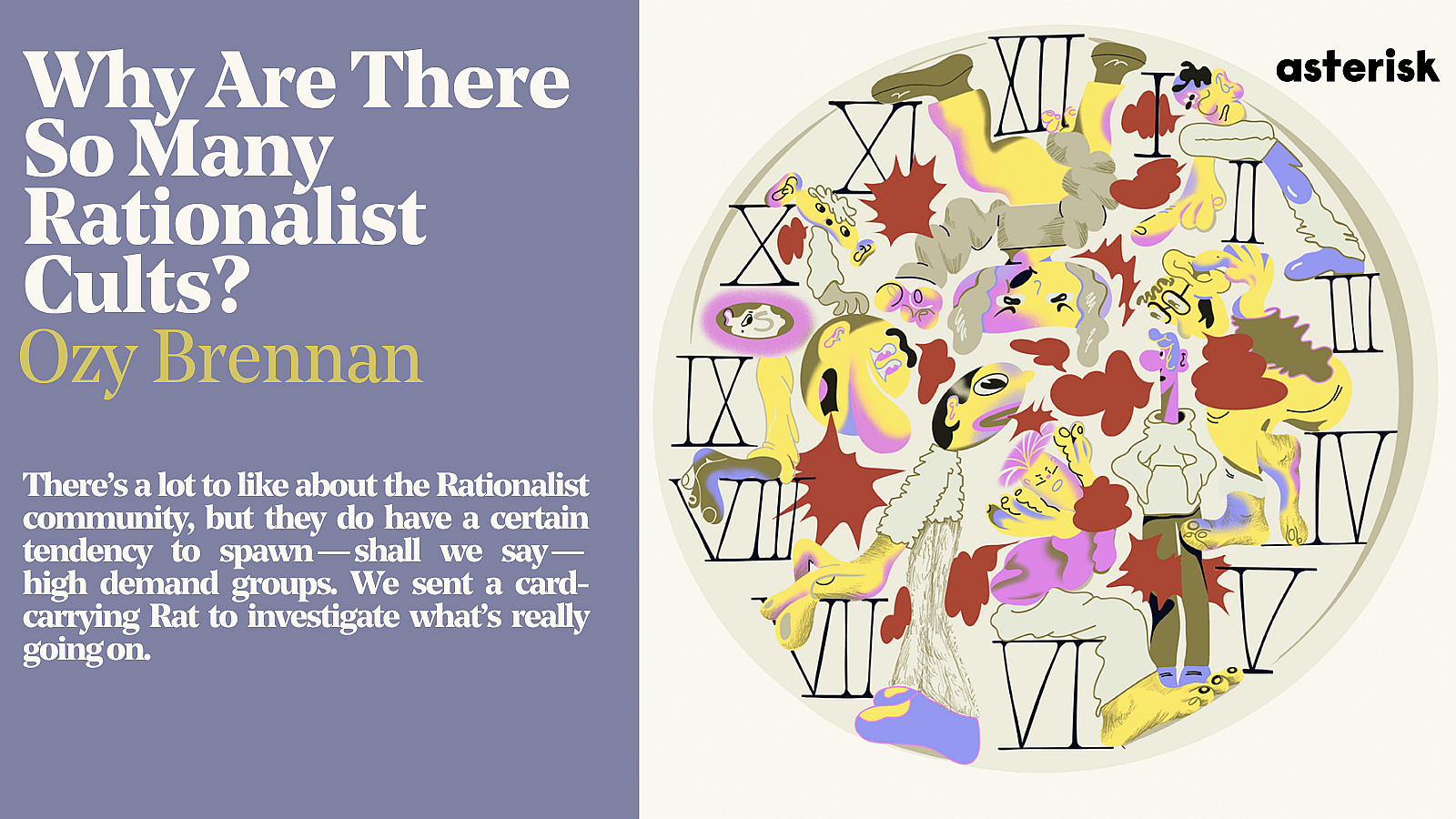
Why Are There So Many Rationalist Cults?
There’s a lot to like about the Rationalist community, but they do have a certain tendency to spawn — shall we say — high demand groups. We sent a card-carrying Rat to investigate what’s really going on.
Immigrants against the State: Yiddish and Italian Anarchism in America
From the 1880s through the 1940s, tens of thousands of first- and second-generation immigrants embraced the anarchist cause after arriving on American shores. Kenyon Zimmer explores why these migrants turned to anarchism, and how their adoption of its ideology shaped their identities, experiences, and actions. Zimmer focuses on Italians and Eastern European Jews in San Francisco, New York City, and Paterson, New Jersey. Tracing the movement's changing fortunes from the pre–World War I era through the Spanish Civil War, Zimmer argues that anarchists, opposed to both American and Old World nationalism, severed all attachments to their nations of origin but also resisted assimilation into their host society. Their radical cosmopolitan outlook and identity instead embraced diversity and extended solidarity across national, ethnic, and racial divides. Though ultimately unable to withstand the onslaught of Americanism and other nationalisms, the anarchist movement nonetheless provided a shining example of a transnational collective identity delinked from the nation-state and racial hierarchies.
‘This is injustice’: how leftist zines were used to sentence anti-ICE protesters to decades in prison
Advocates sound alarm after zines were used as evidence to convict protesters of terrorism charges tied to 2025 protest at Texas ICE facility

Amid Trump’s War on Antifa, Activists Face Arrest for Zines and Group Chats
The Trump administration now has zine distributors and jail support efforts in its sights.

The Rise of Silicon Valley’s Techno-Religion (Published 2025)
The Rationalists, a community focused on the risks of artificial intelligence, regularly gather with tech figures and other like-minded people in a complex that covers much of a city block.


AORTA Zines — A O R T A
In our unique role, AORTA supports over 80 movement groups across the country every year with facilitation, mediation, and coaching. Over time, we’ve witnessed patterns of fracture, horizontal violence, and territorialism that prevents the Left from thriving. This zine series offers five defensive strategies against fragmentation that we think our groups must take up so we don’t fold under the pressure of rising fascism, authoritarianism, political violence, and mis/disinformation.
Zot, Nomad, and Nomadic Identity in the Fediverse
Gen Z Is Pioneering a New Understanding of Truth
The first generation to truly grow up online, Generation Z and their cohort live in a social media ecosystem that blends facts and feelings. It’s significantly shifting how they understand what’s true.

The rationalists are not ok
Who, or what, are the rationalists? They are an internet-spawned sub-culture who ‘practice the art of rationality’. This means they spend lots of time thinking about topics like cognitive biases, Bayesian reasoning, probability and statistics, computer science, AI, decision theory, game theory, transhumanism, etc. Demographically they skew heavily toward STEM students from elite universities and tech guys in the bay area.

TESCREAL
TESCREAL is a neologism proposed by computer scientist Timnit Gebru and philosopher Émile P. Torres. An acronym, it stands for Transhumanism, Extropianism, Singularitarianism, (modern) Cosmism, Rationalists (the internet community, not to be confused with other uses of the term), Effective Altruism, and Longtermism.[1][2] Gebru and Torres argue that these ideologies should be treated as an "interconnected and overlapping" group with shared origins.[1] They claim these constitute a movement that allows its proponents to use the threat of human extinction to justify expensive or detrimental projects and consider it pervasive in social and academic circles in Silicon Valley centered on artificial intelligence.[3] As such, the acronym is sometimes used to criticize a perceived belief system associated with Big Tech.[3][4][5]
Rationalist Cults

Articles on rationalist-adjacent cults: the Zizians, Leverage Research, and the darker outgrowths of the rationalist / LessWrong-derived / Aella polycule scene that is behind "AI Safety" in Silicon Valley. Working thesis: MIRI and CFAR read as high-control groups (cults) who believe in P(DOOM) and use sex (and power) maliciously — yet they are unfortunately the ones who have captured the framing of "AI Safety," which has little to do with actual safety.

The Effective Altruism Kids Aren’t Alright

My Experience with Leverage Research

What Policymakers and the Public Need to Know About the Cult of AI
banteg (@banteg)

The Techno-Religion at the Center of the A.I. Debate

SE Gyges (@segyges.bsky.social)