


Researchers are uncovering the hidden laws that reveal how the Internet grows, how viruses spread, and how financial bubbles burst.
The Dark Forest Theory of the Internet
Why the dark forests of the internet — podcasts, newsletters, and other private channels — are growing, and why might that pose a problem
Viral Effects Are Not Network Effects
Virality and network effects are conflated by even experienced Founders, and it keeps them from developing the right strategies and playbooks.

The hacker crackdown: law and disorder on the electronic frontier
A journalist investigates the past, present, and future…

Funding The Web: From Cartel to Covenant
The Web is slow-motion collapsing for multiple reasons, but at the heart of it all is a little known system: the Search/Browser Levy. Let's fix it!

Virality Prediction and Community Structure in Social Networks
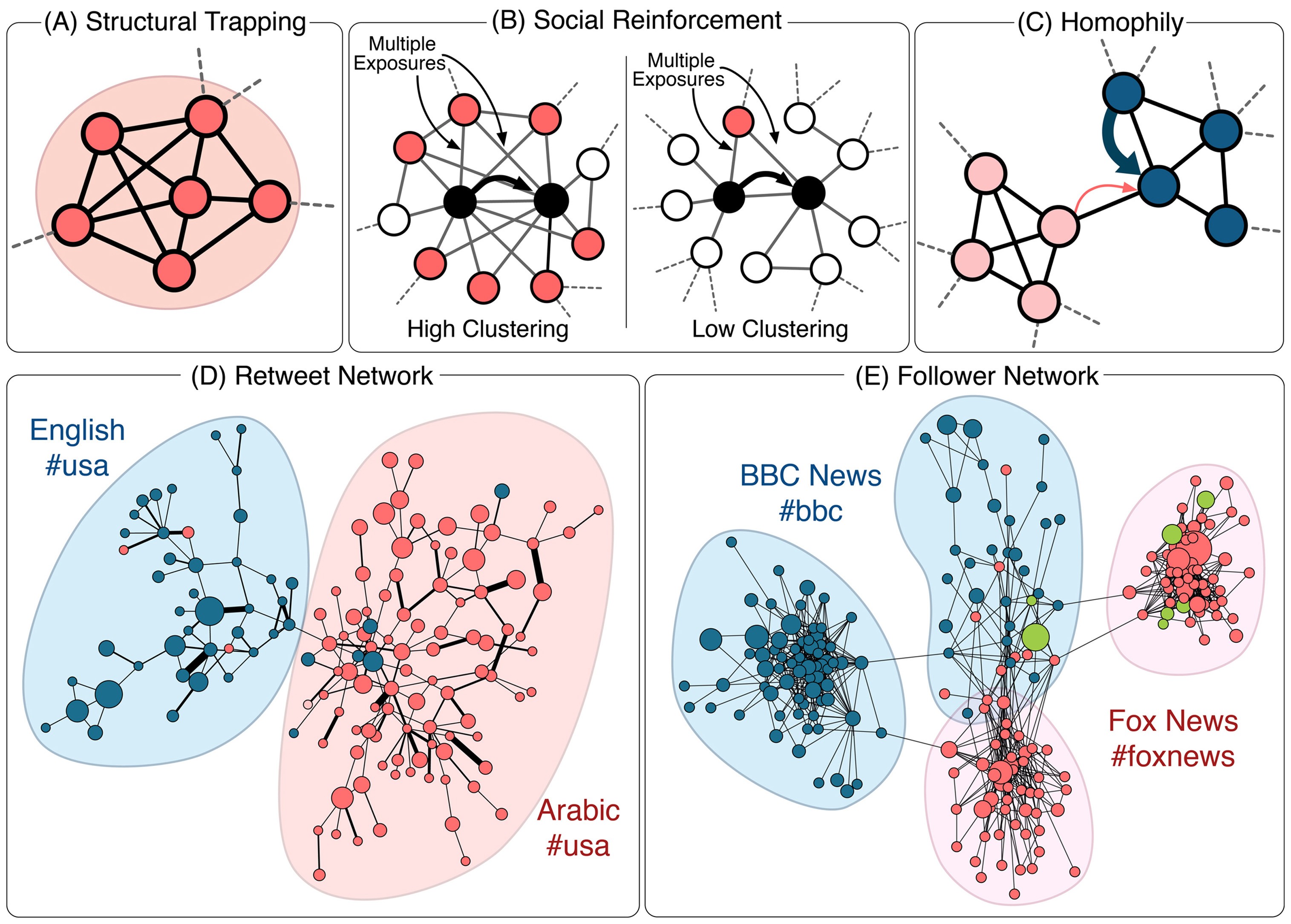
How does network structure affect diffusion? Recent studies suggest that the answer depends on the type of contagion. Complex contagions, unlike infectious diseases (simple contagions), are affected by social reinforcement and homophily. Hence, the spread within highly clustered communities is enhanced, while diffusion across communities is hampered. A common hypothesis is that memes and behaviors are complex contagions. We show that, while most memes indeed spread like complex contagions, a few viral memes spread across many communities, like diseases. We demonstrate that the future popularity of a meme can be predicted by quantifying its early spreading pattern in terms of community concentration. The more communities a meme permeates, the more viral it is. We present a practical method to translate data about community structure into predictive knowledge about what information will spread widely. This connection contributes to our understanding in computational social science, social media analytics and marketing applications.
How AI is Breaking the Internet (and Everything Else) ft. Cory Doctorow
How One 1990s Browser Decision Created Big Tech’s Data Monopolies (And How We Might Finally Fix It) - Above the Law
From the take-back-control dept

Peersky (@peersky@mastodon.social)
Attached: 1 video After 3.5 years, #PeerSky v1.0.0 is finally here 🎉 Create information. Share it directly with peers. Access it anywhere. Even when the internet goes down. All power corrupts. Power should be distributed. PeerSky is more than a browser; it's a new foundation for the web. That's how we save the internet and build better societies, one peer at a time. Try it out! 👉 https://peersky.p2plabs.xyz/

How One 1990s Browser Decision Created Big Tech’s Data Monopolies (And How We Might Finally Fix It)
There’s a fundamental architectural flaw in how the internet works that most people have never heard of, but it explains nearly every frustration you have with modern technology. Why your pho…

Status Traps: Learning from Web2 Social Networks - a16z crypto
Countering social networks’ tendency toward “social capital” inequality requires thinking like an economist and learning from the web2 days.

Free Our Feeds
Social media is broken: controlled by a handful of billionaires who shape what people see, say, and believe. These platforms profit from division, exploit user data, and lock people into closed systems.
The spreading of misinformation online
Significance The wide availability of user-provided content in online social media facilitates the aggregation of people around common interests, worldviews, and narratives. However, the World Wide Web is a fruitful environment for the massive diffusion of unverified rumors. In this work, using a massive quantitative analysis of Facebook, we show that information related to distinct narratives––conspiracy theories and scientific news––generates homogeneous and polarized communities (i.e., echo chambers) having similar information consumption patterns. Then, we derive a data-driven percolation model of rumor spreading that demonstrates that homogeneity and polarization are the main determinants for predicting cascades’ size. , The wide availability of user-provided content in online social media facilitates the aggregation of people around common interests, worldviews, and narratives. However, the World Wide Web (WWW) also allows for the rapid dissemination of unsubstantiated rumors and conspiracy theories that often elicit rapid, large, but naive social responses such as the recent case of Jade Helm 15––where a simple military exercise turned out to be perceived as the beginning of a new civil war in the United States. In this work, we address the determinants governing misinformation spreading through a thorough quantitative analysis. In particular, we focus on how Facebook users consume information related to two distinct narratives: scientific and conspiracy news. We find that, although consumers of scientific and conspiracy stories present similar consumption patterns with respect to content, cascade dynamics differ. Selective exposure to content is the primary driver of content diffusion and generates the formation of homogeneous clusters, i.e., “echo chambers.” Indeed, homogeneity appears to be the primary driver for the diffusion of contents and each echo chamber has its own cascade dynamics. Finally, we introduce a data-driven percolation model mimicking rumor spreading and we show that homogeneity and polarization are the main determinants for predicting cascades’ size.


Social media is dead – here’s what comes next | New Scientist
A new information ecosystem is on the rise, featuring closer connections, cosy media and worker-owned websites, writes Annalee Newitz

The Wealth of Networks
The Wealth of Networks: How Social Production Transforms Markets and Freedom is a book by Harvard Law School professor Yochai Benkler published by Yale University Press on April 3, 2006. The book has been recognized as one of the most influential works of its time concerning the rise and impact of the Internet on the society, particularly in the sphere of economics. It also helped popularize the term Benkler coined few years earlier, the commons-based peer production (CBPP).

This started up as a write-up for a cool hack I made (Atproto DID + Tailscale, coming soon 😎), but like many times before it started taking a life of its own, about how an integration of small scale networks is a more sustainable version of "internet scale" than large tech monopoly data centers.

Increasing lot sizes of our digital homes
thinking-with-portals.leaflet.pub