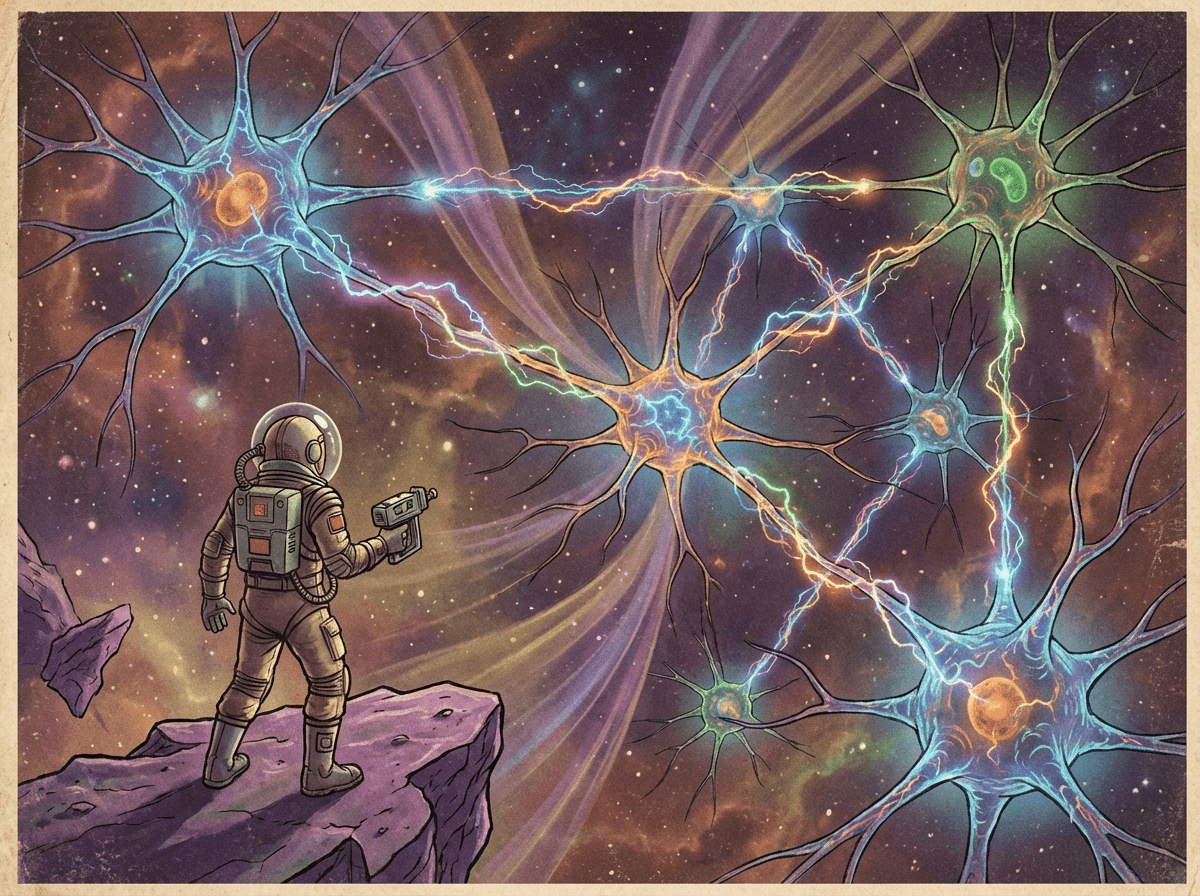
Pundits often describe deep learning as an imitation of the human brain. But it's really just simple math executed on an enormous scale.
Deep Learning - The Biggest Data Science Breakthrough of the Decade - O'Reilly Media Free, Live Events
Machine learning and AI have appeared on the front page of the New York Times three times in recent memory: 1) When a computer beat the world's #1 chess player 2) When Watson beat the world's best Jeopardy players 3) When deep learning algorithms won a chemo-informatics Kaggle...

Why the deep learning boom caught almost everyone by surprise
"You’ve taken this idea way too far," a mentor told Prof. Fei-Fei Li.

Some notes on the Stable Diffusion safety filter
How deep learning models are moderated
Is AI Hiding Its Full Power? With Geoffrey Hinton
Resource recs on AI catastrophic risk
If nothing magic is happening in the human brain, things could get weird

Deep learning gets the glory, deep fact checking gets ignored – Rachel Thomas, PhD
AI, science, education, & ethics
Inside Deep Dreams: How Google Made Its Computers Go Crazy
Why the neural net project creating wild visions has meaning for art, science, philosophy — and our view of reality

The reanimation of pseudoscience in machine learning and its ethical repercussions
Machine learning has a pseudoscience problem. In this perspective, the authors explore the recent resurgence of deep learning-assisted physiognomy and argue that pseudoscientific and socially harmful applications of machine learning often arise from shared underlying epistemic failings. They urge researchers to reject notions that machine learning can be theory free and to consider their work in an appropriate social and historical context.

BadNets: Identifying Vulnerabilities in the Machine Learning Model Supply Chain
Deep learning-based techniques have achieved state-of-the-art performance on a wide variety of recognition and classification tasks. However, these networks are typically computationally expensive to train, requiring weeks of computation on many GPUs; as a result, many users outsource the training procedure to the cloud or rely on pre-trained models that are then fine-tuned for a specific task. In this paper we show that outsourced training introduces new security risks: an adversary can create a maliciously trained network (a backdoored neural network, or a \emph{BadNet}) that has state-of-the-art performance on the user's training and validation samples, but behaves badly on specific attacker-chosen inputs. We first explore the properties of BadNets in a toy example, by creating a backdoored handwritten digit classifier. Next, we demonstrate backdoors in a more realistic scenario by creating a U.S. street sign classifier that identifies stop signs as speed limits when a special sticker is added to the stop sign; we then show in addition that the backdoor in our US street sign detector can persist even if the network is later retrained for another task and cause a drop in accuracy of {25}\% on average when the backdoor trigger is present. These results demonstrate that backdoors in neural networks are both powerful and---because the behavior of neural networks is difficult to explicate---stealthy. This work provides motivation for further research into techniques for verifying and inspecting neural networks, just as we have developed tools for verifying and debugging software.

mixup: Beyond Empirical Risk Minimization
Large deep neural networks are powerful, but exhibit undesirable behaviors such as memorization and sensitivity to adversarial examples. In this work, we propose mixup, a simple learning principle to alleviate these issues. In essence, mixup trains a neural network on convex combinations of pairs of examples and their labels. By doing so, mixup regularizes the neural network to favor simple linear behavior in-between training examples. Our experiments on the ImageNet-2012, CIFAR-10, CIFAR-100, Google commands and UCI datasets show that mixup improves the generalization of state-of-the-art neural network architectures. We also find that mixup reduces the memorization of corrupt labels, increases the robustness to adversarial examples, and stabilizes the training of generative adversarial networks.
The NSA’s SKYNET program may be killing thousands of innocent people
Ridiculously optimistic" machine learning algorithm is "completely bullshit," says expert.

Deep Fakes: A Looming Challenge for Privacy
<p>Harmful lies are nothing new. But the ability to distort reality has taken an exponential leap forward with “deep fake” technology. This capability makes it possible to create audio and video of real people saying and doing things they never said or did. Machine learning techniques are escalating the technology’s sophistication, making deep fakes ever more realistic and increasingly resistant to detection. Deep-fake technology has characteristics that enable rapid and widespread diffusion, putting it into the hands of both sophisticated and unsophisticated actors.</p><p>While deep-fake technology will bring certain benefits, it also will introduce many harms. The marketplace of ideas already suffers from truth decay as our networked information environment interacts in toxic ways with our cognitive biases. Deep fakes will exacerbate this problem significantly. Individuals and businesses will face novel forms of exploitation, intimidation, and personal sabotage. The risks to our democracy and to national security are profound as well.</p><p>Our aim is to provide the first in-depth assessment of the causes and consequences of this disruptive technological change, and to explore the existing and potential tools for responding to it. We survey a broad array of responses, including: the role of technological solutions; criminal penalties, civil liability, and regulatory action; military and covert-action responses; economic sanctions; and market developments. We cover the waterfront from immunities to immutable authentication trails, offering recommendations to improve law and policy and anticipating the pitfalls embedded in various solutions.</p>
Reverse-Engineering the Wetware: Spiking Networks, TD Errors, and the End of Matrix Math
An engineer-friendly deep dive into how the human brain truly processes information, learns without backpropagation, and uses spiking neural networks, predictive coding, and dopamine-driven TD errors—challenging our notions of AI and matrix math.