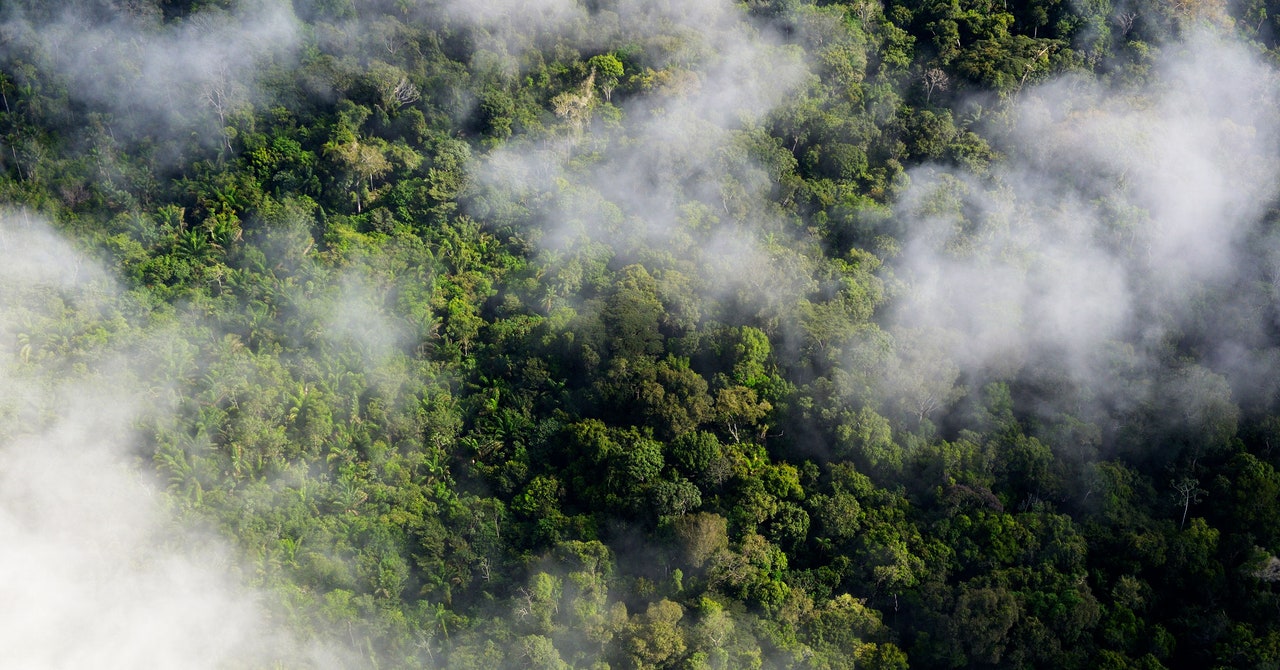
Trees make clouds by releasing small quantities of vapors called “sesquiterpenes.” Scientists are learning more—and it’s making climate models hazy.

Nate on Twitter / X
OSTP just released 'Science: A New Golden Age' — 72 pages modeled on Vannevar Bush's 1945 report. I read the whole thing. It's remarkably good.The sharpest insight is on page 60. AI could do to science what fire suppression did to forests: make each individual tree safer while…— Nate (@NateWBradford) July 21, 2026
The Climate Solution Actually Adding Millions of Tons of CO2 Into the Atmosphere — ProPublica
New research shows that California’s climate policy created up to 39 million carbon credits that aren’t achieving real carbon savings. But companies can buy these forest offsets to justify polluting more anyway.

Dark Forestry | Henry From Online
Seasons are changing for technologists, and the industry we work in isn't the same as it was a decade ago. We have new realities and new responsibilities to accept.

Dark Forestry | Henry From Online
Seasons are changing for technologists, and the industry we work in isn't the same as it was a decade ago. We have new realities and new responsibilities to accept.
Significant underestimation of radiative forcing by aerosol–cloud interactions derived from satellite-based methods
Satellite-based estimates of radiative forcing by aerosol–cloud interactions (RFaci) are consistently smaller than those from global models, hampering accurate projections of future climate change. Here we show that the discrepancy can be substantially reduced by correcting sampling biases induced by inherent limitations of satellite measurements, which tend to artificially discard the clouds with high cloud fraction. Those missed clouds exert a stronger cooling effect, and are more sensitive to aerosol perturbations. By accounting for the sampling biases, the magnitude of RFaci (from −0.38 to −0.59 W m−2) increases by 55 % globally (133 % over land and 33 % over ocean). Notably, the RFaci further increases to −1.09 W m−2 when switching total aerosol optical depth (AOD) to fine-mode AOD that is a better proxy for CCN than AOD. In contrast to previous weak satellite-based RFaci, the improved one substantially increases (especially over land), resolving a major difference with models.

China ‘modified’ the weather to create clear skies for political celebration – study
Researchers say Beijing used cloud-seeding to create artificial rain and lower pollution in July, in latest example of ‘blueskying’ efforts

Extreme CO2 levels could trigger clouds ‘tipping point’ and 8C of global warming
If atmospheric CO2 levels exceed 1,200 parts per million (ppm), it could push the Earth’s climate over a “tipping point”, finds a new study. This would see clouds that shade large part of the oceans start to break up.

Investors say agroforestry isn’t just climate friendly — it’s also profitable
In the latter part of 2016, Ethan Steinberg and two of his friends planned a driving tour across the U.S. to interview farmers. Their goal was to solve a riddle that had been bothering each of them for some time. Why was it, they wondered, that American agriculture basically ignored trees? This was no esoteric […]

B.C.'s clear-cut forests are 'dead zones,' emitting more greenhouse gases than fossil fuels, report finds | CBC News
More greenhouse gases are being emitted from clear-cut logging in British Columbia’s forests than the replanted trees are able to absorb, according to a new report by a local environmental group.

The roles of aerosol direct and indirect effects in past and future climate change
Abstract Using the Geophysical Fluid Dynamics Laboratory's (GFDL's) fully coupled chemistry‐climate (ocean/atmosphere/land/sea ice) model (CM3) with an explicit physical representation of aerosol indirect effects (cloud‐water droplet activation), we find that the dramatic emission reductions (35%–80%) in anthropogenic aerosols and their precursors projected by Representative Concentration Pathway (RCP) 4.5 result in ~1 °C of additional warming and ~0.1 mm day −1 of additional precipitation, both globally averaged, by the end of the 21st century. The impact of these reductions in aerosol emissions on simulated global mean surface temperature and precipitation becomes apparent by mid‐21st century. Furthermore, we find that the aerosol emission reductions cause precipitation to increase in East and South Asia by ~1.0 mm day −1 through the second half of the 21st century. Both the temperature and the precipitation responses simulated by CM3 are significantly stronger than the responses previously simulated by our earlier climate model (CM2.1) that only considered direct radiative forcing by aerosols. We conclude that the indirect effects of sulfate aerosol greatly enhance the impacts of aerosols on surface temperature in CM3; both direct and indirect effects from sulfate aerosols dominate the strong precipitation response, possibly with a small contribution from carbonaceous aerosols. Just as we found with the previous GFDL model, CM3 produces surface warming patterns that are uncorrelated with the spatial distribution of 21st century changes in aerosol loading. However, the largest precipitation increases in CM3 are colocated with the region of greatest aerosol decrease, in and downwind of Asia. , Key Points Aerosol reductions (RCP4.5) cause 1K warming and +0.1 mm/day of precipitation. Sulfate indirect effects greatly enhance aerosol impacts on surface temperature. Aerosol reductions increase precipitation in Asia by 0.5–1.0 mm/day by 2100.

Climate Change is coming for Christmas
Stunted trees, pricey chocolate, threatened reindeer, scant snow—warming is taking a toll.

Visualising Climate 2026 — Conference
A global conference on climate data visualization, storytelling, and science. Bologna, Italy • 4–6 November 2026.

‘I’m glowing’: scientists are unlocking secrets of why forests make us happy
Research project aims to discover how age, size and shape of woodlands affect people’s happiness and wellbeing