

Social media companies claim new language models can remove harmful content in every language. But those systems’ shortcomings can have vast consequences.
X’s Latest Content Findings Reveal Troubling Trends In AI Moderation
The rise of AI-led moderation is changing the future of online discourse, but it's not without risks.

Social media is populist and polarising; AI may be the opposite
Large language models elevate expert consensus and moderate views, in sharp contrast to social platforms

Why you should ignore most AI research you hear about on social media
Writing at the end of the world, from Hveragerði, Iceland
The Impact of AI-Generated Text on the Internet
The proliferation of AI-generated and AI-assisted text on the internet is feared to contribute to a degradation in semantic and stylistic diversity, factual accuracy, and other negative...

The Impact of AI-Generated Text on the Internet
The proliferation of AI-generated and AI-assisted text on the internet is feared to contribute to a degradation in semantic and stylistic diversity, factual accuracy, and other negative...
What's wrong with AI-generated docs
In what is tantamount to a vulgar display of power, social media has been flooded with AI-generated images that mimic the …
‘Contextualization Engines’ can fight misinformation without censorship
Search engines are nice. But we can do far better with modern AI.

People are getting their news from AI – and it’s altering their views
Even when information is factually accurate, how it’s presented can introduce subtle biases. As large language models increasingly bring people the news, this bias is a looming problem.

People are getting their news from AI – and it’s altering their views
Even when information is factually accurate, how it’s presented can introduce subtle biases. As large language models increasingly bring people the news, this bias is a looming problem.
A Detox for Social Media: Redesigning and ‘Diversifying’ Feeds: Institute for Policy Research - Northwestern University
A new study shows that redesigning social media feeds can reset their algorithmic tendencies to amplify toxic content, including politically divisive posts.

AI ‘slop’ is a social judgement
Artificial intelligence (AI)-generated content increasingly saturates our information environment. Efforts to detect and remove it are failing. We propose that calling AI-generated content ‘slop’ is best understood as a social judgement: what a community recognizes as unwanted AI content. Studying AI slop this way makes it tractable, measurable and governable.

Generative propaganda: Evidence of AI’s impact from a state-backed disinformation campaign
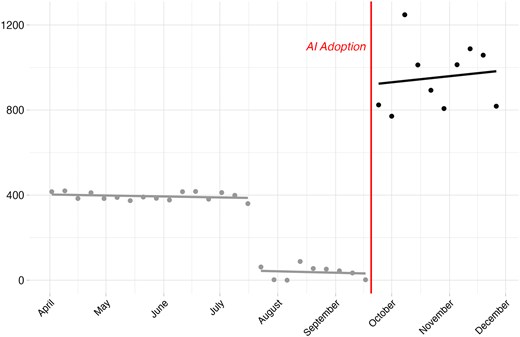
Abstract Can AI bolster state-backed propaganda campaigns, in practice? Growing use of AI and large language models has drawn attention to the potential for accompanying tools to be used by malevolent actors. Though recent laboratory and experimental evidence has substantiated these concerns in principle, the usefulness of AI tools in the production of propaganda campaigns has remained difficult to ascertain. Drawing on the adoption of generative-AI techniques by a state-affiliated propaganda site with ties to Russia, we test whether AI adoption enabled the website to amplify and enhance its production of disinformation. First, we find that the use of generative-AI tools facilitated the outlet’s generation of larger quantities of disinformation. Second, we find that use of generative-AI coincided with shifts in the volume and breadth of published content. Finally, drawing on a survey experiment comparing perceptions of articles produced prior to and following the adoption of AI tools, we show that the AI-assisted articles maintained their persuasiveness in the postadoption period. Our results illustrate how generative-AI tools have already begun to alter the size and scope of state-backed propaganda campaigns.
AI-powered hate content is on the rise, experts say | CBC News
Experts say that artificial intelligence technology is allowing for a rapid increase in the amount of hateful content and misinformation online.

The Impact of AI-Generated Text on the Internet
By mid-2025, roughly 35% of newly published websites were classified as AI-generated or AI-assisted.
