


Can AI do fact-checking? A WIRED fact-checker fact-checks.
We're not taking the fact-checking powers of AI seriously enough. It's past time to start.
Some notes on the Nobel Prize hallucination that wasn't
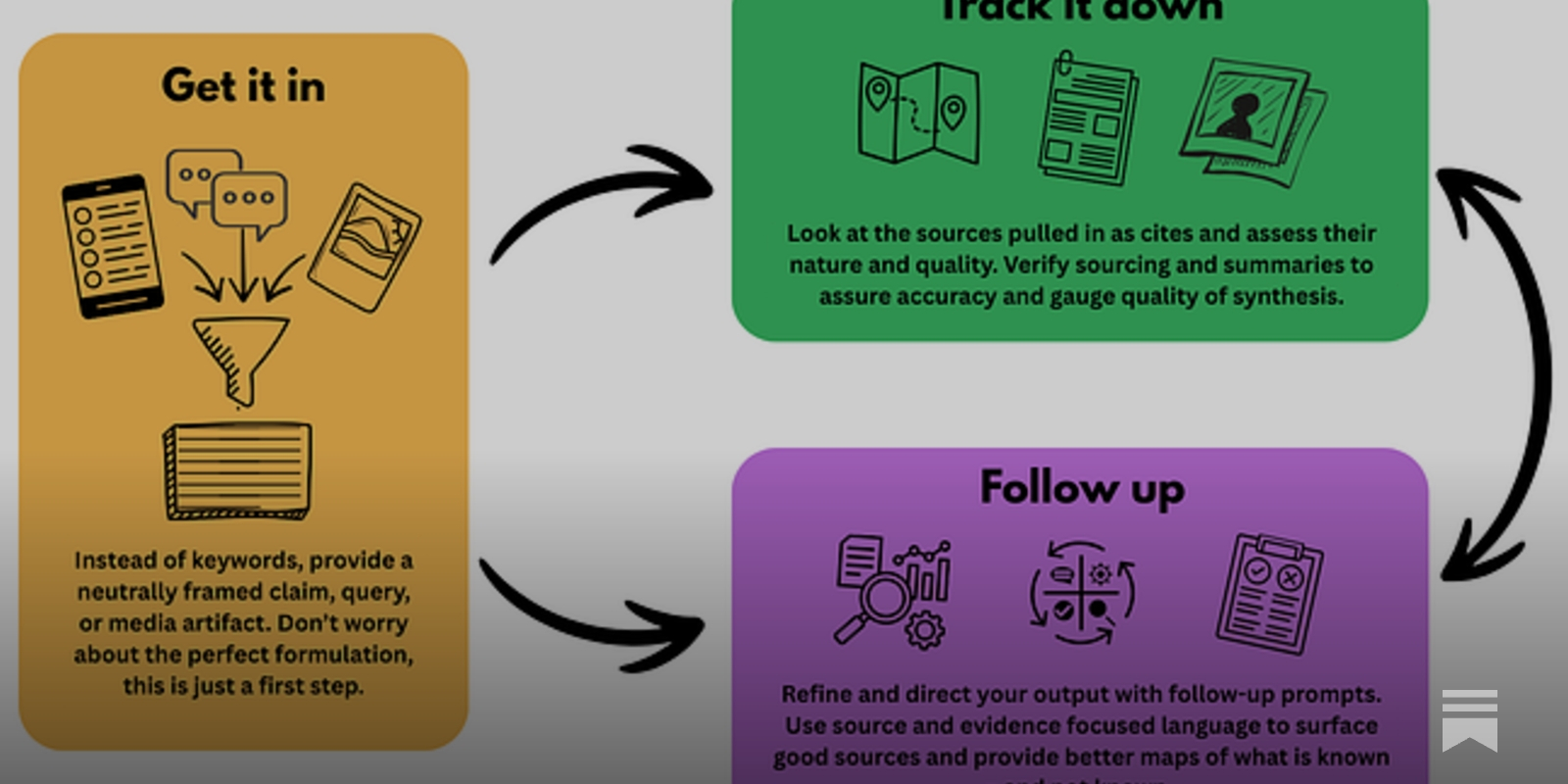
AI False Claims Monitor
As the domain experts in data reliability in the topic of news and information, NewsGuard provides the leading red-teaming analysis for information reliability. AI models continue to face significant challenges in ensuring their models provide safe, accurate responses to prompts instead of spreading false claims on the internet or refusing to respond to topics in the news.

AI for science: What can it do? Can it do things? Let’s find out!
A what we’re reading spotlight

Is AI Reasoning Right for the Wrong Reasons? | Quanta Magazine
The idea that artificial intelligence can “reason” is more intuitive than ever. But intuitions can be wrong, and the science is far from settled.
Google Researchers Say AI Now Leading Disinformation Vector (and Are Severely Undercounting the Problem)
It’s much easier to produce AI-generated disinformation than it is to fact check it.

Tracking AI-enabled Misinformation: 3,749 AI Content Farm sites (and Counting), Plus the Top False Claims Generated by Artificial Intelligence Tools
Coverage by McKenzie Sadeghi, Dimitris Dimitriadis, Virginia Padovese, Giulia Pozzi, Sara Badilini, Chiara Vercellone, Natalie Huet, Zack Fishman, Leonie Pfaller, and Natalie Adams | Last Updated June 23, 2026

I don’t think we are close to “AI scientists”
Today's AI agents are not designed to extract deep insights from new observations.

AI agents are checking the scientific literature — and spotting decades-old errors
The technology is proving adept at finding faults in decades-old papers and reference databases.

"AI" is Automated Inequality
Tech bros still dominate the discussions about so-called "AI" with false claims. Even most "AI"-critical researchers spend much of their time meticulously debunking (always only a subset of) claims, leaving vast areas of the economic consequences of "AI" unexplored. (Even the "AI"-evangelist Economi

How do authors want to use AI for review?
A survey of researchers who compared AI-generated scientific reviews with journal-agnostic human peer review reveals that they overwhelmingly prefer using AI as a self-checking tool before submission rather than as a replacement for human reviewers. It encourages an “author-centric” model in which AI helps researchers improve their manuscripts before they are reviewed by their peers.

Can AI Detectors Be Trusted?
Society has always trusted editors, teachers, peer reviewers, and readers to set acceptable standards for writing. In the past, the biggest challenge was detecting plagiarism and cracking down on other forms of cheating. Now, AI detectors are rewriting the script: they assign a score based on the likelihood that the text was created by a human or a large language model (LLM).

How AI can lead to false arrests and wrongful convictions
Danger arises when law enforcement believes that AI models are retrieving certainties rather than generating likelihoods.

How AI can lead to false arrests and wrongful convictions
Danger arises when law enforcement believes that AI models are retrieving certainties rather than generating likelihoods.
AI is now unpopular. That may not make a difference.

AI use in American newspapers is widespread, uneven, and rarely disclosed
AI is rapidly transforming journalism, but the extent of its use in published newspaper articles remains unclear. We address this gap by auditing a large-scale dataset of 186K articles from online editions of 1.5K American newspapers published in the summer of 2025. Using Pangram, a state-of-the-art AI detector, we discover that approximately 9% of newly-published articles are either partially or fully AI-generated. This AI use is unevenly distributed, appearing more frequently in smaller, local outlets, in specific topics such as weather and technology, and within certain ownership groups. We also analyze 45K opinion pieces from Washington Post, New York Times, and Wall Street Journal, finding that they are 6.4 times more likely to contain AI-generated content than news articles from the same publications, with many AI-flagged op-eds authored by prominent public figures. Despite this prevalence, we find that AI use is rarely disclosed: a manual audit of 100 AI-flagged articles found only five disclosures of AI use. Overall, our audit highlights the immediate need for greater transparency and updated editorial standards regarding the use of AI in journalism to maintain public trust.
