A novel approach from the Allen Institute for AI enables data to be removed from an artificial intelligence model even after it has already been used for training.
Signal's Meredith Whittaker sees AI as another big data grab
The "surveillance business model" is using AI to expand its reach, the privacy expert says.

Spawning.ai
We believe that a future of consenting data will benefit both AI development and the people it is trained on.

What makes something data?
This is a question I posted on BlueSky on Friday 11/21/25, inspired by a talk I recently attended about evaluation of “AI” systems. I think…

Can Synthetic Training Data Survive Its Own Regulation?
Synthetic training data has recently emerged as the quick fix to two different problems: the lack of high-quality training data, and the need to avoid using personal data in training to stay within the boundaries of privacy legislation. Gartner predicts that by 2026 75% of all enterprises will use generative AI to create synthetic training data, a huge increase from less than 5% in 2023.1 Moreover, Gartner predicts that by 2035, solutions that use synthetic data for training will grab three quarters of all end-user spending on enterprise AI software.2 Training data that only a few years ago was the subject of several research papers is now carrying the weight of huge enterprise systems.

Have it both ways: stay discoverable in search while disallowing AI training
Cloudflare is giving site owners a way to stay discoverable while disallowing AI training. New controls and an Accountable designation establish a shared model with Apple, Google, and Microsoft.

Firms like Meta and A16z admit having to pay billions for training data would ruin their generative-AI plans as they fight new copyright rules
Meta, Google, Microsoft, and Andreessen Horowitz are trying to keep AI developers from having to pay for copyrighted material used in AI training.
AI Agent Governance: Access and Accountability
AI agent governance requires clear ownership. Learn how IT leaders can manage sensitive data access, preserve audit trails, and test shutdown controls.

AI and Doctrinal Collapse
Artificial intelligence runs on data. But the two legal regimes that govern data—information privacy law and copyright law—are under pressure. Formally, each re

Supporting Our AI Overlords: Redesigning Data Systems to be Agent-First
Large Language Model (LLM) agents, acting on their users' behalf to manipulate and analyze data, are likely to become the dominant workload for data systems in the future. When working with data,...


lakeFS - Data Version Control
lakeFS is the Control Plane for AI-Ready Data that bridges the data Infrastructure gap for AI. Ensure AI data governance, make AI training and agent runs reproducible, reduce access friction.

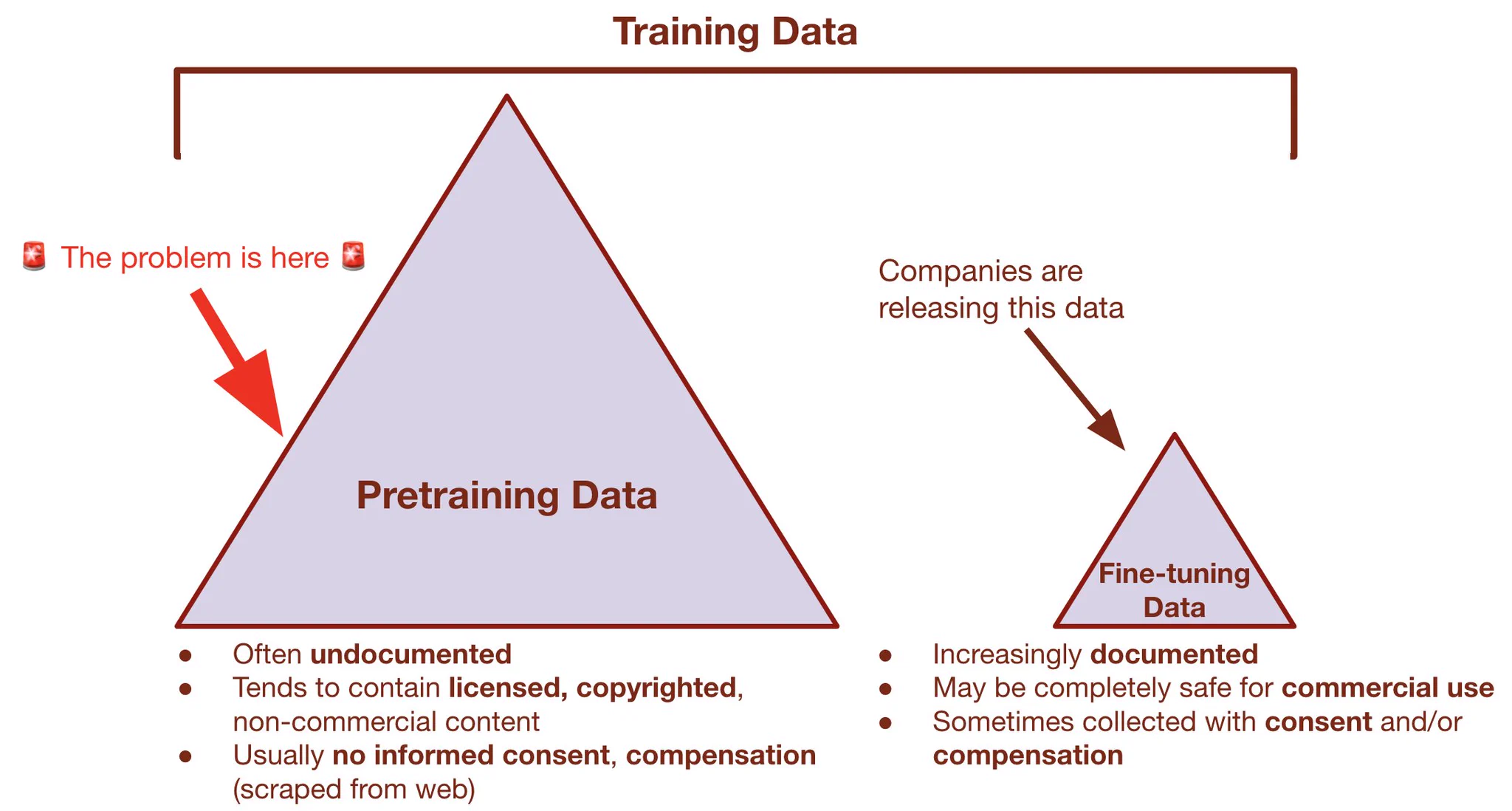
Okay. Inspired by news & @stealcase, let me clarify something. When AI companies release "open training data" for a model, they're generally sharing *fine-tuning* data. The big issues w data and consent are NOT of this type. The issues are with the MAIN DATA used in training.🧵
Okay. Inspired by news & @stealcase, let me clarify something.When AI companies release "open training data" for a model, they're generally sharing *fine-tuning* data. The big issues w data and consent are NOT of this type. The issues are with the MAIN DATA used in training.🧵 pic.twitter.com/k02k37x9CF— MMitchell (@mmitchell_ai) April 12, 2023
A Collectivist, Economic Perspective on AI
Information technology is in the midst of a revolution in which omnipresent data collection and machine learning are impacting the human world as never before. The word ``intelligence'' is being...
Promoting User Data Autonomy During the Dissolution of a Monopolistic Firm
The deployment of AI in consumer products is currently focused on the use of so-called foundation models, large neural networks pre-trained on massive corpora of digital records. This emphasis on scaling up datasets and pre-training computation raises the risk of further consolidating the industry, and enabling monopolistic (or oligopolistic) behavior. Judges and regulators seeking to improve market competition may employ various remedies. This paper explores dissolution -- the breaking up of a monopolistic entity into smaller firms -- as one such remedy, focusing in particular on the technical challenges and opportunities involved in the breaking up of large models and datasets. We show how the framework of Conscious Data Contribution can enable user autonomy during under dissolution. Through a simulation study, we explore how fine-tuning and the phenomenon of "catastrophic forgetting" could actually prove beneficial as a type of machine unlearning that allows users to specify which data they want used for what purposes.
The dawn of the Data Intelligence Engineer | MotherDuck
For Data Teams, AI has changed everything. The traditional work can be run by agents, leaving folks wondering "what's next"? In this blog, MotherDuck CEO Jordan Tigani unpacks the possibilities.