Studying people who live well beyond the age of 100 could reveal the secret to living longer, healthier lives. But the statistics tell another story.
Scientists find humans age dramatically in two bursts – at 44, then 60
US findings suggesting ageing is not a slow and steady process could explain spikes in health issues at certain ages
People who live to 100 have unique gut bacteria signatures
These bacteria could contribute to a healthy gut and, in turn, healthy aging.
Estrogen: Women’s Secret Recipe To Longevity
Longevity is becoming increasingly popular to elongate health-span. We turn to estrogen to understand its impact on women's long-term well-being.

Research finds that renting ages you faster than smoking, obesity
Millions of Aussies are losing years to accelerated ageing because of one absolute living essential, an alarming new study has revealed.

Study Reveals How Much Exercise Older Adults Need Each Week To Live Longer
New research suggests that this level of physical activity can help you extend your lifespan, improve your cognition and more.

Scientists Discover 4 Distinct Patterns of Aging
Scientists have come closer to understanding why people seem to age at different rates.

Ageing Accelerates at Around Age 50 - Some Organs Faster Than Others - Slashdot
A new analysis of protein changes across human tissues has identified an aging acceleration point around age 50, with blood vessels showing the most dramatic deterioration. Researchers examined tissue samples from eight body systems in 76 people of Chinese ancestry aged 14 to 68 who died from accide...

Over nearly 80 years, Harvard study has been showing how to live a healthy and happy life
For nearly 80 years, the Harvard Study of Adult Development has been producing data and lessons on how to live longer, happier, and healthier lives.
The Global Decline in the Mental Health of the Young
One of the major findings in wellbeing research until recently was that happiness was U-shaped by age and unhappiness hump-shaped by age. There was a midlife crisis — a finding reported in well over 600 published papers using data on 145 countries. It was present in both developing and developed countries. And it was persistent over time. The finding of a peak in ill-being in midlife was consistent with Anne Case and Angus Deaton’s work on mortality and the so-called “deaths of despair.”1 In the US in particular and to a lesser extent in other countries, White prime-aged individuals without a college degree had high death rates from suicide, drug overdoses, and cirrhosis of the liver. Drug overdose deaths in the US, for example, peaked at midlife ages. In 2023, the Centers for Disease Control and Prevention (CDC) reported that overdose death rates per 100,000 by age rose from 13.5 for 15-to-24-year-olds to 45.6 for 25-to-34-year-olds and 60.8 for 35-to-44-year-olds, and then declined to 53.3 for 45-to-54-year-olds, 49.2 for 55-to-64-year-olds, and 14.7 for those over the age of 65.2 The morbidity data matched the mortality data.

This Chart Shows Why You Should Never Worry About Getting Older
Some of life's biggest peaks come in later years.
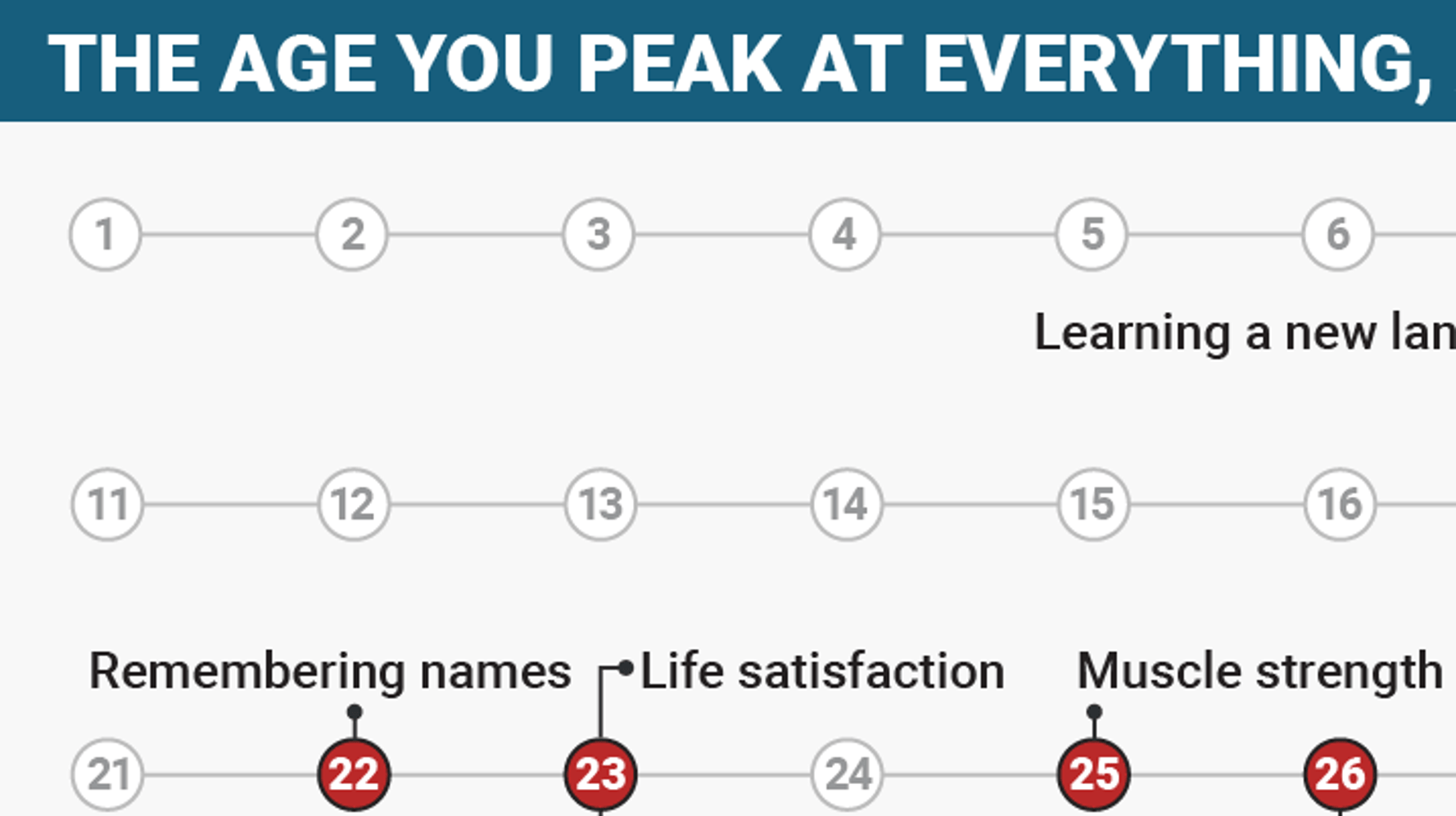
Genetics play less of a role in lifespan than we thought
Large historical analysis points to marriage choices skewing the stats.

Rules for sustaining peak performance as we grow older
Biotech will offer us longevity, and we can harness downstream "superpowers" to improve key skills and live much better as we age.

The Shape-Shifting Power of Menopause
“I know there is a way to grow older that brings us deeply into living.”

How Health Disparities Develop over the Lifecycle
In the Netherlands, there are striking socioeconomic differences in mortality among older adults, with a 4.4 percentage point (67 percent) higher five-year mortality rate for 70-year-old individuals with below-median income than for those with above-median income. To better understand the role of chronic disease in these health disparities, Kaveh Danesh, Jonathan T. Kolstad, William D. Parker, and Johannes Spinnewijn develop an index of chronic disease burden in The Chronic Disease Index: Analyzing Health Inequalities over the Lifecycle (NBER Working Paper 32577). This index is a measure of health status that can be measured earlier in life and shows how chronic health evolves with age and differs across income groups.
Brains of overweight people ‘ten years older’ than lean counterparts at middle-age
Our brains naturally shrink with age, but scientists are increasingly recognising that obesity – already linked to conditions such as diabetes, cancer and heart disease – may also affect the onset and progression of brain ageing; however, direct studies to support this link are lacking.

Home - Peter Attia MD
Explore evidence-informed insights on longevity, nutrition, exercise, sleep, and disease prevention from Dr. Peter Attia to optimize your healthspan and lifespan