


I’ve gotten nearly 2,000 campaign fundraising texts that were meant for someone else. I tried to find out why—and uncovered a labyrinth of politicians, data brokers, and shady tactics.
Inside the Democrats’ Campaign Spam Machine | KQED
We talk about the system behind campaign fundraising texts, how it works, who profits and why changes could be on the horizon.

Stop and Consider:Our campaign
During a federal election there is a large amount of information being distributed, much of it online, which is seeking to influence your vote. Some of this may be disinformation, or false information.

Scam!
64K votes, 1.2K comments. 719K subscribers in the NonPoliticalTwitter community. Twitter and Bluesky without the politics. Come vibe with us as we…
Ted Cruz campaign using firm that harvested data on millions of unwitting Facebook users
Exclusive: Documents reveal donor-funded US startup embedded in Republican’s campaign paid UK university academics to collect psychological profiles on potential voters

Beset
I am not breaking any news when I share the following trenchant insight: spam is back, and it's worse than ever. I'm seeing it across pretty much every front...
Auditing Political Exposure Bias: Algorithmic Amplification on Twitter/X During the 2024 U.S. Presidential Election
Approximately 50% of tweets in X's user timelines are personalized recommendations from accounts they do not follow. This raises a critical question: What political content are users exposed to beyond their established networks, and what implications does this have for democratic discourse online? In this paper, we present a six-week audit of X's algorithmic content recommendations during the 2024 U.S. Presidential Election by deploying 120 sock-puppet monitoring accounts to capture tweets from their personalized "For You" timelines. Our objective is to quantify out-of-network content exposure for right- and left-leaning user profiles and assess any potential inequalities and biases in political exposure. Our findings indicate that X's algorithm skews exposure toward a few high-popularity accounts across all users, with right-leaning users experiencing the highest level of exposure inequality. Both left- and right-leaning users encounter amplified exposure to accounts aligned with their own political views and reduced exposure to opposing viewpoints. Additionally, we observe that new accounts experience a right-leaning bias in exposure within their default timelines. Our work contributes to understanding how content recommendation systems may induce and reinforce biases while exacerbating vulnerabilities among politically polarized user groups. We underscore the importance of transparency-aware algorithms in addressing critical issues such as safeguarding election integrity and fostering a more informed digital public sphere.

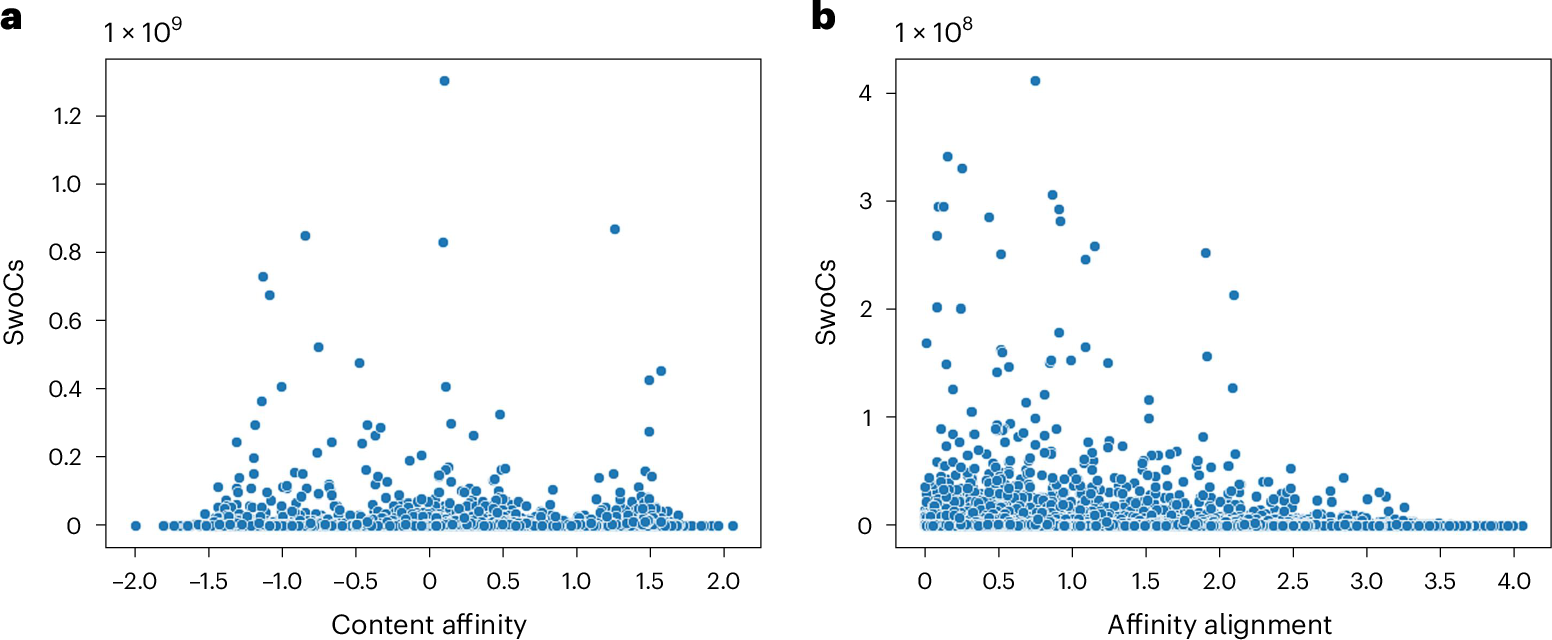
Sharing without clicking on news in social media
Social media have enabled laypersons to disseminate, at scale, links to news and public affairs information. Many individuals share such links without first reading the linked information. Here we analysed over 35 million public Facebook posts with uniform resource locators shared between 2017 and 2020, and discovered that such ‘shares without clicks’ (SwoCs) constitute around 75% of forwarded links. Extreme and user-aligned political content received more SwoCs, with partisans engaging in it more than politically neutral users. In addition, analyses with 2,969 false uniform resource locators revealed higher shares and, hence, SwoCs by conservatives (76.94%) than liberals (14.25%), probably because, in our dataset, the vast majority (76–82%) of them originated from conservative news domains. Findings suggest that the virality of political content on social media (including misinformation) is driven by superficial processing of headlines and blurbs rather than systematic processing of core content, which has design implications for promoting deliberate discourse in the online public sphere.
Who Makes Money From Facebook: Politicians and Political Candidates | Whattofix.tech
WHAT TO FIX’s Meta Monetization Archive reveals how numerous pages affiliated with politicians and political candidates have been —and in some cases continue to be— accessing Facebook's monetization services.
Political disinformation concentrates in repeated claims across media
The prevalence and dynamics of disinformation remain contentious, partly because measures have relied on posts containing URLs from untrustworthy sources. We move beyond this by detecting disinformation in text and across posts. Using retrieval-augmented generation, we match six million Facebook, Instagram, and X posts by politicians from the United States, United Kingdom, and Germany, and two million articles from news outlets to fact-checked claims. We show that disinformation is concentrated in a small number of combinations of policy issues and parties and that just over hundred distinct claims account for around half of all disinformation across the three countries. They often appear first on a single platform, later on multiple, and subsequently in news coverage before being fact-checked. These findings suggest that disinformation is concentrated in a narrow segment of political communication, potentially creating repeated exposure that may shape the terms of public debate through both social and news media.
Conservative PACs have paid at least $1.6 million to the extended Metric Media network this election cycle, a Tow Center investigation reveals.
Nonprofits and political action committees (pacs) are using Metric Media’s extended network of local news sites to provide a range of campaign services to conservative candidates in the run-up to the November midterm elections, new research by the Tow Center shows. The tactic of using partisan newspapers to launder advocacy is being taken up […]

Exposure to the Russian Internet Research Agency foreign influence campaign on Twitter in the 2016 US election and its relationship to attitudes and voting behavior
There is widespread concern that foreign actors are using social media to interfere in elections worldwide. Yet data have been unavailable to investigate links between exposure to foreign influence campaigns and political behavior. Using longitudinal survey data from US respondents linked to their Twitter feeds, we quantify the relationship between exposure to the Russian foreign influence campaign and attitudes and voting behavior in the 2016 US election. We demonstrate, first, that exposure to Russian disinformation accounts was heavily concentrated: only 1% of users accounted for 70% of exposures. Second, exposure was concentrated among users who strongly identified as Republicans. Third, exposure to the Russian influence campaign was eclipsed by content from domestic news media and politicians. Finally, we find no evidence of a meaningful relationship between exposure to the Russian foreign influence campaign and changes in attitudes, polarization, or voting behavior. The results have implications for understanding the limits of election interference campaigns on social media.
Once mass spam texts were made legal, younger donors vanished, leaving a grassroots fundraising machine that subsists on squeezing vulnerable seniors, some of whom give hundreds of times a day. It’s a horrific model. Consultants get generationally wealthy, and the party hollows out its future.

Jake Grumbach
We found that as of right now 73% of your campaign donation goes back to the consultants and vendors (!!!), four times more than just 20 years ago. Only 13% to ads. Even I was shocked.


