Techies love making outrageous promises—but they’re pushing the limits of plausibility.
Infinity Revenue, Infinity Possibilities
The Deceptively Cute Game Growing Faster Than Any Company in History
louisgray.com: The Myth of the Billion Dollar Startup
According to the Wall Street Journal, there are now as many as thirty companies who consider themselves startups valued at a billion dollars or more , based on how much money they’ve raised through pr

» A Looking Glass Half Empty, Part 1: Just Lookin’ for a Hit The Digital Antiquarian
There was some discussion about it: “Wow, gosh, it’d sure be nice if we were making more money and selling more copies so we could do crazy games of the type we want, as opposed to having to worry about how we’re going to sell more.” Hey, I’d love it if the public was more into what I like to do and a little less into slightly more straightforward things. But I totally get that they’re into straightforward things. I don’t have any divine right to have someone hand me millions of dollars to make a game of whatever I want to do. At some fundamental level, everyone has a wallet, and they vote with it.
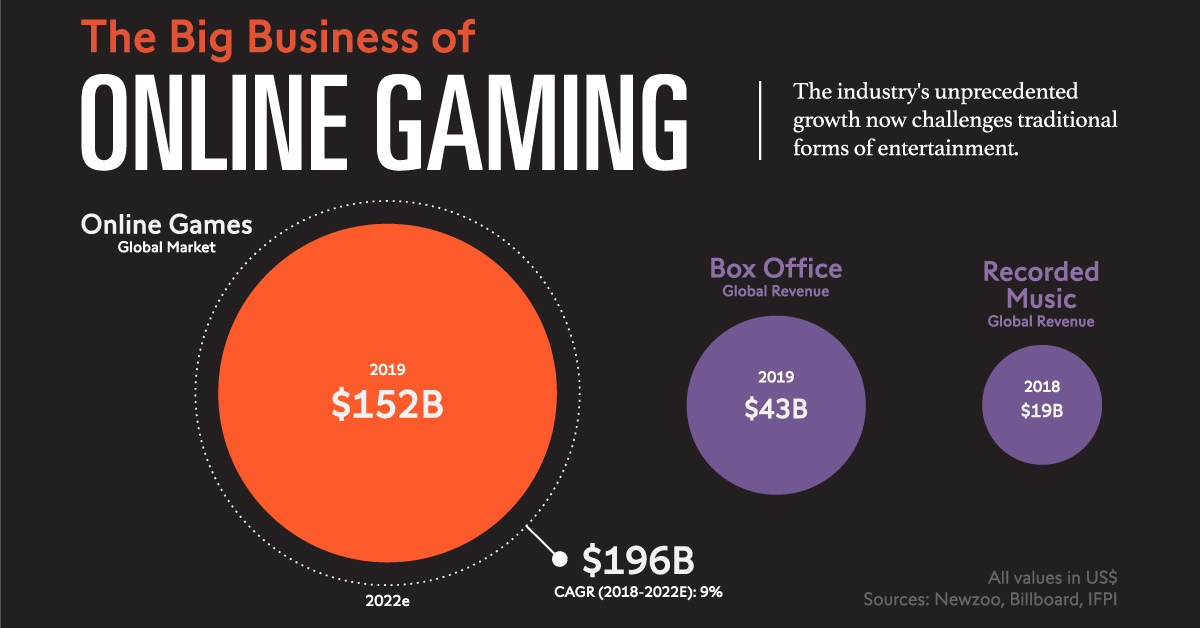
Online Gaming: The Rise of a Multi-Billion Dollar Industry
By 2022, the online gaming market is expected to rake in $196 billion in revenue, more than box office and recorded music revenues combined.
Is Big Tech's AI Gamble Starting to Look Riskier? - Slashdot
The Washington Post looks at giant tech companies "feeding every available dollar into the cash-incinerating maw of AI machines." They warn "Tech superstars that once had oodles of cash left over at the end of each year are now flipping into the red..." [While optimists expect] huge corporate p...

Startups Target the Tricky Task of Making AI Seem More Human
Simulated human behavior companies raise millions

American tech giants are making life tough for startups
Big, rich and paranoid, they have reams of data to help them spot and buy young firms that might challenge them

‘THIN AIR,’ REAL MONEY — The Trump Crypto Game
An 8-bit game about real money. Play as Trump: you only make money. Play as an investor: you only lose. Every figure is drawn from Public Citizen's report and the sources it cites.
Why infinite scroll's inventor wants to kill his creation : The Indicator from Planet Money
We practically live on our phones these days. Scrolling and scrolling, endlessly. Entrepreneur Aza Raskin is responsible for creating this infinite scroll. He also testified against Meta, who have been under fire — and in court — charged with making their apps addictive to children. On today’s show: Raskin tells us about the changes he thinks platforms should make to help people take their attention back. Come see Planet Money live on stage! 12 cities. Details and tix here: planetmoneybook.com Related episodes: The Social Media Crisis How algorithms are changing the way we speak For sponsor-free episodes of The Indicator from Planet Money, subscribe to Planet Money+ via Apple Podcasts or at plus.npr.org. Fact-checking by Cooper Katz McKim. Music by Drop Electric. Find us: TikTok, Instagram, Facebook, Newsletter.

AI's Trillion-Dollar Opportunity: Sequoia AI Ascent 2025 Keynote
Shady Numbers And Bad Business: Inside The Esports Bubble - Kotaku
The mainstream narrative of esports has been lovingly crafted by those who benefit from its success. There’s big money in esports, they say. You’ve heard

500+ Billion Tokens Later: Letting AI Agents Decompile A First-Person Shooter
During the last 3 months, I spent some of my time and tokens decompiling a popular first-person shooter. The goal was not to reach a simple proof-of-concept state. Instead, we really wanted an accurate, stable and feature-complete recreation of the game. The avid reader of my blog might have noticed that I had previously written two posts that have since been removed. Everyone else might now be wondering which game I am talking about. To both of you I can only say that corporate America was here to ruin our fun.

The secret developers of the video game industry
In July 2015, developer Comcept launched a Kickstarter campaign for its game Red Ash. It didn’t go well. Despite raising over $500,000 in pledges, the campaign missed its target and critics pummeled its approach — pointing to Comcept launching the campaign before seeing through a previous one, announcing a console port without identifying which console and continuing the campaign after finding external funding. For production studio Hyde, which had teamed with Comcept to develop the game, the campaign presented a new problem. Hyde has been around since 2002, has worked on over 200 games and has had a hand in some of Japan’s biggest franchises, including Final Fantasy, Persona and Yakuza. It just can’t talk about most of them. The team often works in secret, doing its job but not appearing in the credits or mentioning the work publicly. Speaking with Polygon, Hyde President Kenichi Yanagihara estimates that he will never be able to talk about 70 percent of what the company does. And that worked fine until Hyde asked the public for money.
Kill net neutrality and you’ll kill us, say 800 US startups
The Verge is about technology and how it makes us feel. Founded in 2011, we offer our audience everything from breaking news to reviews to award-winning features and investigations, on our site, in video, and in podcasts.

In 2025, venture capital can’t pretend everything is fine any more
Venture capital is screwed. A bubble in AI is their last hope, and they’re betting everything on Sam Altman. It’s heartwarming. Today, we have the Pitchbook-NVCA Venture Monitor for Q1 2025. This i…

Timing Is Everything in the AI Bubble
This week's tech sell-off is a symptom of a deeper problem: no one knows when - or how - big tech's $1 trillion bet on AI is going to pay off.