

Statistics, comparisons and rankings: comprehensive geography and demography database on all countries in the world.

We Do Not Know the Population of Every Country in the World for the Past Two Thousand Years
Economists have reported results based on populations for every country in the world for the past two thousand years. The source, McEvedy and Jones’ Atlas of World Population History, includes many estimates that are little more than guesses and that do not reflect research since 1978. McEvedy and Jones often infer population sizes from their view of a particular economy, making their estimates poor proxies for economic growth. Their rounding means their measurement error is not “classical.” Some economists augment that error by disaggregating regions in unfounded ways. Econometric results that rest on McEvedy and Jones are unreliable.“… we haven’t just pulled the figures out of the sky. Well, not often.”—McEvedy and Jones (1978, p. 11)

Census DataPacks | Australian Bureau of Statistics
DataPacks contain comprehensive data about people, families and dwellings for all Census geographies ranging from Australia down to Statistical Area Level 1. They are containers of data based on Census Community profiles and include digital boundary files, metadata and reference documents to enable you to read the data.
A fact-based worldview for all | Gapminder
We live in a globalized world, not only in terms of trade and migration. More people than ever care about global development. But most people have severe misconceptions about contemporary global development. We know, because we have tested people’s knowledge. One of the main reasons for this is that students don’t learn to understand the world based on statistics and facts. Instead, we have a dramatic worldview formed by outdated school books and sensationalist news-stories. People intuitively believe that most things are getting worse. The dramatic worldview leads to irrational decisions by individuals, nonprofits, governments and business. For the first time in human history reliable statistics exist. There’s data for almost every aspect of global development. The data shows a very different picture: a world where most things improve; a world that is not divided; and a world where the fast population growth will soon be over. The world has never been less bad. But that doesn’t mean it’s perfect.
OpenPlanetData
Free, open geographic datasets about planet Earth — country and region boundaries, daily OpenStreetMap planet snapshots, and time zones in GeoJSON, GeoPackage, and GeoParquet. No API keys, no rate limits.
Population change, age structure, and socio-economic performance
Concerns about declining or ageing populations often centre on the possibility that fewer people or older age structures could weaken economies, strain fiscal systems, and reduce living standards. However, population change reflects multiple demographic processes, including fertility, mortality, and migration, and its relationship with socio-economic performance depends on capital accumulation, human capital, productivity, institutions, and policy responses. We examine national data at the global scale to test whether, and to what extent, overall population growth or older population age structures are associated with economic and social outcomes using hybrid machine-learning approaches. Across nine indices of socio-economic performance, we find no evidence that slower-growing or older populations perform worse on average. Instead, countries with low or negative overall population growth and older age structures often have higher values for many indicators, and within-country time series show similar broad patterns for most responses. Our results suggest that demographic change is not inevitably associated with socio-economic decline, and that further research is needed to identify the institutional, economic, policy, and demographic mechanisms underlying these global patterns.


All The Places
A growing set of web scrapers designed to output consistent geodata about as many places of business in the world as possible.
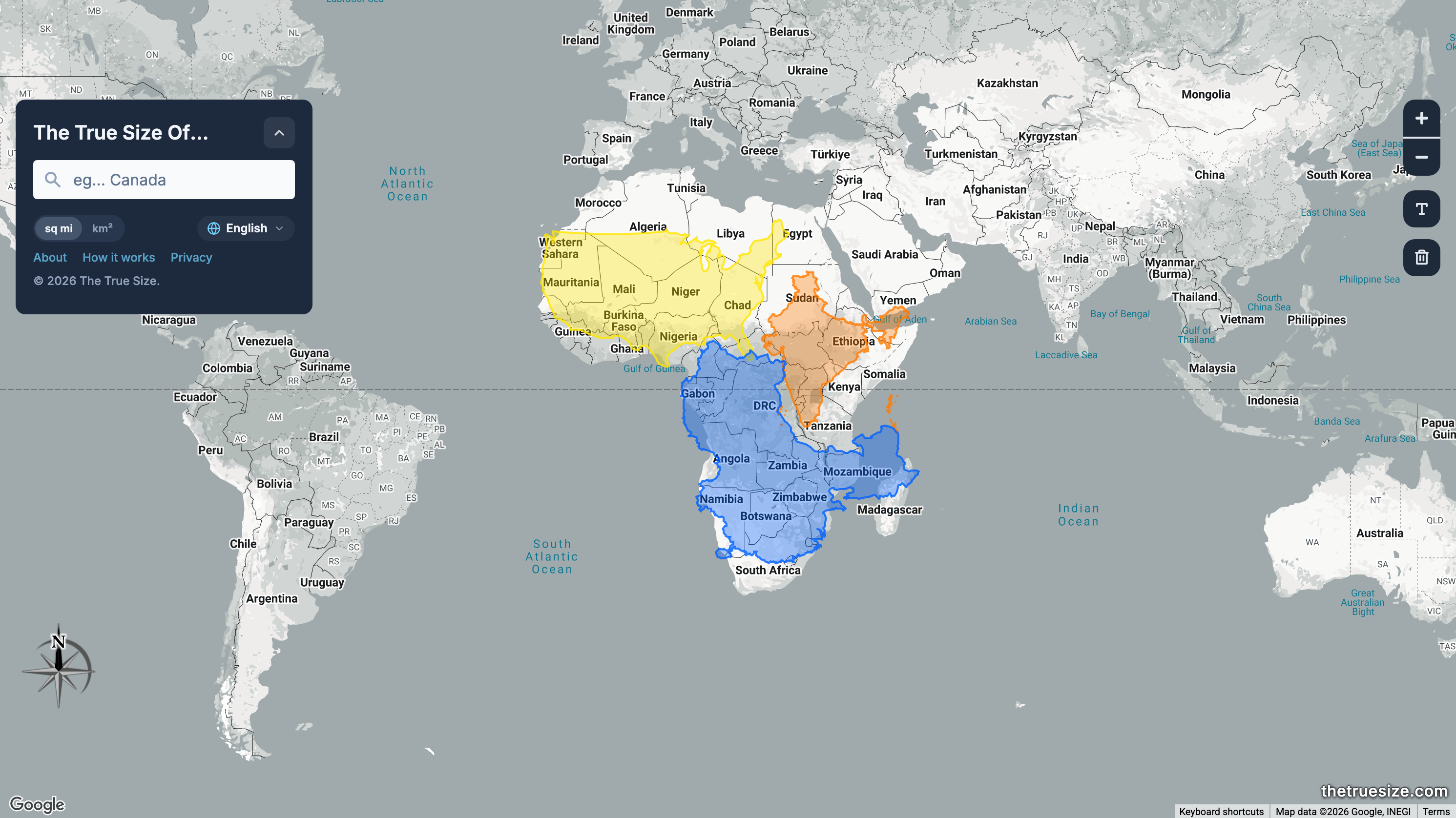
Compare Countries, States, Provinces, and Regions with This Simple Tool
Drag, drop and rotate countries, states, provinces, and regions around the map to compare their relative size. Is Greenland really as big as all of Africa? You may be surprised at what you find! A great tool for educators.
More Than Half the World Is Now Urban, UN Report Says
The world’s population is now 6.6 billion, according to a new UN report, and slightly more than half live in urban areas, the majority of them in developing countries.

Search the world's information, including webpages, images, videos and more. Google has many special features to help you find exactly what you're looking for.
Search the world's information, including webpages, images, videos and more. Google has many special features to help you find exactly what you're looking for.
Search the world's information, including webpages, images, videos and more. Google has many special features to help you find exactly what you're looking for.
Search the world's information, including webpages, images, videos and more. Google has many special features to help you find exactly what you're looking for.
Search the world's information, including webpages, images, videos and more. Google has many special features to help you find exactly what you're looking for.
I tried answering "How big is AT Protocol in Europe" It's still an evolving story (and data collection script), but here is my first attempt: atproto.eu/stats/ It includes a breakdown per country, growth chart, PDSes used and the apps/lexicons are most used (beyond microblogging).

atproto.eu
atproto.eu