

We study the distributions of money in a simple closed economic system for different types of monetary transactions. We know that for arbitrary and random sharing with locally conserving money transactions, the money distribution goes to the Gibb's distribution of statistical mechanics. We then consider the effects of savings, etc. and see how the distribution changes. We also propose a new model where the agents invest equal amounts of money in each transaction. We find that for short time-period, the money distribution obeys a power-law with an exponent very close to unity, and has an exponential tail; after a very long time, this distribution collapses and the entire amount of money goes to a tiny fraction of the population.
Credit Crises, Precautionary Savings, and the Liquidity Trap*
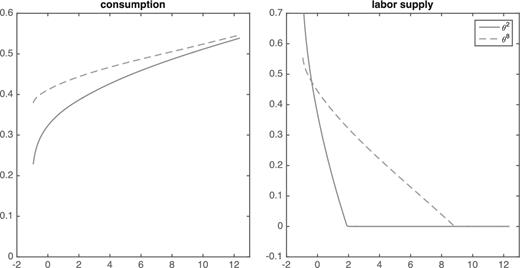
Abstract We study the effects of a credit crunch on consumer spending in a heterogeneous-agent incomplete-market model. After an unexpected permanent tightening in consumers’ borrowing capacity, constrained consumers are forced to repay their debt, and unconstrained consumers increase their precautionary savings. This depresses interest rates, especially in the short run, and generates an output drop, even with flexible prices. The output drop is larger with sticky prices, if the zero lower bound prevents the interest rate from adjusting downward. Adding durable goods to the model, households take larger debt positions and the output response can be larger.
Is Inequality Inevitable?
Wealth naturally trickles up in free-market economies, model suggests

A Debt Puzzle
Over 60% of US households with credit cards are currently borrowing – i.e., paying interest – on those cards. We attempt to reconcile the high rate of credit card borrowing with observed levels of life cycle wealth accumulation. We simulate a lifecycle model with five properties that create demand for credit card borrowing. First, the calibrated labor income path slopes upward early in life. Second, income has transitory shocks. Third, consumers invest actively in an illiquid asset, which is sufficiently illiquid that it can not be used to smooth transitory income shocks. Fourth, consumers may declare bankruptcy, reducing the effective cost of credit card borrowing. Fifth, households have relatively more dependents early in the life-cycle. Our calibrated model predicts that 20% of the population will borrow on their credit card at any point in time, far less than the observed rate of over 60%. We identify a resolution to this puzzle: hyperbolic time preferences. Simulated hyperbolic consumers borrow actively in the revolving credit card market and accumulate relatively large stocks of illiquid wealth, matching observed data.

Ergodicity Economics – Formal economics without parallel universes
Does the way we look at a problem – over time or across an ensemble – change what we see? The main insight from Ergodicity Economics is that when ergodicity […]
A Theory of the Consumption Function, with and without Liquidity Constraints
This paper argues that the modern stochastic consumption model, in which impatient consumers face uninsurable labor income risk, matches Milton Friedman's (1957) original description of the Permanent Income Hypothesis much better than the perfect foresight or certainty equivalent models did. The model can explain the high marginal propensity to consume, the high discount rate on future income, and the important role for precautionary behavior that were all part of Friedman's original framework. The paper also explains the relationship of these questions to the Euler equation literature, and argues that the effects of precautionary saving and liquidity constraints are often virtually indistinguishable.
Demand for emergency savings is higher for low-income households, but so is the cost of shocks
This paper examines how the precautionary motive varies with income. I first develop a theoretical benchmark of how we would expect precaution to vary with income starting from a basic version of the buffer-stock model. Emergency savings provide a way for households to smooth over shocks and so give insight into the precautionary motive. Using data from the Survey of Consumer Finances in the USA, I show that as income declines, the desired emergency savings relative to income increase, suggesting that low-income households are more precautionary. Observable differences, such as income uncertainty, do not explain the rise. Instead, I propose and estimate a model with a minimum subsistence level and unexpected expenses. The model implies that low-income households are increasingly exposed to shocks, explaining the increase in precaution. Supporting the approach, I show that expenses on repairs are a larger fraction of the spending of low-income households.
Stackelberg Mean Field Games: convergence and existence results to the problem of Principal with multiple Agents in competition
In a situation of moral hazard, this paper investigates the problem of Principal with $n$ Agents when the number of Agents $n$ goes to infinity. There is competition between the Agents expressed by the fact that they optimize their utility functions through a Nash equilibrium criterion. Each Agent is offered by the Principal a contract which is divided into a Markovian part involving the state/production of the Agent and a non--Markovian part involving the states/productions of all the other Agents. The Agents are in interactions. These interactions are characterized by common noise, the empirical distribution of states/productions and controls, and the contract which is not assumed to be a map of the empirical distribution. By the help of the mean field games theory, we are able to formulate an appropriate $limit$ problem involving a Principal with a $representative$ Agent. We start by solving the problem of both the Principal and the $representative$ Agent in this $limit$ problem. Then, when $n$ goes to infinity, we show that the problem of Principal with $n$ Agents converges to the $limit$ problem of Principal with a $representative$ Agent. A notable result is that, despite allowing a general type of contracts, it is approximately optimal for the Principal to offer contracts to the $n$ Agents that are maps of the empirical distribution of states/productions and controls of the Agents.


Why the super rich are inevitable
Why some mathematicians argue the economy is designed to create a few super rich people – unless we stop it.

BETTER THAN FREE | Edge.org
This super-distribution system has become the foundation of our economy and wealth. The instant reduplication of data, ideas, and media underpins all the major economic sectors in our economy, particularly those involved with exports — that is, those industries where the US has a competitive advantage. Our wealth sits upon a very large device that copies promiscuously and constantly.
Exponential Economist Meets Finite Physicist | Do the Math
[An updated treatment of some of this material appears in Chapter 2 of the Energy and Human Ambitions on a Finite Planet (free) textbook, also mirrors a 2022 article in Nature Physics..]
Economic idea — Offset documentation
In traditional monetary systems, money is issued by the state. Participants of the market can then use the money issued by the state to buy and sell goods and services in the market.
Money & Macro
Effort for Payment: A Tale of Two Markets
The standard model of labor is one in which individuals trade their time and energy in return for monetary rewards. Building on Fiske's relational theory (1992), we propose that there are two types of markets that determine relationships between effort and payment: monetary and social. We hypothesize that monetary markets are highly sensitive to the magnitude of compensation, whereas social markets are not. This perspective can shed light on the well-established observation that people sometimes expend more effort in exchange for no payment (a social market) than they expend when they receive low payment (a monetary market). Three experiments support these ideas. The experimental evidence also demonstrates that mixed markets (markets that include aspects of both social and monetary markets) more closely resemble monetary than social markets.

Exponential Growth Bias and Household Finance
ABSTRACT Exponential growth bias is the pervasive tendency to linearize exponential functions when assessing them intuitively. We show that exponential growth bias can explain two stylized facts in household finance: the tendency to underestimate an interest rate given other loan terms, and the tendency to underestimate a future value given other investment terms. Bias matters empirically: More‐biased households borrow more, save less, favor shorter maturities, and use and benefit more from financial advice, conditional on a rich set of household characteristics. There is little evidence that our measure of exponential growth bias merely proxies for broader financial sophistication.

The Future of Money: How the Digital Revolution Is Tran…
A cutting-edge look at how accelerating financial chang…
