


I work on problems with networks because I am an ordinary person and I care about ordinary people. Sometimes caring about ordinary people means finding new ropes to pull on and throwing your weight into it. For those of us inside the US but outside the VIP lounge of American
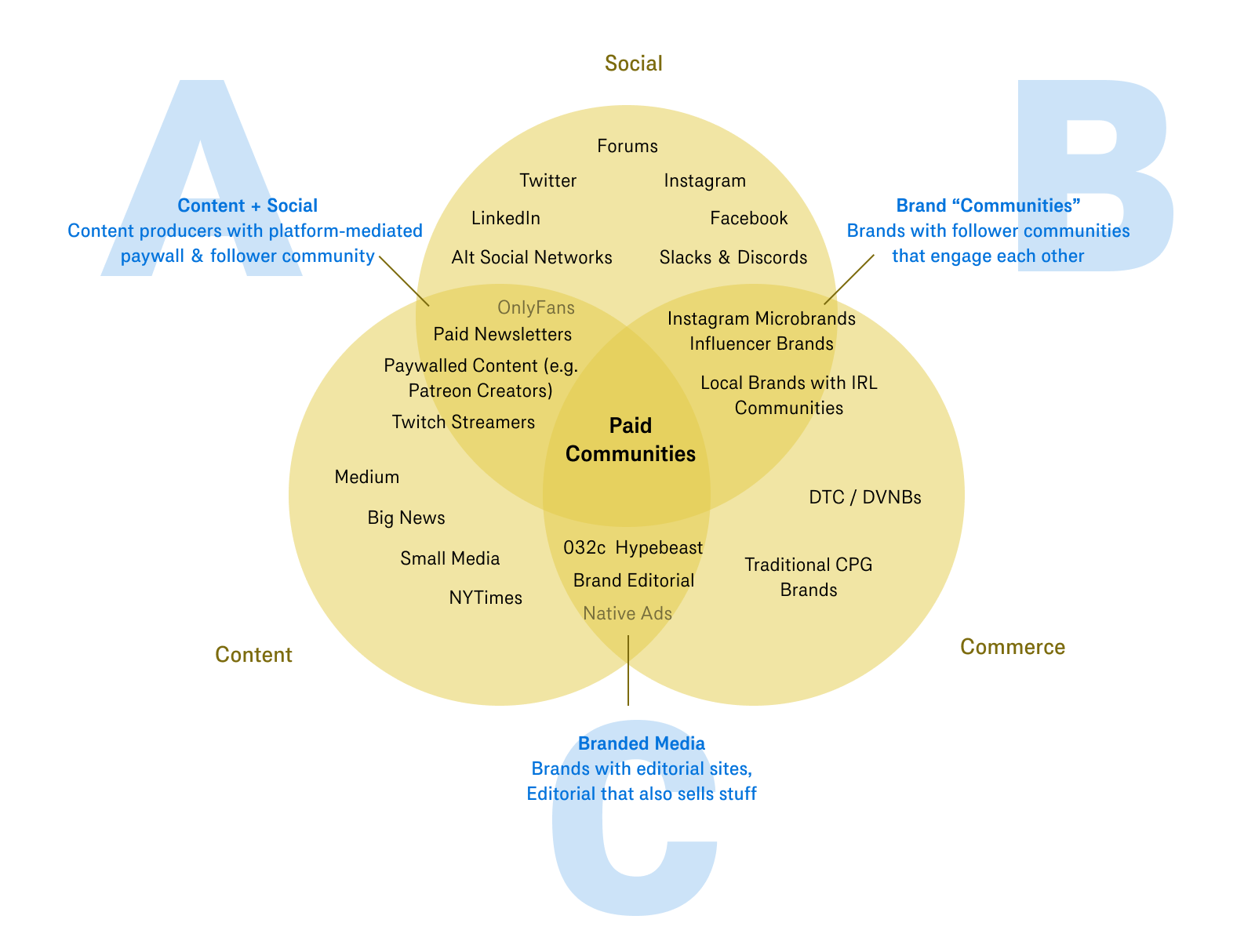
Come for the Network, Pay for the Tool
Paid groups, bespoke social networks, and the meaning of community for internet-native businesses.
Institute of Network Cultures | Ben Grosser: Planning the Exodus from Platform Realism
Thinking about the current state of platforms, I’m reminded of Mark Fisher’s articulation of capitalist realism, the idea that we don’t imagine or build alternatives to capitalism because we can no longer envision a world without it. Big tech, in a few short years, has managed to instill within the public a similar state of platform realism. So many are unable to imagine how global communication, media, search, etc. could ever function without the platforms. Despite a growing malaise, it’s become difficult for many to consider a world without big tech platforms as a viable conception of the future.

What people in the global majority need from networks
Or really, what some people in the global majority/Majority World need from networks, but that's too long for a headline.

Your Life is Driven by Network Effects
Revealing the Unseen Forces That Guide Your Life What city you live in. Who you date or marry. Which job you choose. What clothes you wear. We all think we make these choices ourselves. It certainly feels like we’re in full control. But it turns out that our choices — both in our startups and in … Continue reading "Your Life is Driven by Network Effects"

Entering the Age of Networks - Of Souls & Silos
Institutions are out, networks are in. What are the consequences, the perils and the promise? Originally published in The Orange County Register, March 5, 2015 Everyone’s interested in human networks these days. How to make them work, how to structure…

Digitalisation and the Remaking of the Ideal Worker
The ideal worker concept, typified by an unencumbered male, continues to influence workplace norms, despite a more gender-mixed workforce. This article examines whether this concept is being disrupted or reproduced as digitalisation becomes increasingly embedded in the workplace. Based on qualitative research in two professional services firms, the analysis shows how the ideal worker themes of work prioritisation and presenteeism have been maintained but adapted. Significantly, the study reveals how the novel dimension of connectedness is reshaping the ideal worker norm as enhanced digitalisation becomes interwoven in social relations. This has modified informal expectations about how, when and where work is performed, altering work organisation. This reconfiguration may in principle broaden scope for conformity with the ideal worker model, but in practice the heightened intrusion of work demands on personal time and into domestic space potentially works against gender equality.
Fitter. Happier. More productive. Working remotely.
An economic analysis of distributed teams Travel the world as a digital nomad. Surf a new beach every morning. Eat a different local cuisine each night. Or just stay home all day in your pajamas. It doesn’t really matter. You can get your work done e...

Introducing a network for thoughtful conversations
The quality of conversations on the Internet is terrible. Most platforms like Twitter, Facebook, Instagram, Reddit, etc. optimize for engagement as their key metric. This spawns and rewards behavior that leads to bragging of gameable metrics such as likes and followers, self-feeding thought bubbles, knee-jerk reactions, “if you’re not on our side, you’re on their side” mentality, and thought policing even by people who think they’re fighting for a good cause. Today’s Internet doesn’t incentiviz
Are You in the Simcluster?
A diagnostic, philosophical, and mildly uncomfortable guide to network membership.
communicating open social networks to normies - SPACEGIRL transmissions
(or, how communication is hard, most people aren't berry-tasters, and we are really bad at naming things)
The Local Connection Crisis: New Data on What Communities Need
Inside Facebook's African Sweatshop
Workers in the Nairobi office are among the lowest-paid workers for the platform anywhere in the world

One of my long held convictions is most people don't care about concepts like "openness" or "decentralization" or "interoperability" (people are busy!) but they do care about what those enable. It's the job of the much smaller number of people who do care to build the experience people will love.
Must watch if you work on digital social spaces

Saleh
New video on Interface Studies: what happens when software borrows a word from a different world and what makes an interface “social”? youtu.be/j7xidb5fK8c?is=x15JSgEFhSjD1A…


