Ursula Franklin is one of my all-time favorite thinkers about both the obvious and obscured parts of our technological world.
Ursula K. Le Guin — Ursula on Writing: A Rant about "Techonolgy"
Ursula K. Le Guin on the presence of technology in her work
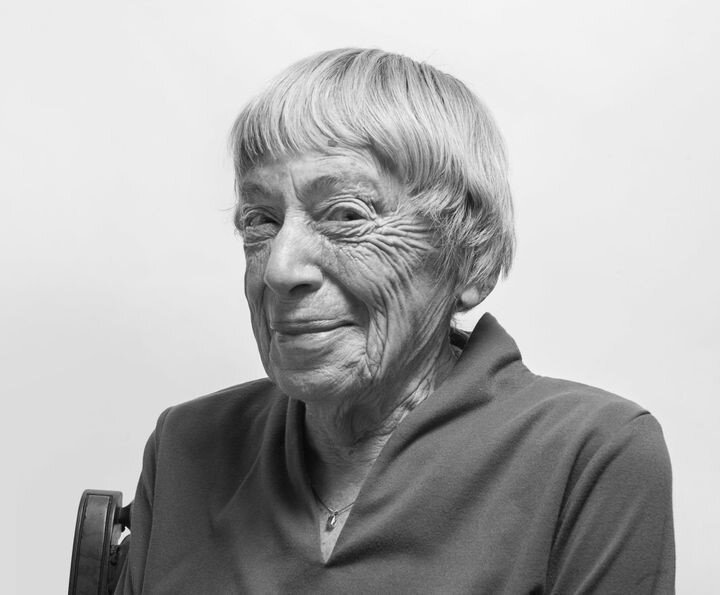
The 1989 CBC Massey Lectures, "The Real World of Technology"
Technology has always been a part of human existence. Today though, says the experimental physicist, Ursula M. Franklin, technology has large-scale effects on culture itself. Ursula Franklin is an experimental physicist, University Professor Emeritus at the University of Toronto, a former board member of the National Research Council and the Science Council of Canada, and a companion of the Order...

Ursula Franklin
Ursula Martius Franklin was a Canadian metallurgist, activist, research physicist, author, and educator who taught at the University of Toronto for more than 40 years. Franklin is best known for her writings on the political and social effects of technology. She was the author of The Real World of Technology, which is based on her 1989 Massey Lectures; The Ursula Franklin Reader: Pacifism as a Map, a collection of her papers, interviews, and talks; and Ursula Franklin Speaks: Thoughts and Afterthoughts, containing 22 of her speeches and five interviews between 1986 and 2012. Franklin was a practising Quaker and actively worked on behalf of pacifist and feminist causes. She wrote and spoke extensively about the futility of war and the connection between peace and social justice. Franklin received numerous honours and awards, including the Governor General's Award in Commemoration of the Persons Case for promoting the equality of girls and women in Canada and the Pearson Medal of Peace for her work in advancing human rights. In 2012, she was inducted into the Canadian Science and Engineering Hall of Fame. A Toronto high school, Ursula Franklin Academy, as well as Ursula Franklin Street on the University of Toronto's St. George campus, have been named in her honor.

Humanities in the Machine - Blain Smith
There is something quietly remarkable about the people who built the foundations of modern computing. Not their technical achievements, though those are extraordinary. What is remarkable is where they came from before they ever touched a machine.
The Periodic Table of Cognition
I’ve been studying the early history of electricity’s discovery as a map for our current discovery of artificial intelligence. The smartest people alive back then, including Isaac Newton, who may have been the smartest person who ever lived, had confident … Continue reading →

Invention & Discovery Cards
A Civilization-inspired tech tree but for the real life history of science and discovery. Inventions and discoveries presented in illustrated Magic-style cards.
Pluralistic: Ellen Ullman’s “Close to the Machine” (16 Jul 2025) – Pluralistic: Daily links from Cory Doctorow
Close To the Machine is Ellen Ullman's classic memoir of writing software in Silicon Valley at the start of the dotcom bubble; it was originally published in 1997 and reprinted in 2022 for the 25 anniversary by Farrar, Straus and Giroux's MCD books:
Amelia Wattenberger
I create things on the web, explore novel interfaces, turn data into meaning, and empower devs with AI.
Ursula K. Le Guin — The Dispossessed
A bleak moon settled by utopian anarchists, Anarres has long been isolated from other worlds, including its mother planet, Urras—a civilization of warring nations, great poverty, and immense wealth. Now Shevek, a brilliant physicist, is determined to reunite the two planets, which have been divided by centuries of distrust. He will seek answers, question the unquestionable, and attempt to tear down the walls of hatred that have kept them apart.
Has technological innovation lost the plot? An interview with AI ethicist Dr. Shannon Vallor | Chicago Policy Review
Shannon Vallor is the Baillie Gifford Chair in the Ethics of Data and Artificial Intelligence at the Edinburgh Futures Institute (EFI) at the University of Edinburgh, where she is also appointed in Philosophy. Professor Vallor’s research explores how new technologies, especially AI, robotics, and data science, reshape human moral character, habits, and practices. She is […]

Joanna Russ- SF and Technology as Mystification
Talk about technology, long familiar to science-fiction readers and writers, is getting popular in Academia too. Particularly interesting to humanists is the connection between technology and whatever their own particular subject happens to be; I've attended three such formal symposia in the last five years, six including SF conventions, and including informal discussions among students, in writing classes, SF classes, and elsewhere, somewhere between fifty and sixty.
Ursula Le Guin
The Age of Wonders and Terrors
Twenty years ago, when the idea of AI taking over the world in our lifetimes still struck most of us as the unconstrained fantasy of those who knew too much science fiction and too little science, …

Telepath: building a new kind of computer
So, we made a thing: Let’s back up: for as long as I can remember, I’ve been obsessed with computers, fascinated not just by what they can do but what they could become. Like many, I took my early inspiration from science fiction. I dreamed of someday having something like the Enterprise’s computer. And why not? Science fiction has always driven scientists, engineers, and inventors to create real things that change the world.