People in tech use AI apps to record and transcribe meetings, workplace chats and even dates—all in the name of productivity.
AI tools make things up a lot, and that’s a huge problem | CNN Business
Artificial intelligence-powered tools like ChatGPT have mesmerized us with their ability to produce authoritative, human-sounding responses to seemingly any prompt. But as more people turn to this buzzy technology for things like homework help, workplace research, or health inquiries, one of its biggest pitfalls is becoming increasingly apparent: AI models sometimes just make things up.
Ryan Singer on Twitter / X
Tools like Cursor hint at where AI-driven user interfaces are going. Chat is only 10%. Most of the output (and UI) is a domain-specific representation of the state of the work.In the case of AI coding, 90% of what you're looking at and thinking about is the IDE, the diffs, the… pic.twitter.com/z0nTUx4WnM— Ryan Singer (@rjs) June 13, 2025

Your medical provider might be recording your mental health care visits – The Markup
Mental health providers are increasingly using AI technology to record conversations, raising privacy concerns among patients and practitioners.

Racial and ethnic differences in how US adults use and view AI
Asian Americans are most likely to say they use chatbots and that they’ve heard a lot about these tools.
Something Big Is Happening
A personal note for non-tech friends and family on what AI is starting to change.
AI is teaching us to speak like bots, and it’s a problem - Fast Company
AI is creeping into our everyday conversations, making us less patient and teaching us to 'prompt' others instead of talking to them.
More Than a Tool
What We Learned from a Year of Conversations About AI
Privacy Considerations with AI Tools
Artificial intelligence (AI) tools come in all sorts of flavors. There are notetaking and transcription tools, chatbots, device-wide agentic AI features, grammar and writing tools, translation assistants, AI summaries, and research tools, among others. As a term, “AI” may refer to features in apps, apps themselves, third-party plug-ins, or a...
Half of Americans report using AI services, with information and productivity leading use cases
New Epoch AI/Ipsos poll reveals high AI engagement, diverse use cases, and emerging workplace integration

Human–AI Collaboration at Scale: Task Criticality, Agency, and Friction Across 250,000 Conversations
Stanford University researchers analyzed nearly 250,000 real-world human-AI conversations from Claude.ai to understand collaborative dynamics, finding that over half of interactions involve...
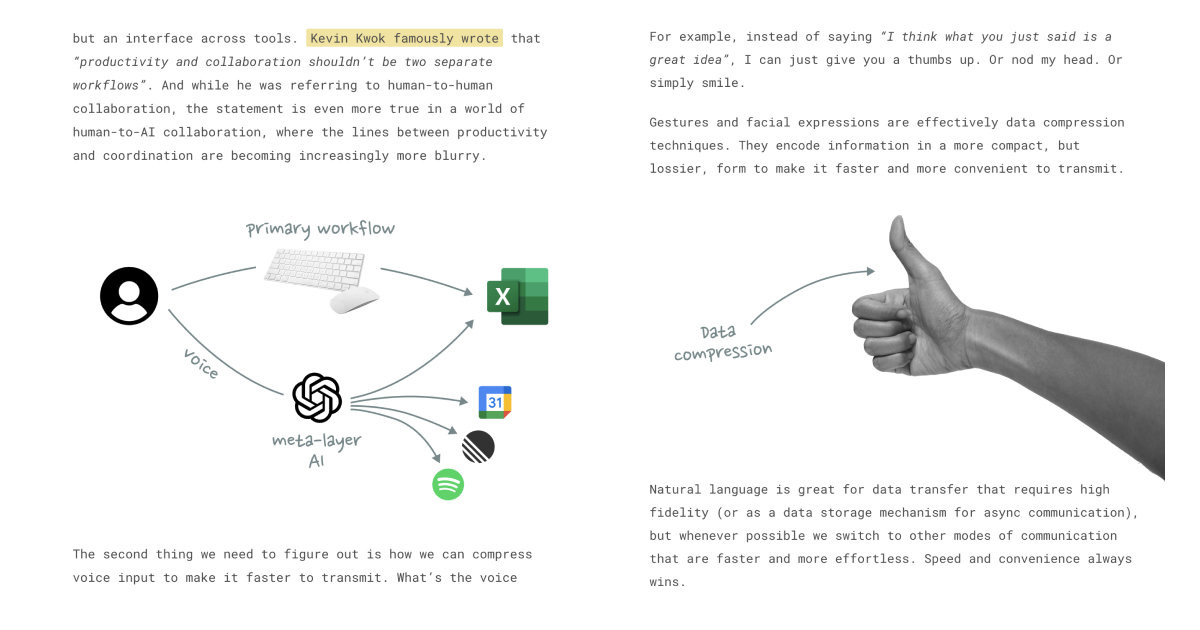
The case against conversational interfaces
Conversational interfaces are a bit of a meme. Every couple of years a shiny new AI development emerges and people in tech go "This is it! The next computing paradigm is here! We'll only use natural language going forward!". But then nothing actually changes and we continue using computers the way w
Oh no, Google is turning everything into a podcast
Otter Voice Meeting Notes
Otter.ai uses artificial intelligence to empower users with real-time transcription meeting notes that are shareable, searchable, accessible and secure.

"AI" and Productivity
[I keep bringing these up on Bluesky, so I think it’s time to gather them up and make a post out of them.] This is a collection of articles...
Do You Speak ChatGPTese? Beyond Writing, AI Is Also Flattening The Way We Talk
A study of hundreds of thousands of YouTube videos and podcasts reveals that AI isn’t just changing how we write, it’s subtly altering our spoken language too, raising new concerns about cultural homogenization and who controls the words we use. A study of hundreds of thousands of lectures and podcasts reveals that AI isn’t just changing how we write, it’s subtly altering our spoken language too, raising new concerns about cultural homogenization and who controls the words we use.

Building Private Processing for AI tools on WhatsApp
We are inspired by the possibilities of AI to help people be more creative, productive, and stay closely connected on WhatsApp, so we set out to build a new technology that allows our users around …