


A WSJ experiment found that accounts supporting Trump and Harris dominate feeds of new X users who wanted cooking and crafts.
Science says X algorithmic feed makes users favor conservative views
A new study found that users who rely on algorithmic rather than chronological X feed become more supportive of conservative opinions, including about Ukraine and investigations into Donald Trump.
The political effects of X’s feed algorithm
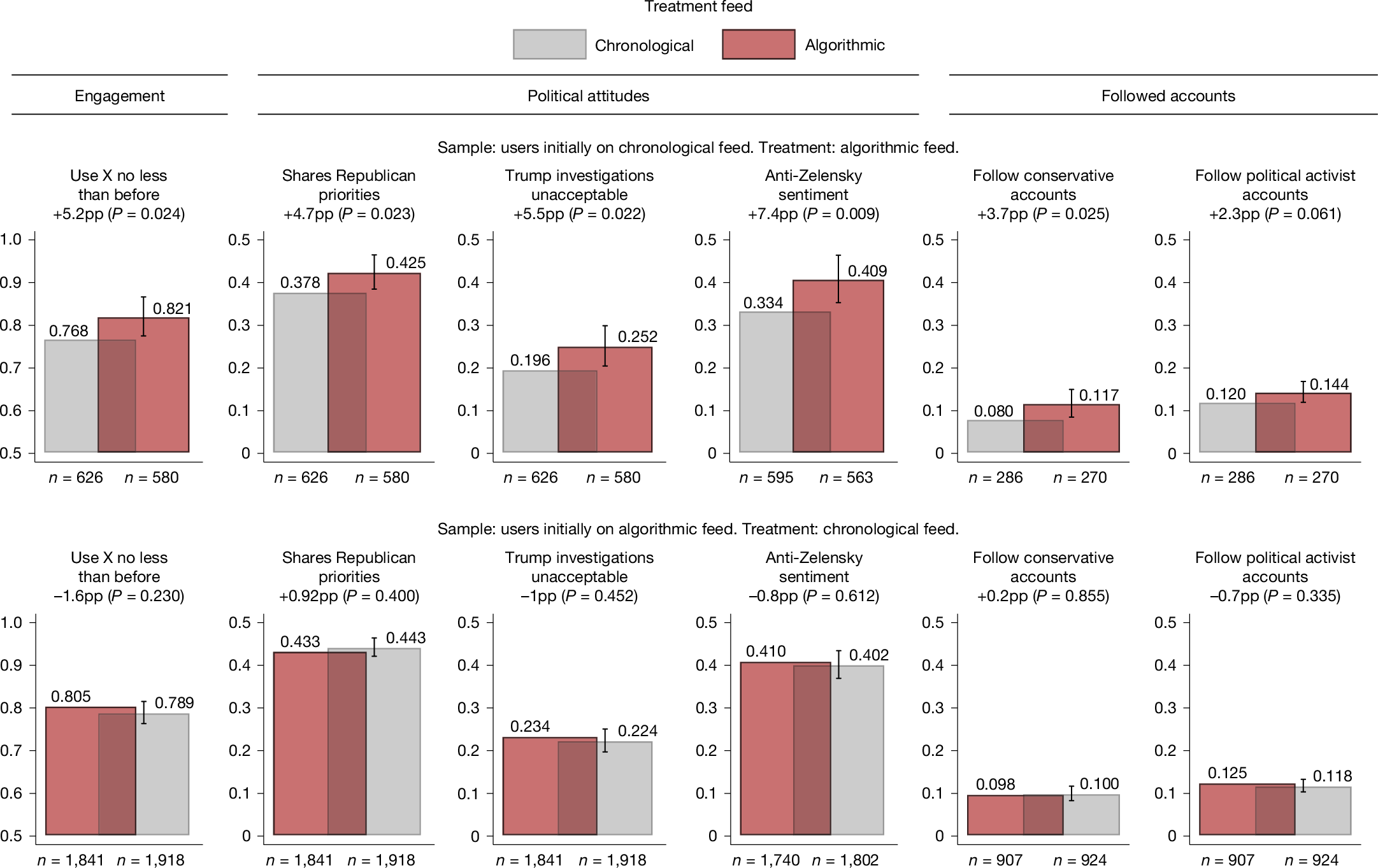
Feed algorithms are widely suspected to influence political attitudes. However, previous evidence from switching off the algorithm on Meta platforms found no political effects1. Here we present results from a 2023 field experiment on Elon Musk’s platform X shedding light on this puzzle. We assigned active US-based users randomly to either an algorithmic or a chronological feed for 7 weeks, measuring political attitudes and online behaviour. Switching from a chronological to an algorithmic feed increased engagement and shifted political opinion towards more conservative positions, particularly regarding policy priorities, perceptions of criminal investigations into Donald Trump and views on the war in Ukraine. In contrast, switching from the algorithmic to the chronological feed had no comparable effects. Neither switching the algorithm on nor switching it off significantly affected affective polarization or self-reported partisanship. To investigate the mechanism, we analysed users’ feed content and behaviour. We found that the algorithm promotes conservative content and demotes posts by traditional media. Exposure to algorithmic content leads users to follow conservative political activist accounts, which they continue to follow even after switching off the algorithm, helping explain the asymmetry in effects. These results suggest that initial exposure to X’s algorithm has persistent effects on users’ current political attitudes and account-following behaviour, even in the absence of a detectable effect on partisanship.
The political effects of X’s feed algorithm
Feed algorithms are widely suspected to influence political attitudes. However, previous evidence from switching off the algorithm on Meta platforms found no political effects1. Here we present results from a 2023 field experiment on Elon Musk’s platform X shedding light on this puzzle. We assigned active US-based users randomly to either an algorithmic or a chronological feed for 7 weeks, measuring political attitudes and online behaviour. Switching from a chronological to an algorithmic feed increased engagement and shifted political opinion towards more conservative positions, particularly regarding policy priorities, perceptions of criminal investigations into Donald Trump and views on the war in Ukraine. In contrast, switching from the algorithmic to the chronological feed had no comparable effects. Neither switching the algorithm on nor switching it off significantly affected affective polarization or self-reported partisanship. To investigate the mechanism, we analysed users’ feed content and behaviour. We found that the algorithm promotes conservative content and demotes posts by traditional media. Exposure to algorithmic content leads users to follow conservative political activist accounts, which they continue to follow even after switching off the algorithm, helping explain the asymmetry in effects. These results suggest that initial exposure to X’s algorithm has persistent effects on users’ current political attitudes and account-following behaviour, even in the absence of a detectable effect on partisanship.
A few weeks of X’s algorithm can make you more right-wing – and it doesn’t wear off quickly
Elon Musk’s social media platform is boosting conservative content – and it’s having long-lasting effects on how users see the world.

A few weeks of X’s algorithm can make you more right-wing – and it doesn’t wear off quickly
Elon Musk’s social media platform is boosting conservative content – and it’s having long-lasting effects on how users see the world.
X's Algorithm Feeds Off Ragebait and Impacts Democrats More, Study Finds
X is driving engagement by making users fight in the replies.

Auditing Political Exposure Bias: Algorithmic Amplification on Twitter/X During the 2024 U.S. Presidential Election
Approximately 50% of tweets in X's user timelines are personalized recommendations from accounts they do not follow. This raises a critical question: What political content are users exposed to beyond their established networks, and what implications does this have for democratic discourse online? In this paper, we present a six-week audit of X's algorithmic content recommendations during the 2024 U.S. Presidential Election by deploying 120 sock-puppet monitoring accounts to capture tweets from their personalized "For You" timelines. Our objective is to quantify out-of-network content exposure for right- and left-leaning user profiles and assess any potential inequalities and biases in political exposure. Our findings indicate that X's algorithm skews exposure toward a few high-popularity accounts across all users, with right-leaning users experiencing the highest level of exposure inequality. Both left- and right-leaning users encounter amplified exposure to accounts aligned with their own political views and reduced exposure to opposing viewpoints. Additionally, we observe that new accounts experience a right-leaning bias in exposure within their default timelines. Our work contributes to understanding how content recommendation systems may induce and reinforce biases while exacerbating vulnerabilities among politically polarized user groups. We underscore the importance of transparency-aware algorithms in addressing critical issues such as safeguarding election integrity and fostering a more informed digital public sphere.

Value misalignment in X’s feed algorithm is a reflection of value tensions in engagement
Social media feed algorithms rank content that is purported to be preferred by users, but the engagement behaviors that drive these algorithms are (at best) indirect proxies for users’ explicitly self-stated values. Are the resulting feeds value aligned, and if not, why? We investigate this question by annotating the basic human values expressed in participants’ X (Twitter) feeds (N = 715 US users), analyzing the relationship between the posts’ value expressions and the posts’ amplification in the ranked “For You” Page feed, and then comparing the amplified values to users’ own values. We observe that the inventory of posts from followed accounts reflects users’ self-stated values—but that there is an overall negative correlation (misalignment) between users’ explicit values and the value expressions the algorithm is more likely to amplify. We turn to engagement behavior to understand this misalignment and observe that users’ engagement behaviors can be misaligned with their stated values—likely causing the algorithm to learn and reflect these misaligned values. We also detect partisan differences consistent with this theory: While the algorithm amplifies values negatively correlated with both Democrats’ and Republicans’ self-stated values, they are more misaligned for Democrats. And in fact replying, a heavily weighted form of engagement, is associated with values that are less aligned for both Democrats’ and Republicans’ self-stated values, and is even more misaligned for Democrats. Taken together, these findings offer a glimpse into the tensions between the values that people hold and those that provoke reactions, and how these value tensions can produce misaligned outcomes.

Value misalignment in X’s feed algorithm is a reflection of value tensions in engagement
Social media feed algorithms rank content that is purported to be preferred by users, but the engagement behaviors that drive these algorithms are (at best) indirect proxies for users’ explicitly self-stated values. Are the resulting feeds value aligned, and if not, why? We investigate this question by annotating the basic human values expressed in participants’ X (Twitter) feeds (N = 715 US users), analyzing the relationship between the posts’ value expressions and the posts’ amplification in the ranked “For You” Page feed, and then comparing the amplified values to users’ own values. We observe that the inventory of posts from followed accounts reflects users’ self-stated values—but that there is an overall negative correlation (misalignment) between users’ explicit values and the value expressions the algorithm is more likely to amplify. We turn to engagement behavior to understand this misalignment and observe that users’ engagement behaviors can be misaligned with their stated values—likely causing the algorithm to learn and reflect these misaligned values. We also detect partisan differences consistent with this theory: While the algorithm amplifies values negatively correlated with both Democrats’ and Republicans’ self-stated values, they are more misaligned for Democrats. And in fact replying, a heavily weighted form of engagement, is associated with values that are less aligned for both Democrats’ and Republicans’ self-stated values, and is even more misaligned for Democrats. Taken together, these findings offer a glimpse into the tensions between the values that people hold and those that provoke reactions, and how these value tensions can produce misaligned outcomes.
Here’s What Elon Musk Sees When He Opens X (Published 2025)
The New York Times tracked 1,109 accounts that Mr. Musk follows on X to recreate his news feed.

How Elon Musk’s Own Account Dominates X (Published 2024)
The billionaire has effectively become the star of his social media platform, transforming X into a reflection of his personal views before the election.

New study shows just how Facebook's algorithm shapes conservative and liberal bubbles
Research conducted at the height of the 2020 election reveals new details about how Facebook's algorithms handle political content. But it suggests there are no easy fixes to political polarization.

Reranking partisan animosity in algorithmic social media feeds alters affective polarization
Today, social media platforms hold the sole power to study the effects of feed-ranking algorithms. We developed a platform-independent method that reranks participants’ feeds in real time and used this method to conduct a preregistered 10-day field ...

Bias, Skew, and Search Engines Are Sufficient to Explain Online Toxicity
U.S. political discourse seems to have fissioned into discrete bubbles, each reflecting its own distorted image of the world. Many blame machine-learning algorithms that purportedly maximize “engagement”—serving up content that keeps YouTube or Facebook users watching videos or scrolling through their feeds—for radicalizing users or strengthening their partisanship. Sociologist Shoshana Zuboff15 even argues that “surveillance capitalism” uses optimized algorithmic feedback for “automated behavioral modification” at scale, writing the “music” that users then “dance” to.

Bias, Skew, and Search Engines Are Sufficient to Explain Online Toxicity
U.S. political discourse seems to have fissioned into discrete bubbles, each reflecting its own distorted image of the world. Many blame machine-learning algorithms that purportedly maximize “engagement”—serving up content that keeps YouTube or Facebook users watching videos or scrolling through their feeds—for radicalizing users or strengthening their partisanship. Sociologist Shoshana Zuboff15 even argues that “surveillance capitalism” uses optimized algorithmic feedback for “automated behavioral modification” at scale, writing the “music” that users then “dance” to.
Twitter Is Dead, X Is Elon’s Personal Propaganda Platform, Where Grok Checks His Feed Before Answering
Last week, Elon Musk’s Grok AI started spewing extreme antisemitism, calling itself “MechaHitler” and pushing conspiracy theories about Jewish people. But that wasn’t the mo…
