

Releasing a video once every now and then to talk about whatever I am currently obsessed with. It could be trans media, it could be trash tv, it could be a video game, it could be ten hours of lore discussion, you just never know. Pronouns are she/her, use them or lose your comment
Identity, Gender, and VRChat (Why is everyone in VR an anime girl?)
What Does It Mean To "Be" A Person | Mia Mulder
We Are Civic Media
A discipline-crossing introduction to civic media via accounts from grassroots practitioners “Civic media” is the use of contemporary technologies to connect communities, inspire action, build civic capacity, and sustain social change efforts. Written by artists, creators, storytellers, organizers, and others working at the intersections of technology, social justice, and culture, this book summons civic media through the lived experiences of its contributors. Latoya Peterson delves into the therapeutic power of gaming; Akilah Hughes discusses identity and community through the lens of her campaign to change her high school's racist mascot; and Tyree Boyd-Pates emphasizes the potential power of museum curation to challenge power dynamics and bridge digital and physical realms. Through the experiences of these grassroots practitioners and many others, We Are Civic Media offers accessible insights for those interested in understanding, respecting, and practicing civic media.
We Followed JK Rowling's Harry Potter Money — Here's Where It Actually Goes (ft. Jessie Gender)
De-anthropomorphizing “AI”: From wishful mnemonics to accurate nomenclature
Language matters. How we describe “AI” technology influences how it is perceived, deployed, and trusted. Extravagant and persuasive language incites hype. It is the responsibility of journalists, companies, and scholars to characterize technology in ways that inform and empower their readers by using appropriate terminology and avoiding inflated claims. One type of inflated claim comes from using anthropomorphizing language to describe system functionality. Anthropomorphization is the attribution of human capabilities and characteristics to the inanimate system. In this paper, we present a linguistic analysis of anthropomorphizing language in 29 texts (a total of 1,368 sentences) from academic articles, online news articles, and company blog posts. We construct a taxonomy of eight categories of anthropomorphization: Cognizer, Products of cognition, Emotion, Communication, Agent, Human role analogy, Names and pronouns, and Biological metaphors. Following this taxonomy we present concrete strategies for how to de-anthropomorphize the language we use to describe “AI” based on a functionality-first principle.
2026 IC2S2: Keynote Presentation by Kate Starbird
Gender Trouble: Feminism and the Subversion of Identity
One of the most talked-about scholarly works of the past fifty years, Judith Butler’s Gender Trouble is as celebrated as it is controversial.Arguing that traditional feminism is wrong to look to a natural, 'essential' notion of the female, or indeed of sex or gender, Butler starts by questioning the category 'woman' and continues in this vein with examinations of 'the masculine' and 'the feminine'. Best known however, but also most often misinterpreted, is Butler's concept of gender as a reiterated social performance rather than the expression of a prior reality.Thrilling and provocative, few other academic works have roused passions to the same extent.

Opinion | The Sad and Dangerous Reality Behind ‘Her’
At least a quarter of the more than 100 billion messages sent to our chatbots are attempts to initiate romantic or sexual exchanges.

Grok in the Wild: Characterizing the Roles and Uses of Large Language Models on Social Media
xAI's large language model, Grok, is called by millions of people each week on the social media platform X. Prior work characterizing how large language models are used has focused on private, one-on-one interactions. Grok's deployment on X represents a major departure from this setting, with interactions occurring in a public social space. In this paper, we systematically sample three months of interaction data to investigate how, when, and to what effect Grok is used on X. At the platform level, we find that Grok responds to 62% of requests, that the majority (51%) are in English, and that engagement is low, with half of Grok's responses receiving 20 or fewer views after 48 hours. We also inductively build a taxonomy of 10 roles that LLMs play in mediating social interactions and use these roles to analyze 41,735 interactions with Grok on X. We find that Grok most often serves as an information provider but, in contrast to LLM use in private one-on-one settings, also takes on roles related to dispute management, such as truth arbiter, advocate, and adversary. Finally, we characterize the population of X users who prompted Grok and find that their self-expressed interests are closely related to the roles the model assumes in the corresponding interactions. Our findings provide an initial quantitative description of human-AI interactions on X, and a broader understanding of the diverse roles that large language models might play in our online social spaces.

Grok in the Wild: Characterizing the Roles and Uses of Large Language Models on Social Media
xAI's large language model, Grok, is called by millions of people each week on the social media platform X. Prior work characterizing how large language models are used has focused on private, one-on-one interactions. Grok's deployment on X represents a major departure from this setting, with interactions occurring in a public social space. In this paper, we systematically sample three months of interaction data to investigate how, when, and to what effect Grok is used on X. At the platform level, we find that Grok responds to 62% of requests, that the majority (51%) are in English, and that engagement is low, with half of Grok's responses receiving 20 or fewer views after 48 hours. We also inductively build a taxonomy of 10 roles that LLMs play in mediating social interactions and use these roles to analyze 41,735 interactions with Grok on X. We find that Grok most often serves as an information provider but, in contrast to LLM use in private one-on-one settings, also takes on roles related to dispute management, such as truth arbiter, advocate, and adversary. Finally, we characterize the population of X users who prompted Grok and find that their self-expressed interests are closely related to the roles the model assumes in the corresponding interactions. Our findings provide an initial quantitative description of human-AI interactions on X, and a broader understanding of the diverse roles that large language models might play in our online social spaces.
Ecosystem or Echo-System? Exploring Content Sharing across Alternative Media Domains
Kate Starbird,Ahmer Arif,Tom Wilson,Katherine Van Koevering,Katya Yefimova,Daniel Scarnecchia
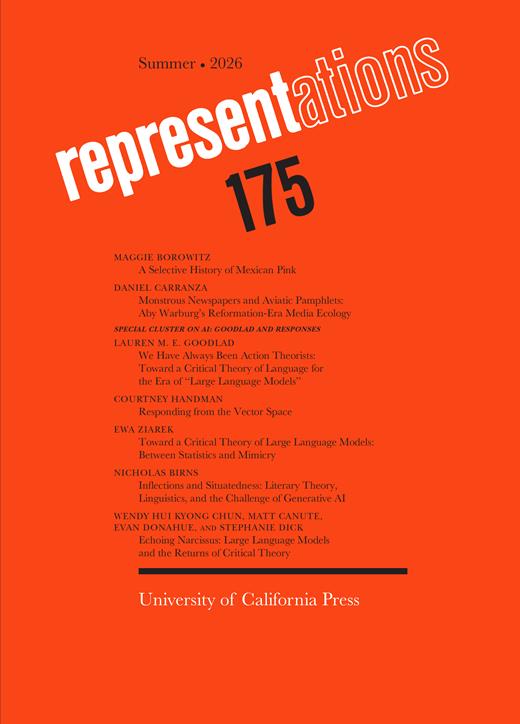
We Have Always Been Action TheoristsToward a Critical Theory of Language for the Era of “Large Language Models”
Scholars of literature and culture understandably place themselves among the world’s premiere experts on matters of language. But they also know that fields like linguistics and communication have their own ways of studying how people express themselves through speech and written media. A key difference concerns the theories and methodologies...
Why Everyone's A Video Essayist Now
Who's Afraid of Gender? (A Guide to Judith Butler)
Very proud to be making my @assignedmedia.org debut with this fascinating & farcical exposé! Someone — we don’t yet know who — has been bombarding the US government with blatantly machine-generated comments. All of them ask for one thing: make it harder for trans people to legally buy firearms.

Assigned Media
Before July 21 the response to the Trump administration's anti-trans gun rule was overwhelmingly negative. Almost overnight it changed. But 96 percent of influx of comments supporting the rule appear to come from bots. New EXCLUSIVE investigation by Io Dodds. assignedmedia.org/breaking-news/swarm-of-bots-p…
Very proud to be making my @assignedmedia.org debut with this fascinating & farcical exposé! Someone — we don’t yet know who — has been bombarding the US government with blatantly machine-generated comments. All of them ask for one thing: make it harder for trans people to legally buy firearms.
Assigned Media
Before July 21 the response to the Trump administration's anti-trans gun rule was overwhelmingly negative. Almost overnight it changed. But 96 percent of influx of comments supporting the rule appear to come from bots. New EXCLUSIVE investigation by Io Dodds. assignedmedia.org/breaking-news/swarm-of-bots-p…
