

Revolution.Social is a podcast about the future of social media and reclaiming our digital communities, hosted by technologist and community advocate Rabble, a.k.a. Evan Henshaw-Plath — who was Twitter’s first employee and hired Jack Dorsey. In weekly interviews, Rabble will interview thought leaders, technologists, academics, and more about the need for a new social media "bill of rights." Just as the original Bill of Rights protected individual freedoms from government overreach, we need fundamental protections from corporate control and surveillance capitalism. This is the start of a conversation about what developers are building, how they're building it, and what consumers need to be asking for. Guests will include Jack Dorsey (former CEO & co-founder of Twitter); Kara Swisher (host of On with Kara Swisher, co-host of Pivot); Cory Doctorow (science fiction author & former editor of Boing Boing); and Taylor Lorenz (founder of User Mag, host of Power User).
Rebuilding Social Media From Scratch!
Rebuilding Social Media From Scratch!
Our Social Media is Broken. Is Decentralization the Fix? | Internet Archive Blogs
When Jack Dorsey, founder of the very centralized social media platform, Twitter, posted this message about decentralized social media, our DWeb community took note:
Medium CEO Tony Stubblebine on AI Slop, Quality Content & Social Media Fragmentation
Bluesky COO Rose Wang On Building a Better Social Network
The Future of Twitter: Q&A with Jack Dorsey
An in-depth conversation on 10 years of tweeting, the importance of live media, and “the puddle.”

Shifts in U.S. Social Media Use, 2020–2024: Decline, Fragmentation, and Enduring Polarization
The social media ecosystem appears to be in flux. Twitter’s rebranding to X has come to symbolize a broader reorganization of online publics – political reshuffling, user attrition, and uncertainty over the role of legacy platforms. Simultaneously, the shift from text-based, networked feeds toward algorithmically curated, short-form video has accelerated, with TikTok setting the pace for the wider ecosystem [18, 14, 16]. At the same time, everyday communication increasingly migrates from large, open networks to semi-private spaces such as group chats and messaging apps. Commentators describe a digital public sphere in transition: smaller, more fragmented, less dominated by traditional social networking sites, and rise of more broadcast-oriented forms of media – with some even suggesting that we are seeing the beginning of the end of the social media era.
Decentralized Social Media for 40 Million+ Users (with Bluesky’s Jay Graber)
The promise of ATproto is social media without corporate overlords | The Web Dev Podcast Series 1
Developers building apps on ATproto, the technology behind social media apps like Bluesky and Leaflet, are promising us a future where we own our content and aren’t at the whims of a tiny handful of companies. Software engineer Zeu Capua talks to host Jason Lengstorf about the promise of social media where we can actually own our own data.

Scientists no Longer Find Twitter Professionally Useful, and have Switched to Bluesky
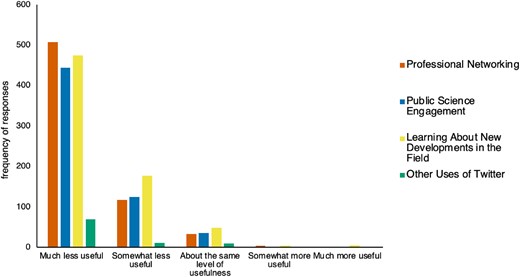
Synopsis Social media has become widely used by the scientific community for a variety of professional uses, including networking and public outreach. For the past decade, Twitter has been a primary home of scientists on social media. In recent years, new leadership at Twitter has made substantive changes that have resulted in increases in the prevalence of pseudoscience, conspiracy theory, and harassment on the platform, causing many scientists to seek alternatives. Bluesky has been suggested as a good alternative to Twitter, but the phenomenon of academics switching social media platforms has not previously been studied. Here we report on the results of a survey distributed to scientists on Twitter and Bluesky (n = 813). Results overwhelmingly confirm that changes to Twitter have made the social media platform no longer professionally useful or pleasant, and that many scientists have abandoned it in favor of Bluesky. Results show that for every reported professional benefit that scientists once gained from Twitter, scientists can now gain that benefit more effectively on Bluesky than on Twitter.
Rudy Fraser on Blacksky, Mutual Aid & Reclaiming Social Media
After the feed with Eli Pariser, Ben Smith, and Jasmine Sun
Social Media Should Be Public Infrastructure (with Ben Cerveny)
Is Substack Notes a ‘Twitter clone’? We asked CEO Chris Best
Substack Notes just dropped. Can the startup survive this foray into social media?

Recently I’ve been thinking about a couple of... - Adam Wood
Recently I’ve been thinking about a couple of different tech-related things that sort of overlap. One is the (emerging) shape of the new social web; the other is a pull I’m feeling to try and lessen reliance on American companies. I’ve been interested in / concerned by what became of social media for some time.1 Since the sundering of Twitter in 2022, I’ve kept an eye on the various alternatives, with particular interest in Mastodon and Bluesky. Actually, to be more accurate, my interest has been in the protocols behind those platforms: ActivityPub and AT Protocol respectively. Both have their...

Even pre-Elon, Twitter never drove all that much traffic to @techdirt.com, even if it was *my* preferred social media site. Nowadays Bluesky drives a ton of traffic to Techdirt, way more than even old Twitter did (X sends nothing). Only site that currently sends more than bsky is reddit.

Ben Collins
This is exactly right. The Onion quietly left Twitter a month ago and... our weekly subscribers went up. It's because we're doing well here, on Instagram and on YouTube. As a business, being on Twitter is somewhere between useless or detrimental, unless you're selling boner pills.
