

Topos Institute Colloquium, 20th of March 2025. ——— This talk explores "care" as a missing dimension in contemporary discussions on technology, using debates around LLMs and AI alignment as a case study. Our civilization’s technological prowess is largely identified with abstraction and optimization—powers that have yielded immense benefits but which have also reshaped our relationship with reality. Increasingly, our drive to abstract and optimize takes on a life of its own, leading both technologists and non-technologists alike to engage with the world primarily through questions of modeling, measurement, and control. But what we care about cannot be appropriately tended to in such an instrumental framework, for it lacks a defined ultimate goal, a why for which we model, measure, and control. Our challenge is designing how to pursue technological progress within a broader context of care, not mere "values" that are relative to imperatives of efficiency and optimization.
What we can’t measure about AI – yet | Aeon Essays
The costs of transformative innovations are immediately clear: it’s the longterm gains that are hardest to understand

Field Theory: AI as Social Science Question, Object & Tool
Uses of advanced artificial intelligence are changing how societies organize labor, govern, produce knowledge, and make meaning. In light of these developments, this essay argues that AI models, tools, and systems pose three interrelated imperatives for social science: they demand renewed attention to social theories of how technology, human experience, and social order are entangled; they require study as objects of inquiry in their own right; and they offer capabilities that may transform—or upend—the practice of social investigation itself. From Weber’s analysis of rationalization to Du Bois’s study of technology and inequality to contemporary scholarship on algorithmic governance, the essay examines what social science distinctively offers: the capacity to historicize the apparently unprecedented, to trace connections across scales, and to center those most affected by technological change. It identifies how algorithmic systems are remaking the distribution of opportunity and risk as a central task of social inquiry and asks what futures social science might help bring into being.
Care at the Edge of Automation – Topos Institute
Technologies don’t just solve problems, they change us. We invent technologies, and they invent us in turn, shaping our lives and worlds. This is the phenomenon that Terry Winograd and Fernando Flores, in Understanding Computers and Cognition (1986), called “ontological design.” It matters now more than ever—along with a second lesson they saw clearly. Technological research is always guided (and sometimes misguided) by deep ontological assumptions about, e.g., the nature of cognition, agency, and communication. If we are to create technologies that truly serve human flourishing and care, we must bring these hidden assumptions into the open and question them at their roots.

The Scaling Era: An Oral History of AI, 2019–2025
An inside view of the AI revolution, from the people an…

Anthropomorphism Is Breaking Our Ability to Judge AI
Tech Policy Press fellow James Ball asks, how should we interact with a technology designed to ‘speak’ with us on what appear to be human terms?
How to be a wise optimist about science and technology?
I believe the central problem of the 21st century is how civilization co-evolves with science and technology. As our understanding of the world deepens, it enables technologies that confer ever more power to both improve and damage the world. There's currently much public discussion of this in the context of artificial superintelligence (ASI). However, it's a fundamental recurring challenge, affecting areas including climate change, genetic engineering, nanotechnology, geoengineering, brain-computer interfaces, and many more. How can we best benefit from science and technology, while supplying safety sufficient to ensure a healthy, flourishing civilization?
Presentations — Benedict Evans
Every year, I produce a big presentation exploring macro and strategic trends in the tech industry. New in May 2025, ‘AI eats the world’.

The Scaling Era: An Oral History of AI, 2019–2025
An inside view of the AI revolution, from the people and companies making it happen.
The Era of Experience & The Age of Design: Richard S. Sutton, Upper Bound 2025
AI as Social Technology: Astor Lecture by Professor Henry Farrell
AI as Social Technology: Astor Lecture by Professor Henry Farrell
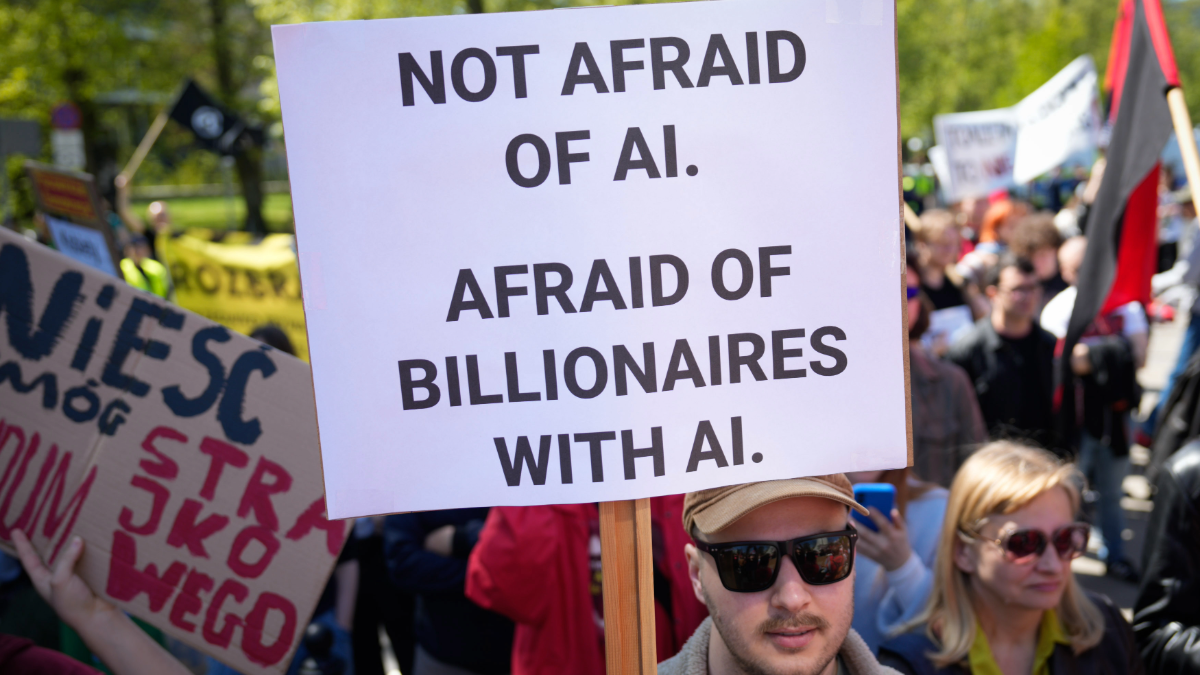
Separating AI’s Technological Problems From its Capitalism Problems
Nathan E. Sanders and Bruce Schneier say integrating a technology as disruptive as AI responsibly requires deep structural reforms.
WDR 2026: The Promise of Artificial Intelligence
The World Development Report 2026 explores how artificial intelligence is reshaping development as a general‑purpose technology.

AI Angst
My input stream is full of it: Fear and loathing and cheerleading and prognosticating on what generative AI means and whether it’s Good or Bad and what we should be doing. All the channels: Blogs and peer-reviewed papers and social-media posts and business-news stories. So there’s lots of AI angst out there, but this is mine. I think the following is a bit unique because it focuses on cost, working backward from there. As for the genAI tech itself, I guess I’m a moderate; there is a there there, it’s not all slop. But first…

The Third AI Summer, Henry Kautz, AAAI 2020 Robert S. Engelmore Memorial Award Lecture
Intelligence Rising
Artificial Intelligence (AI) is expected to be one of the most transformative technologies in human history.
