

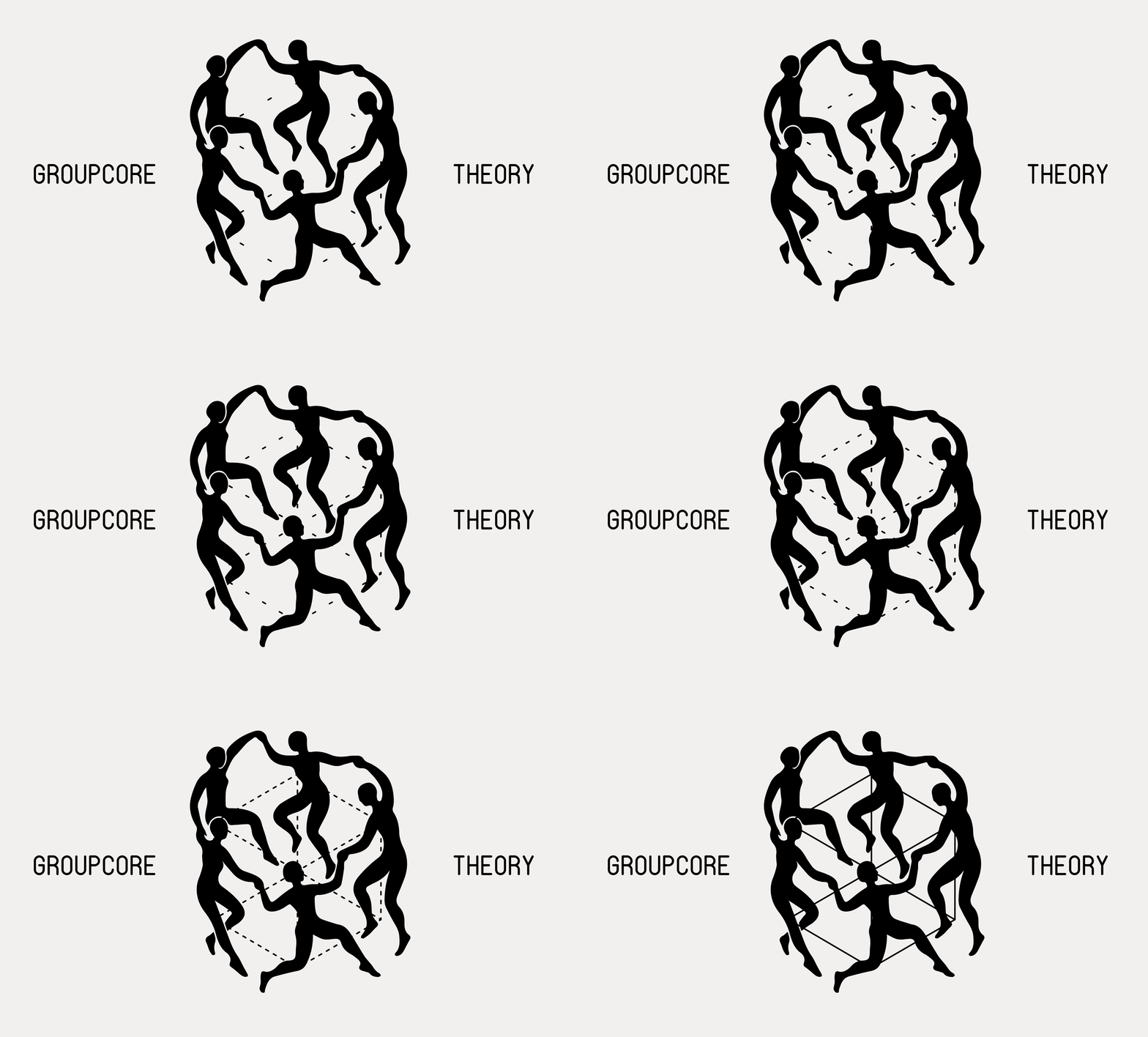
In a recent post I wrote that Metalabel’s focus is groupcore: software, tools, economics, spaces, and ideas that help creative people cooperate. But what does groupcore mean? Can one groupcore as a verb? Is groupcore distinct from other forms of coordination we already know? Groupcore is a term I
Groupthink
Groupthink is a psychological phenomenon that occurs within a group of people in which the desire for harmony or conformity in the group results in an irrational or dysfunctional decision-making outcome. Cohesiveness, or the desire for cohesiveness, in a group may produce a tendency among its members to agree at all costs.[1] This causes the group to minimize conflict and reach a consensus decision without critical evaluation.[2][3]
Creative Computing Group by @tgoerke.bsky.social — Grain
Let's start a group at CODIP to explore creative computing. Let's not start by defining creativity nor computing. It would be a trap. Let's collect artifacts instead. Images, text, thoughts,...
TeamTopologies/Team-Topologies-Community-Materials
A list of materials relating to Team Topologies (articles, tools, canvases, etc.) generated by the community.
Dark Forest OS
A private internet for creative groups — groupcore infrastructure to cooperate, create, and coordinate
co/core · 5.0 ★ | at-store
co/core is a cooperative for AI inference — people pooling the Macs they already own to run open models for each other. Tag: Developer.

Stigmergic Collaboration: A Theoretical Framework for Mass Collaboration
"This thesis presents an application-oriented theoretical framework for generalised and specific collaborative contexts with a special focus on Internet-based mass collaboration. The proposed framework is informed by the author's many years of collaborative arts practice and the design, building and moderation of a number of online collaborative environments across a wide range of contexts and applications. The thesis provides transdisciplinary architecture for describing the underlying mechanisms that have enabled the emergence of mass collaboration and other activities associated with 'Web 2.0' by incorporating a collaboratively developed definition and general framework for collaboration and collective activity, as well as theories of swarm intelligence, stigmergy, and distributed cognition. "Accompanying this creative arts thesis is a DVD-Rom which includes offline versions of the three Internet based collaborative environments designed, built and implemented in accordance with the frameworks for digital stigmergy and mass collaboration developed in the written work. The creative works in conjunction with the written thesis help to explore and more rigorously define the collaborative process in general, while testing the theory that stigmergy is an inherent component of collaborative processes which incorporate collective material production. "Supported by a range of contemporary examples of Internet activity, including the accompanying creative works, it is found that stigmergy is a deeply rooted mechanism inherent in not only traditional material collaborative processes, but a range of emerging online practices which may be broadly categorised as digital stigmergic cooperation and collaboration. This latter class enables the extreme scaling seen in mass collaborative projects such as Wikipedia.org, open source software projects and the massive, multiplayer environment, Second Life. This scaling is achieved through a range of attributes which are examined, such as the provision of a localised site of individualistic engagement which reduces demands placed upon participants by the social negotiation of contributions while increasing capacity for direct and immediate creative participation via digital workspaces. Also examined are a range of cultural, economic and sociopolitical impacts which emerge as a direct result of mass collaboration's highly distributed, non-market based, peer-production processes, all of which are shown to have important implications for the further transformation of our contemporary information and media landscape."
What is Modal - Modal Collective
Modal is an independent collective building emancipatory software.
Working Group Formation: Polite Goshawk · Issue #14 · lexicon-community/governance
What is the objective? Explore the definition and reference implementation of Lexicon Lenses, a transformation of records from one type to another. This working group is expected to production docu...
Community relations, management, design, and governance
These four words mean different things, and frequently call for different talents and skillsets used by different people. And yet, they seem to get used interchangeably, and lumped into one person&…

Drupal's collective purpose
How Drupal is fueled by a collective sense of purpose that sets us apart from other open source software communities and organizations.
Drupal's collective purpose
How Drupal is fueled by a collective sense of purpose that sets us apart from other open source software communities and organizations.
Groupe (mathématiques)
En mathématiques, un groupe est une des structures algébriques fondamentales de l'algèbre générale. C'est un ensemble muni d'une loi de composition interne associative admettant un élément neutre et, pour chaque élément de l'ensemble, un élément symétrique.

remember
For groups The final step in organizing group conversations about computer use is to commit to remembering what has been said before. And to say it again....

co/core — an AI cooperative
co/core is a cooperative for AI inference — people pooling the Macs they already own to run open models for each other, instead of renting from the big clouds. An experiment in AI infrastructure we build, share, and own together. Bring your existing OpenAI-compatible code, or share a Mac and help run it.
"Teams working across organizational boundaries, sharing structured data, and building on each other’s work with ease." I know it's called "adversarial interop", but it actually feels like "community interop", at least right now

Toni Schneider
Conference Takeaways I’m back from ATmosphereConf in Vancouver, and I'm processing what I saw and heard. The atproto developer community could not have been nicer and more welcoming. Here are some takeaways. ... toni.org/2026/04/03/conference-takeawa…
