

Bayes’ Theoremfor the curious and bewildered;an excruciatingly gentle introduction.
Bayesian Thinking in Everyday Life
More than 200 years ago, Thomas Bayes came up with a brilliant idea that has helped shape the world today, called Bayes Theorem. This…

Useful Mental Model: Normal Distribution - Scott H Young
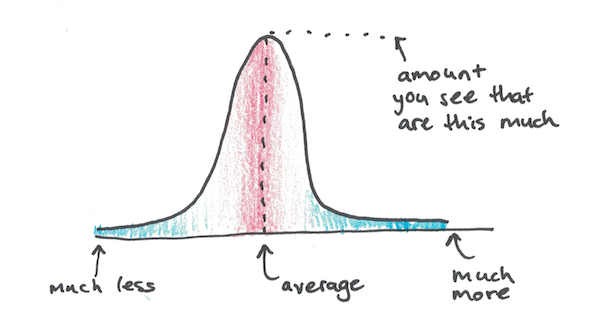
Some ideas are so powerful once you know them, you start to see them everywhere. Normal distributions are one of these ideas. Let's understand it!
The Buffett Formula: Going to Bed Smarter Than When You Woke Up
Learn how Warren Buffett and Charlie Munger turn curiosity into insight. Discover how interest-driven learning builds understanding and reveals hidden opportunities.

Bayesian Inference of Social Norms as Shared Constraints on Behavior
People act upon their desires, but often, also act in adherence to implicit social norms. How do people infer these unstated social norms from others' behavior, especially in novel social contexts? We propose that laypeople have intuitive theories of social norms as behavioral constraints shared across different agents in the same social context. We formalize inference of norms using a Bayesian Theory of Mind approach, and show that this computational approach provides excellent predictions of how people infer norms in two scenarios. Our results suggest that people separate the influence of norms and individual desires on others' actions, and have implications for modelling generalizations of hidden causes of behavior.

The Wisdom of Individuals: Exploring People's Knowledge About Everyday Events Using Iterated Learning
Abstract Determining the knowledge that guides human judgments is fundamental to understanding how people reason, make decisions, and form predictions. We use an experimental procedure called ‘‘iterated learning,’’ in which the responses that people give on one trial are used to generate the data they see on the next, to pinpoint the knowledge that informs people's predictions about everyday events (e.g., predicting the total box office gross of a movie from its current take). In particular, we use this method to discriminate between two models of human judgments: a simple Bayesian model ( Griffiths & Tenenbaum, 2006 ) and a recently proposed alternative model that assumes people store only a few instances of each type of event in memory (Min K ; Mozer, Pashler, & Homaei, 2008 ). Although testing these models using standard experimental procedures is difficult due to differences in the number of free parameters and the need to make assumptions about the knowledge of individual learners, we show that the two models make very different predictions about the outcome of iterated learning. The results of an experiment using this methodology provide a rich picture of how much people know about the distributions of everyday quantities, and they are inconsistent with the predictions of the Min K model. The results suggest that accurate predictions about everyday events reflect relatively sophisticated knowledge on the part of individuals.


The Assessment of Prior Distributions in Bayesian Analysis
In the Bayesian framework, quantified judgments about uncertainty are an indispensable input to methods of statistical inference and decision. Ultimately, all components of the formal mathematica...

The mistake we all make... and the simple experiment that reveals it
Your answer reveals how you see the world – and the common error that hampers our decision making. In an extract from his new book, psychologist Richard Nisbett reveals the ‘mindware’ to help us think smarter

The Myth and Magic of Generating New Ideas
A mathematician on how to get the mind into motion.

Inference characteristics of Llama · Cursor
A primer on inference math and an examination of the surprising costs of Llama.
Illusions of Understanding in the Sciences
Scientists seek to understand the causes of observed phenomena. Beliefs that they have succeeded are based on understanding that is rarely or possibly never complete, and varies in depth and quality. Most often scientists believe they understand more than they do, making their belief an illusion. This illusion then persists in explanations scientists provide in print, in talks, or in discussions. The illusion that a scientist has a valid and complete explanation tends to be magnified when the data are well described by mathematical and computer simulation models due to the precision of such models and their ability to predict well; prediction does not imply causality, but gives the illusion that it does. The first part of this essay supports the case for the universality of partial and incomplete levels of understanding by showing the difficulty of reaching a deep level of understanding for even a simple analysis and model that most scientists use and believe they understand: linear regression. The second part highlights some implications of the existence of many levels of understanding and explanation, and their use by scientists for design, testing, analysis, and theory development. It discusses the way that deduction and induction depend on the levels of understanding and the implications of the illusion that a scientist’s understanding is deep. It makes a case that the many incomplete levels of understanding affect, often unwittingly, the ways scientists design experiments, test theories, comprehend, communicate, and teach.

Stanford researchers find a single question could be the key to changing someone’s mind
Curiosity goes a lot further than we might think.

Mental Models: The Best Way to Make Intelligent Decisions (~100 Models Explained)
The smartest people in the world use mental models to make intelligent decisions, avoid stupidity, and increase productivity. Let's take a look at how ...

Mental Models: The Best Way to Make Intelligent Decisions (~100 Models Explained)
The smartest people in the world use mental models to make intelligent decisions, avoid stupidity, and increase productivity. Let's take a look at how ...
Noise in Cognition: Bug or Feature?
Noise in behavior is often considered a nuisance: Although the mind aims for the best possible action, it is let down by unreliability in the sensory and response systems. Researchers often represent noise as additive, Gaussian, and independent. Yet a careful look at behavioral noise reveals a rich structure that defies easy explanation. First, in both perceptual and preferential judgments sensory and response noise may potentially play only minor roles, with most noise arising in the cognitive computations. Second, the functional form of the noise is both non-Gaussian and nonindependent, with the distribution of noise being better characterized as heavy-tailed and as having substantial long-range autocorrelations. It is possible that this structure results from brains that are, for some reason, bedeviled by a fundamental design flaw, albeit one with intriguingly distinctive characteristics. Alternatively, noise might not be a bug but a feature. Specifically, we propose that the brain approximates probabilistic inference with a local sampling algorithm, one using randomness to drive its exploration of alternative hypotheses. Reframing cognition in this way explains the rich structure of noise and leads to the surprising conclusion that noise is not a symptom of cognitive malfunction but plays a central role in underpinning human intelligence.
