Use /goal for long-running autonomous task execution in Grok Build.
Grok
Grok is an AI assistant built by xAI. Chat, create images, write code, and get real-time answers from the web and X.

gawkbot: the open source Grok Bot, bots you (almost) control
gawkbot is the open source Grok Bot. gawkbots automate your menial work via AI models and build you microapps to manage the outcome, so that you have a false sense of control.
Designing Grok Bot for a world of persistent agents
How we designed Grok Bot for agents that persist beyond a single session — from a chat history to a Bot roster, presence, a computer of the Bot’s own, and work that starts without a prompt.
xai-org/grok-build
SpaceXAI's coding agent harness and TUI. Fullscreen, mouse interactive, extensible.

The Hitchhiker's Guide to Agentic AI: From Foundations to Systems
The Hitchhiker's Guide to Agentic AI is a comprehensive practitioner's reference for building autonomous AI systems. The book covers the full stack from first principles to production deployment, organized around a central thesis: building great agentic systems requires understanding every layer of the pipeline, not just one. The book opens with the LLM substrate -- transformer architecture, GPU systems, training and fine-tuning (SFT,LoRA, MoE), model compression, and inference optimization -- treated as essential foundations rather than the primary focus. It then develops the alignment and reasoning layer: reinforcement learning from human feedback (RLHF), PPO, DPO and its variants, GRPO, reward modeling, and RL for large reasoning models including chain-of-thought and test-time scaling. The second half is devoted to agentic AI proper. Topics include agentic training and trajectory-based RL, retrieval-augmented generation (RAG and Agentic RAG), memory systems (in-context, external, episodic, and semantic), agent harness design and context management, and a taxonomy of agent design patterns. Inter-agent coordination is covered in depth: the Model Context Protocol (MCP), agent skills and tool use, the Agent-to-Agent (A2A) communication protocol, and multi-agent architectures spanning centralized, decentralized, and hierarchical topologies. The book concludes with agent development frameworks, agentic UI design, evaluation methodology for agentic tasks, and production deployment. Each chapter pairs rigorous theoretical foundations with implementation guidance, code examples, and references to the primary literature.

Grok's AI CSAM Shitshow
We are experiencing world events like the kidnapping of Maduro through the lens of the most depraved AI you can imagine.

ARC-AGI-3: A New Challenge for Frontier Agentic Intelligence
We introduce ARC-AGI-3, an interactive benchmark for studying agentic intelligence through novel, abstract, turn-based environments in which agents must explore, infer goals, build internal models of environment dynamics, and plan effective action sequences without explicit instructions. Like its predecessors ARC-AGI-1 and 2, ARC-AGI-3 focuses entirely on evaluating fluid adaptive efficiency on novel tasks, while avoiding language and external knowledge. ARC-AGI-3 environments only leverage Core Knowledge priors and are difficulty-calibrated via extensive testing with human test-takers. Our testing shows humans can solve 100% of the environments, in contrast to frontier AI systems which, as of March 2026, score below 1%. In this paper, we present the benchmark design, its efficiency-based scoring framework grounded in human action baselines, and the methodology used to construct, validate, and calibrate the environments.
Scaling long-running autonomous coding · Cursor
We've been experimenting with running coding agents autonomously for weeks at a time.
scaleapi/SWE-bench_Pro-os
SWE-Bench Pro: Can AI Agents Solve Long-Horizon Software Engineering Tasks?
What You Need to Know About Grok AI and Your Privacy
xAI’s generative AI tool, Grok AI, is unhinged compared to its competitors. It’s also scooping up a ton of data that people post on X. Here’s how to keep your posts out of Grok—and why you should.

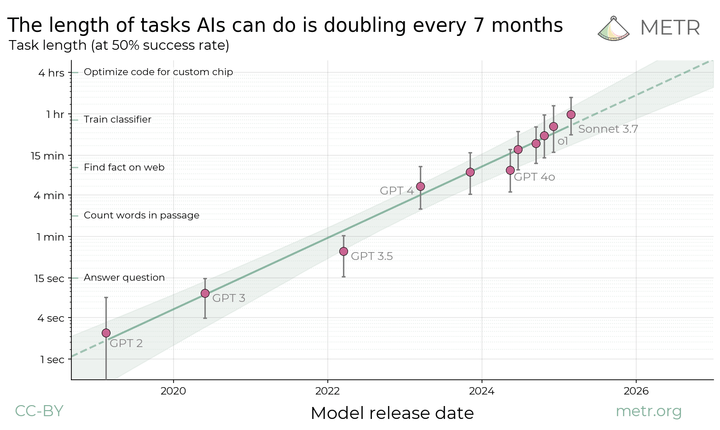
Measuring AI Ability to Complete Long Tasks
We propose measuring AI performance in terms of the *length* of tasks AI agents can complete. We show that this metric has been consistently exponentially increasing over the past 6 years, with a doubling time of around 7 months. Extrapolating this trend predicts that, in under a decade, we will see AI agents that can independently complete a large fraction of software tasks that currently take humans days or weeks.
Hyperagents
Self-improving AI systems aim to reduce reliance on human engineering by learning to improve their own learning and problem-solving processes. Existing approaches to self-improvement rely on fixed, handcrafted meta-level mechanisms, fundamentally limiting how fast such systems can improve. The Darwin Gödel Machine (DGM) demonstrates open-ended self-improvement in coding by repeatedly generating and evaluating self-modified variants. Because both evaluation and self-modification are coding tasks, gains in coding ability can translate into gains in self-improvement ability. However, this alignment does not generally hold beyond coding domains. We introduce \textbf{hyperagents}, self-referential agents that integrate a task agent (which solves the target task) and a meta agent (which modifies itself and the task agent) into a single editable program. Crucially, the meta-level modification procedure is itself editable, enabling metacognitive self-modification, improving not only the task-solving behavior, but also the mechanism that generates future improvements. We instantiate this framework by extending DGM to create DGM-Hyperagents (DGM-H), eliminating the assumption of domain-specific alignment between task performance and self-modification skill to potentially support self-accelerating progress on any computable task. Across diverse domains, the DGM-H improves performance over time and outperforms baselines without self-improvement or open-ended exploration, as well as prior self-improving systems. Furthermore, the DGM-H improves the process by which it generates new agents (e.g., persistent memory, performance tracking), and these meta-level improvements transfer across domains and accumulate across runs. DGM-Hyperagents offer a glimpse of open-ended AI systems that do not merely search for better solutions, but continually improve their search for how to improve.
PrimeIntellect-ai/prime-agent
A self-improving RLM agent for coding workflows and long-running autonomous tasks.
agentOS - Everything Agents Need to Run and Operate - Rivet
The complete platform for production AI agents. Stateful runtime, universal agent interface, and secure code execution. One SDK, one platform, deploy anywhere.
Groq On-demand Pricing for Tokens-as-a-Service
Groq powers leading openly-available AI models. View the pricing of our core models including GPT-OSS, Kimi K2, Qwen3 32B, and more.