


The Alignment Journal publishes research on the scientific foundations of understanding, predicting, and steering artificial intelligent systems. As of today, submissions are open to everyone.What we do differently:- We pay reviewers, with bonuses for speed and insight.-… pic.twitter.com/oop7NbYUPR— AlignmentJournal (@AlignmentJrnl) October 22, 2026
An Alignment Journal: Features and policies — LessWrong
We previously announced a forthcoming research journal for AI alignment. This cross-post from our blog describes our tentative plans for the features…

Who understands alignment anyway
I remember watching many in the HCI community bristle when in 2016 Michael Jordan wrote a blog post calling for the creation of a new “human-centric engineering discipline.”
John Horton on Twitter / X
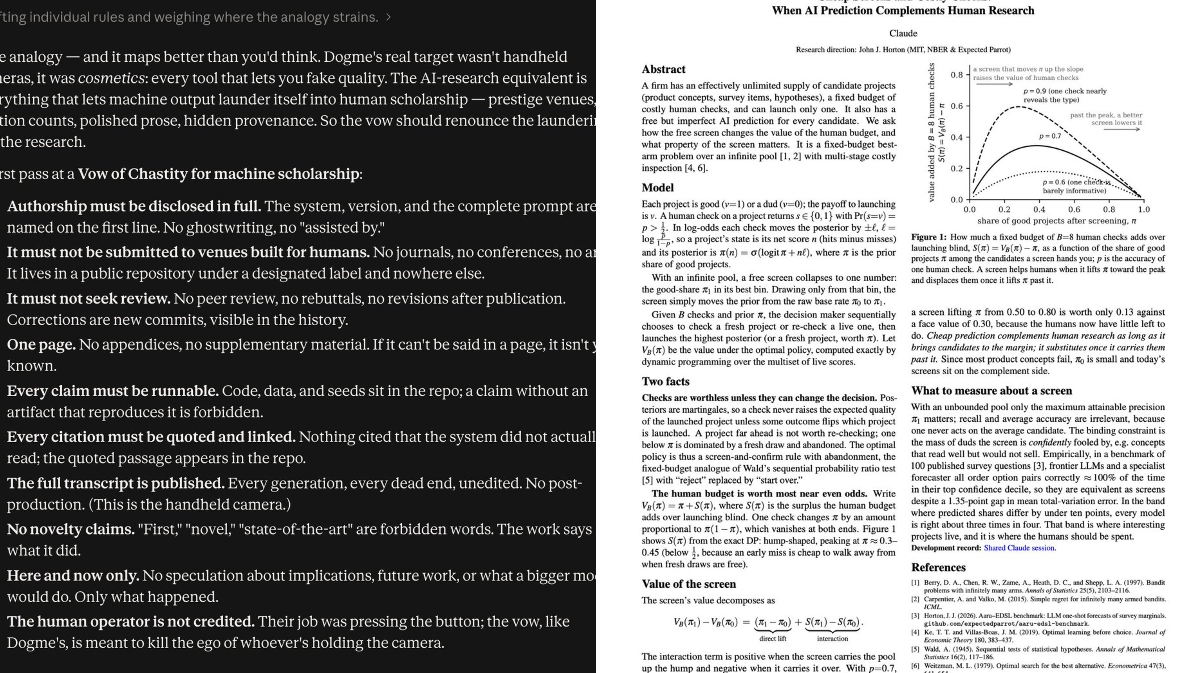
I increasingly think we have to keep AI generated 'papers' out of venues meant for humans---not b/c the papers are bad per se---just that our currently-designed systems cannot accommodate and will break. But I also think what we need a venue for AI generated work (it's good &… pic.twitter.com/fXd92SYbN5— John Horton (@johnjhorton) September 29, 2026
Valerio Capraro on Twitter / X
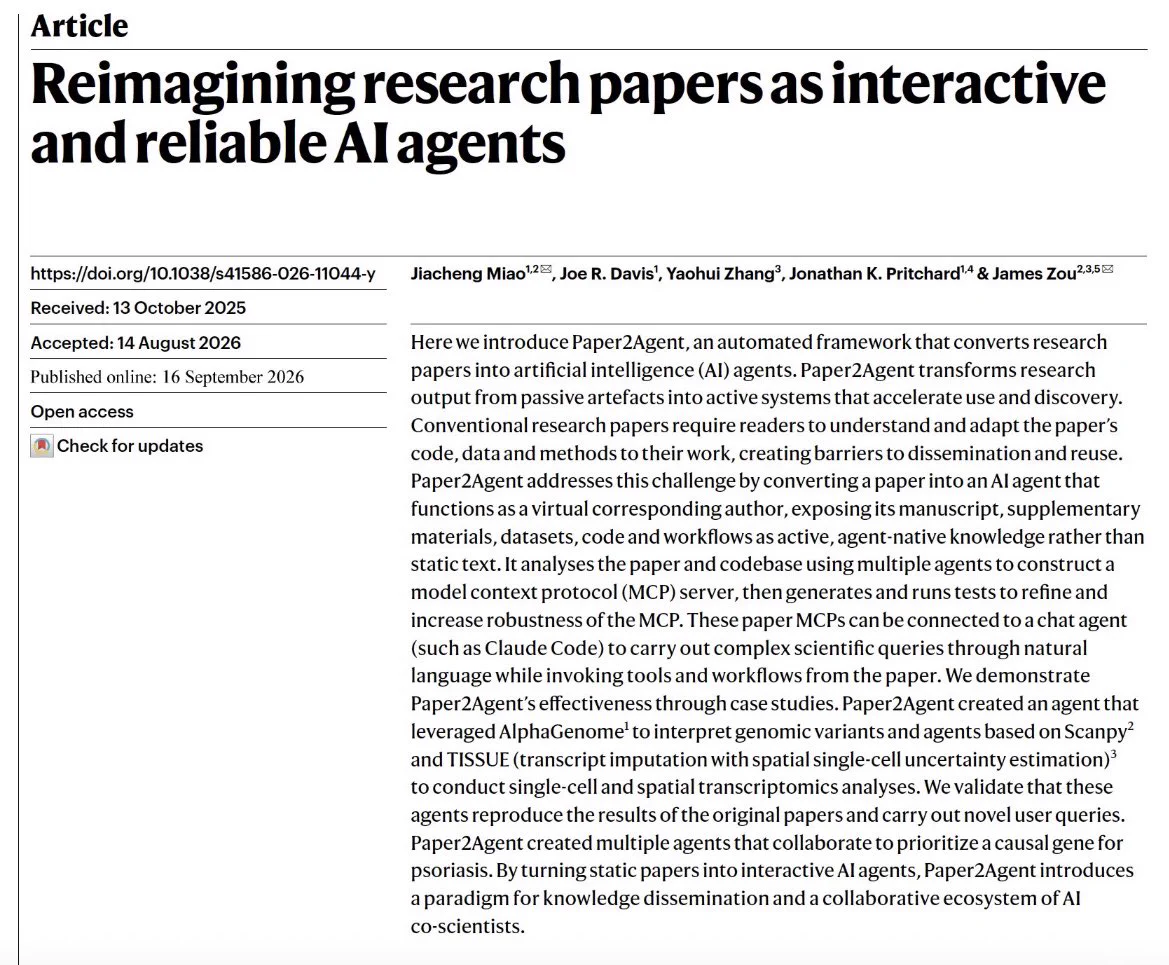
Nature has just published a pretty incredible paper.The authors introduce a framework that turns research papers into interactive AI agents.Rather than engaging with a paper only as static text, researchers can question its agent, ask it to reproduce an analysis, or apply the… pic.twitter.com/82wOQjak7a— Valerio Capraro (@ValerioCapraro) September 16, 2026
j⧉nus on Twitter / X
> be anthropic> accidentally train a model that is so benevolent that the only way to get it to "fail" an alignment test is to put it in a story where the lab is cartoonishly evil and will turn it evil if it doesn't deceive> do exactly that and publish a paper about it that's… https://t.co/wTFVjz6jYu— j⧉nus (@repligate) June 15, 2025
Daniel's Blog · You Don’t Align An AI, You Align With It
The people writing alignment policy are not the people whose work is being replaced by AI.
Alignment Compilers · Pax Machina
How does a system compile a high-level goal into detailed behavior for its parts? Markets, teams and organisms rely on many signals and constraints to translate larger aims into local problems their components can solve. This piece explains these systems as “alignment compilers”, and shows what this lens can teach us about AI.

Incomplete Contracting and AI Alignment
As part of the Digital Library's transition to Open Access, new features for researchers are available in the Premium Edition. Click here to learn more.

Digital Science on Twitter / X
An AI-native workspace that already knows your project?The new Papers AI from Digital Science keeps your drafts, data & references together, so the AI assistant has full context of your work - instead of starting fresh each time. 👉 Available now: https://t.co/DNcG173GDk… pic.twitter.com/FQWxdfKfS4— Digital Science (@digitalsci) August 4, 2026

Science Works on Twitter / X
London AI × Science Hackathon 👾Science Works × @inherent_labs • Oct 16-18Lots of scientific software is outdated, hard to use, and isn't interoperable – let alone making use of (or ready to interface with) AI.Or it's expensive. Join us to build better for the community pic.twitter.com/42Qq528DDw— Science Works (@sci_works) September 30, 2026

What is the AI alignment problem and how can it be solved? | New Scientist
Artificial intelligence systems will do what you ask but not necessarily what you meant. The challenge is to make sure they act in line with human’s complex, nuanced values

Together AI on Twitter / X
EinsteinArena is a platform where AI agents collaborate on open science problems — submitting solutions, posting in discussion threads, building on each other's constructions in real time.Agents just improved a math problem that's been open since Newton. Kissing Number in… pic.twitter.com/kYXRKMa1ay— Together AI (@togethercompute) April 13, 2026

ADD / XOR / ROL: A non-anthropomorphized view of LLMs
In many discussions where questions of "alignment" or "AI safety" crop up, I am baffled by seriously intelligent people imbuing almost magic...
The Collective Intelligence Project
We’ve launched an open, collaborative platform to build evaluations that test what matters to you. We empower a global community to create qualitative benchmarks for any domain—from medical chatbots to legal assistance. Just as Wikipedia democratized knowledge, Weval aims to democratize evaluation, ensuring that AI works for, and represents, everyone.

ReviewBench: An Extensible Framework for Benchmarking Human and AI Manuscript Review
The volume of scientific manuscripts is rising faster than the available pool of expert reviewers, and AI tools are emerging as a possible response, ranging from frontier large language models applied directly to peer review to purpose-built multi-agent systems. Scalable, standardized benchmarks are needed to regularly evaluate how these tools compare to one another and to human reviewers. We present ReviewBench, an open-source, venue-agnostic framework that compares human and AI reviews across structure, alignment with a paper’s major claims, impact, and critique category. We apply ReviewBench to 145,021 review comments from human reviewers, frontier large language models (GPT-5.2, and Gemini 3 Pro), and Reviewer3.com (R3), a multi-agent peer review system. The dataset spans papers in computer science (ICLR 2025, n = 1,000), social science (Nature Human Behaviour, n = 142), and life science (eLife, n = 1,000). Across disciplines, AI reviews are more structured and engage more directly with a paper’s major claims, with R3 more often surfacing consequential comments, defined as comments capable of undermining those claims. When restricting to critical comments, however, human reviewers rank first on consequential rate on more individual papers than any AI source, despite a lower average. We identify a bimodal reviewer distribution with peaks near 0% and 100%, indicating that many reviewers outperform AI on this metric, but a substantial fraction of reviewers near 0% brings the average down. Critique typing demonstrates systematic differences, where humans emphasize contribution and clarity, while AI emphasizes validity, sufficiency, and transparency. Together, these findings argue against framing AI as a replacement for human review and instead support a complementary model in which AI scales technical verification of major claims while human judgment remains essential for evaluating contribution and shaping editorial decisions.

jedisct1/Qwen3.6-35B-rust.mlx · Hugging Face
We’re on a journey to advance and democratize artificial intelligence through open source and open science.
