


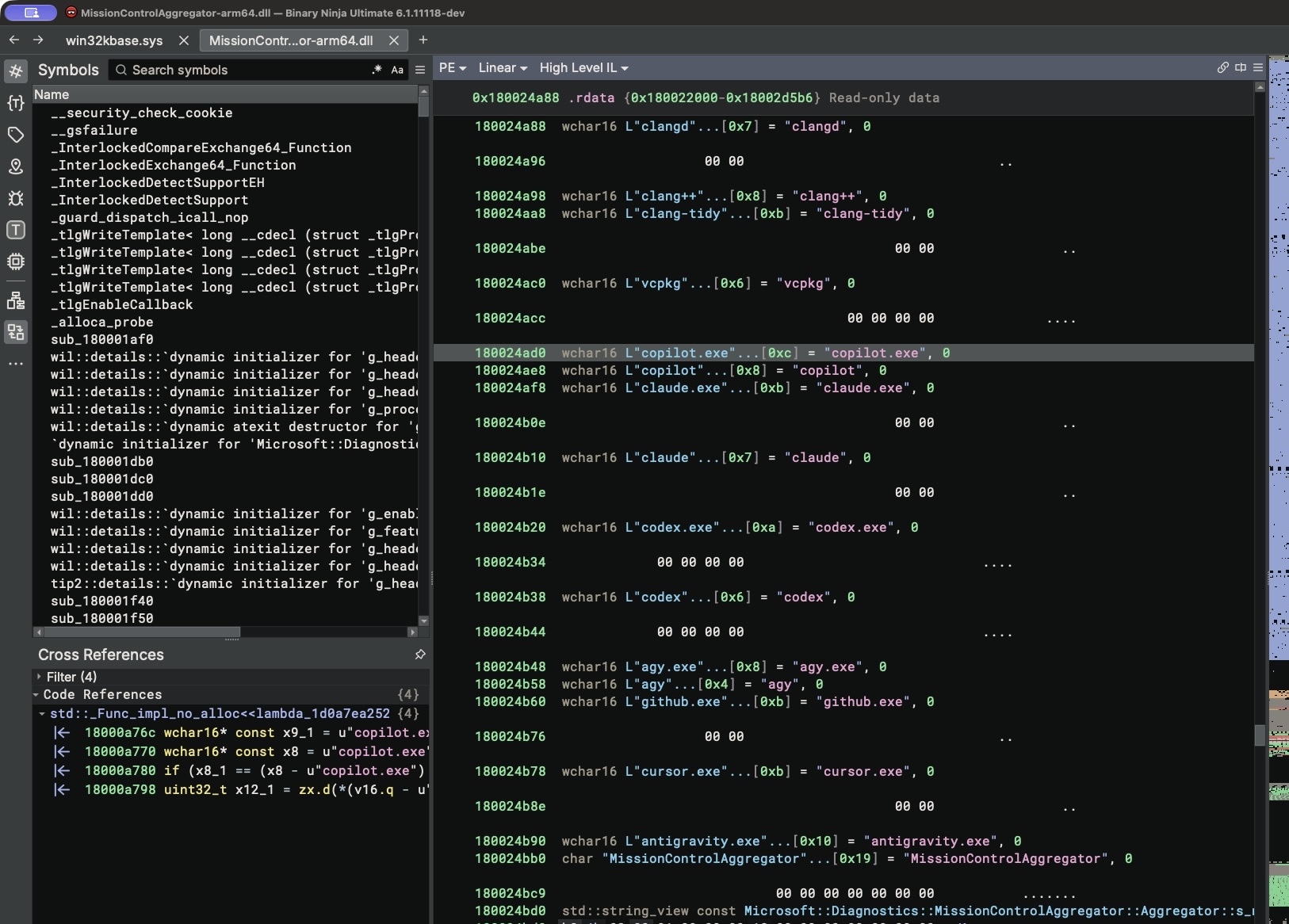
I found that Windows starts to collect your coding agent usage information. Windows 11 build 26200.9974 checks codex.exe, claude.exe, copilot.exe, cursor.exe, antigravity.exe, github.exe and agy.exe through MissionControlAggregator, then reports agent bitsets in ETW. pic.twitter.com/AYqA6xpLQZ— Crackmes.one (@CrackmesOne) November 16, 2026
Windows 11 Is Collecting Data on Which Coding Agents and Developer Tools You Use
Reverse engineering Windows 11's MissionControlAggregator reveals coding-agent and developer-tool usage bits in a diagnostic ETW report.
Cognition | Agent Trace: Capturing the Context Graph of Code
We’re excited to join in Cursor, Cloudflare, Vercel, git-ai, OpenCode and others in support of [Agent Trace](https://agent-trace.dev/). As described in the spec, Agent Trace is an open, vendor-neutral spec for recording AI contributions alongside human authorship in version-controlled codebases.
The Coding Agent Data Deal
On user data control, coding agents as retrievers, and the value of your coding transcripts

The Coding Agent Data Deal
On user data control, coding agents as retrievers, and the value of your coding transcripts
Agent READMEs: An Empirical Study of Context Files for Agentic Coding
Agentic coding tools receive goals written in natural language, break them down into specific tasks, and write or execute code with minimal human intervention. Central to this process are agent context files (e.g., AGENTS.md and CLAUDE.md) that provide persistent, project-level instructions. In this paper, we conduct the first large-scale empirical study of 2,303 agent context files from 1,925 repositories to characterize their structure, maintenance, and content. We find that these files are not static documentation but complex, difficultto-read artifacts that evolve like configuration code through frequent, small additions. Our content analysis of 16 instruction types shows that developers prioritize functional context, such as test procedures (75.9%), implementation details (70.8%), and architecture (68.1%). We also identify a significant gap: non-functional requirements such as security (14.8%) and performance (14.5%) are rarely specified. These findings indicate that while developers use context files to make agents functional, they provide few guardrails to ensure that agent-written code is secure or performant, highlighting the need for improved tools and practices.

Securing the Model Context Protocol: Building a safer agentic future on Windows
As AI agents become more capable and integrated into daily workflows, the need for secure, standardized communication between tools and agents has never been greater. At Microsoft Build 2025, we’re announcing an early preview of how Windows 11 is e

Microsoft's open source tools were hacked to steal passwords of AI developers | TechCrunch
Microsoft shut down dozens of GitHub code repositories for Azure and AI coding tools after a reported hack.

AI Coding Agents: Adoption Trends - The JetBrains Blog
How many developers use AI coding agents (Claude Code, Codex, Cursor, JetBrains Junie, and others)? Evidence from the Developer Ecosystem Survey 2026.
GitHub - jarrodwatts/claude-hud: A Claude Code plugin that shows what's happening - context usage, active tools, running agents, and todo progress
A Claude Code plugin that shows what's happening - context usage, active tools, running agents, and todo progress - jarrodwatts/claude-hud
What I Found Interesting in Claude Code's Source
A breakdown of the most interesting engineering patterns in Claude Code's leaked source code: composable system prompts, runtime instruction injection, context compression, forking, prompt caching architecture, and more.
perplexityai/SPACE
Sandboxed Platform for Agentic Code Execution: pluggable-runtime sandboxes for running agent and user code in isolation.
perplexityai/SPACE
Sandboxed Platform for Agentic Code Execution: pluggable-runtime sandboxes for running agent and user code in isolation.
Adoption and Impact of Command-Line AI Coding Agents: A Study of Microsoft's Early 2026 Rollout of Claude Code and GitHub Copilot CLI
Organizations rolling out agentic command line tools like Anthropic's Claude Code and GitHub's Copilot CLI need to know who will try them, who will keep using them, and whether the tools produce enough output to justify their cost. At organizational scale, token spend can run into millions of dollars annually, so misreading adoption, retention, or impact can make a rollout expensive without changing engineering velocity. Studying tens of thousands of engineers at Microsoft over its early-2026 rollout, we find that first use spread primarily through social networks, retention was associated more with engineers' coding activity than with demographics, and adopters merged roughly 24% more pull requests than they would have otherwise. We use merged pull requests as our proxy for output -- acknowledging that a merged PR is not the same as the value it delivers -- and the lift persists across our four-month window. These results suggest that CLI coding agents are neither uniformly adopted nor mere novelty effects and that organizations should treat visible peer use as central to rollout strategy.
Supported agents – Every coding agent Paseo runs
Run Claude Code, Codex, Copilot, OpenCode, Cursor CLI, Gemini CLI, and dozens more coding agents from your phone. Self-hosted, your code stays on your machine.
