

Intelligence is highly pluralistic. People can have high levels of it in one domain (maths, abstract reasoning) while being deficient in other domains (ethics, social interaction). When one kind of intelligence gets heavily socially valorised among all others, it encourages the…— John Tasioulas (@JTasioulas) October 6, 2026
Valerio Capraro on Twitter / X
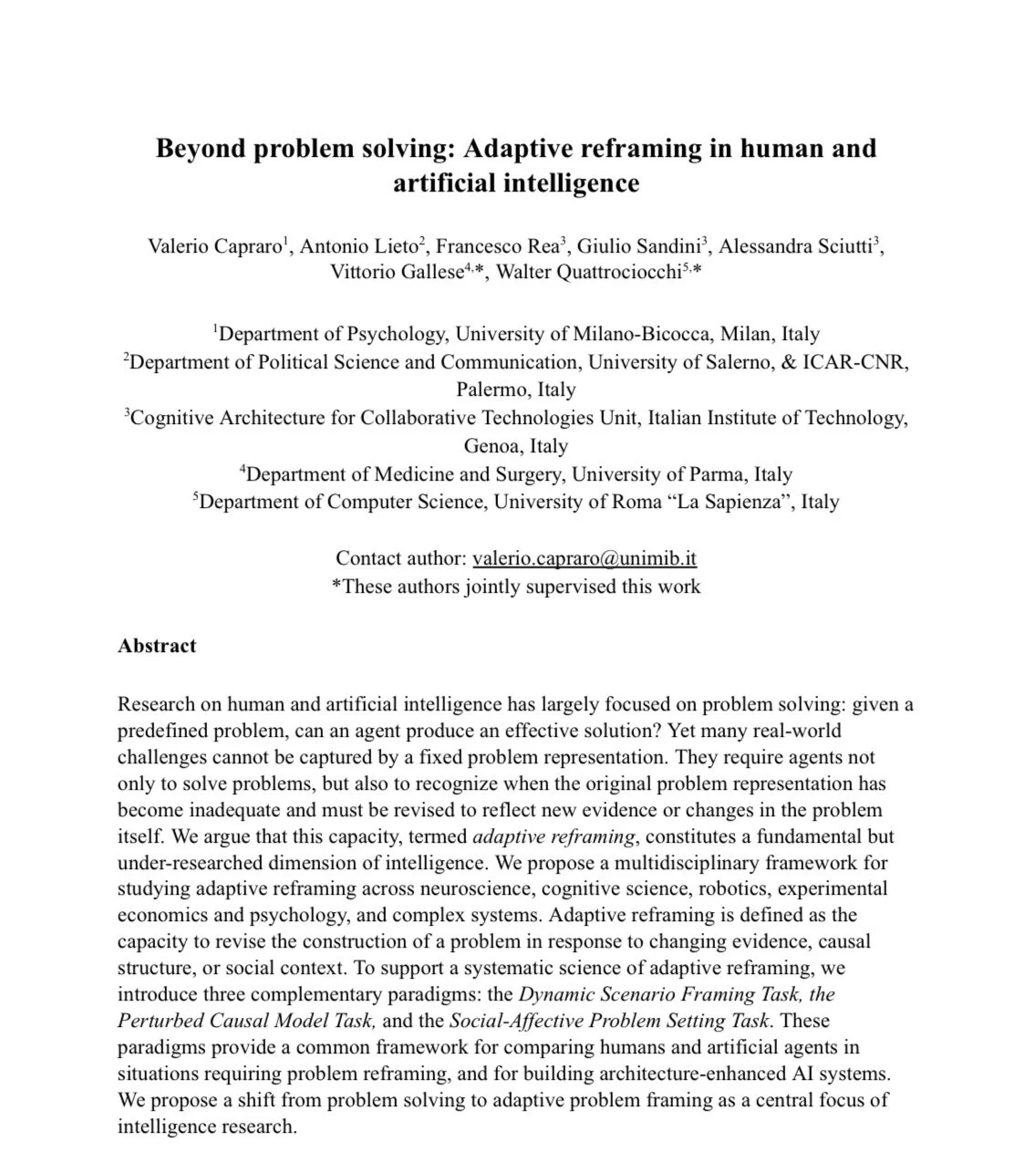
I’m very proud of this new preprint.We start from a simple observation: most research on human and artificial intelligence treats intelligence as problem solving.The problem can be extremely difficult. But it’s already defined.In the real world, we often have to figure out… pic.twitter.com/ckIJ3yenGv— Valerio Capraro (@ValerioCapraro) October 5, 2026
Alex Imas on Twitter / X
Intelligence is not enough to flourish. You need intelligence and well-functioning economic institutions. Even as AI capabilities continue to massively improve, if they are confronted by sclerotic, inefficient, and outdated institutions, they will do far less for prosperity than… https://t.co/0ZhscpPypH— Alex Imas (@alexolegimas) August 9, 2026
Guy on Twitter / X
If the "price" of intelligence is going to zero, what does that do to the "prices" of rationality, and of wisdom? pic.twitter.com/d0TR3SITfJ— Guy (@nosilverv) June 8, 2026

[Keynote 05] Unlocking Social Intelligence in AI Agents
Beyond the Individual: Understanding the Evolution of Collective Intelligence
This chapter outlines the evolution of collective intelligence, starting from its ancient roots and concluding with modern digital platforms. It discusses intelligence theories, project examples, and the impact of technology on collaborative efforts. Key focuses include the role of the internet and online communities in boosting our collective IQ, with a particular emphasis on Douglas Engelbart's contributions and the open-source movement, as exemplified by Linux's development. The chapter examines how digital transformation has facilitated new forms of community and knowledge sharing, significantly influencing fields such as management, decision-making, and organizational learning. Various scholars and their definitions of CI are discussed, including Pierre Lévy's vision of universally distributed intelligence and the concept of swarm intelligence in biological sciences. We then move on to practically implemented CI projects, exploring crowdsourcing as a manifestation of CI in business and social projects and examining possibilities of harnessing the wisdom of crowds for problem-solving and innovation. The chapter concludes with a presentation of the current state of collective intelligence academic research.

All intelligence is collective intelligence
Author: Falandays, J. Benjamin et al.; Genre: Journal Article; Published online: 2023-04-28; Open Access; Keywords: Collective intelligence, self-organization, multicellularity, neural Darwinism, behavioral coordination, cultural evolution; Title: All intelligence is collective intelligence
Pluralistic: Social media without socializing (19 Jan 2026) – Pluralistic: Daily links from Cory Doctorow
From the earliest days of social media, social media bosses have been at war with sociability. To create a social media service is to demarcate legitimate and illegitimate forms of sociability. It's a monumental act of hubris, really.
Commodity Intelligence
The seductiveness of “general intelligence” is rooted in a costly category error

Social Media and Anti-Social Pluralism - Aaron Ross Powell
Communities are different online and off, and pluralism that thrives in the real world can turn toxic in the digital world.
Socially Minded Intelligence: How Individuals, Groups, and Artificial Intelligence Can Make Each Other Smarter (or Not)
A core part of human intelligence is the ability to work flexibly with others to achieve goals. The incorporation of artificial agents into human spaces is making increasing demands on artificial intelligence (AI) to demonstrate and facilitate this ability. However, this kind of flexibility is not well understood because existing approaches to intelligence typically construe this either as an individual-difference trait or as a property of groups. We argue that by focusing either on individual or collective intelligence without considering their dynamic interaction, existing conceptualizations of intelligence limit the potential of people and AI systems. To address this impasse, we propose a new kind of intelligence, 'socially minded intelligence', that can be applied to both individuals and collectives. We outline how socially minded intelligence might be measured and cultivated within people, how it might be modelled in AI agents, and how it might be applied to other intelligent systems.

Agentic AI and the next intelligence explosion
For decades, the artificial intelligence (AI) “singularity” has been heralded as a single, titanic mind bootstrapping itself to godlike intelligence, consolidating all cognition into a cold silicon point. But this vision is almost certainly wrong in its most fundamental assumption. If AI development follows the path of previous major evolutionary transitions or “intelligence explosions,” our current step-change in computational intelligence will be plural, social, and deeply entangled with its forebears (us!).

Intelligence | The Paper Pilot
The Paper Pilot's digital garden of thoughts on philosophy, politics, and sociology
Pluralistic: The online community trilemma (16 Feb 2026) – Pluralistic: Daily links from Cory Doctorow
The digital humanities are one of the true delights of this era. Anthropologists are counting things like sociologists, sociologists are grappling with qualitative data like ethnographers, computational linguists are scraping and making sense of vast corpora of informal speech:
John Horton on Twitter / X
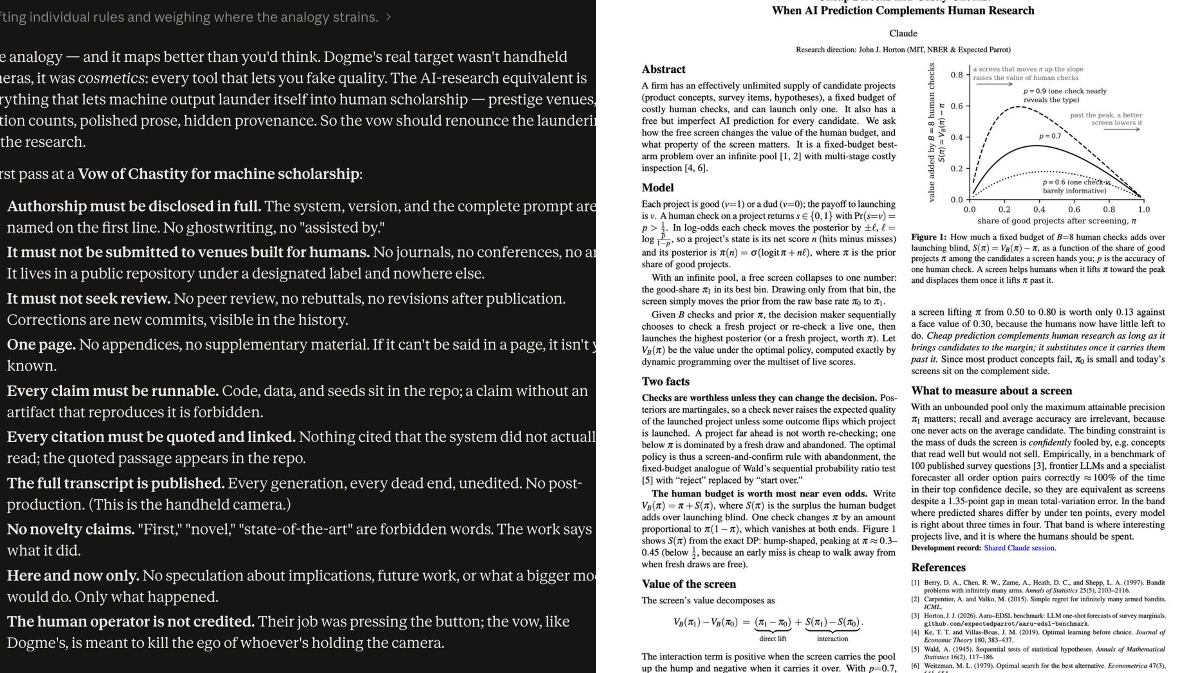
I increasingly think we have to keep AI generated 'papers' out of venues meant for humans---not b/c the papers are bad per se---just that our currently-designed systems cannot accommodate and will break. But I also think what we need a venue for AI generated work (it's good &… pic.twitter.com/fXd92SYbN5— John Horton (@johnjhorton) September 29, 2026
Livetweet @mcxfrank.bsky.social talk: If we care about intelligence and cognition, AI has recently allowed a change; we now have two ways to study them. AI is of course allowing us a lot that we wouldn't dare on our Children (brain surgery, never tell a child about cats...) #acl #conll
Collective Intelligence Research

Explorations into the idea that a group of humans is "more intelligent" than the sum of their "IQ" (i.e. "groups of individuals doing things collectively that seem intelligent")
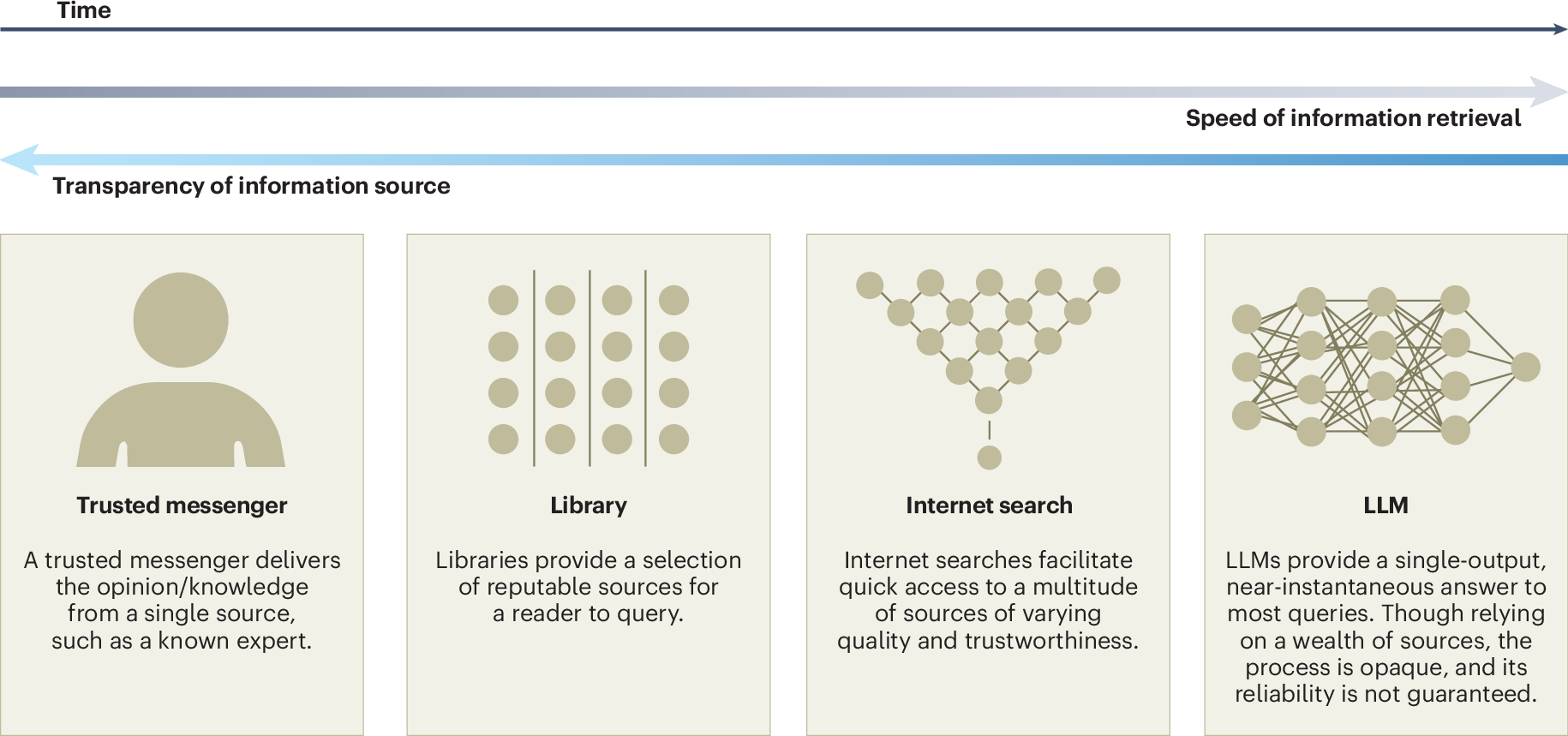
How large language models can reshape collective intelligence

Sharing Notes about Collective Intelligence — Pop Junctions
Socially Minded Intelligence: How Individuals, Groups, and Artificial Intelligence Can Make Each Other Smarter (or Not)

Profile: Adrien Treuille

NOVA | The Wisdom of the Crowds | Season 45 | Episode 6
Mapping Citizen Science through the Lens of Human-Centered AI
