


wtf is this way to handle mathematicians work and scientific communicationTLDR: Leven and Tristan worked over several months on one of the Millenium Prize Problems with various AIs to reach final interesting results. OpenAI apparently heard about it in the last days and… https://t.co/zNozwkFcFO pic.twitter.com/XcefJ17AQe— Thomas Wolf (@Thom_Wolf) September 8, 2026
Thomas Wolf on Twitter / X
Very thoughtful piece from Kevin Buzzard (perfect IMO score, number theorist, pioneer of formal maths in Lean)if math is not just about “human understanding,” then what is it about?and if ai capabilities keep growing exponentially what happens since “mathematics is infinite”? https://t.co/h7yYmZS01T pic.twitter.com/wFp2fec52Q— Thomas Wolf (@Thom_Wolf) October 2, 2026

OpenAI accused of stealing math proof from expert Andreas Thom | Valerio Capraro posted on the topic | LinkedIn
BREAKING: OpenAI might have stolen another major proof. In a detailed Mathstodon post, which I report in full in the comments, Andreas Thom presents several pieces of evidence suggesting that OpenAI may have trained Astra on conversations in which he and Gábor Kun were working on Gromov’s soficity conjecture, one of the ten problems OpenAI later announced Astra had solved. I know Andreas. We met several times early in our careers. He is an exceptional mathematician, a leading expert on sofic and hyperlinear groups, and one of the most respected scholars in the field. He has spent two decades working on this problem. If his account is correct, this is not a minor dispute over attribution. It would mean that unpublished human work was absorbed into a model and then presented to the world as a breakthrough by the model itself. And if the allegations raised by Levent Alpöge, Tristan Buckmaster, and now Andreas Thom are all substantiated, we are no longer looking at isolated incidents. We may be looking at one of the greatest intellectual scandals in the history of science. AI is not discovering new mathematics. AI is stealing human discovery. | 201 comments on LinkedIn

Can AI replace mathematicians? Vienna researchers weigh in
In September, OpenAI announced that some 10,000 AI agents partially 'solved' the Navier–Stokes problem, one of the most prestigious open challenges in mathematics. University of Vienna mathematicians Nathanaël Berestycki and Vera Fischer agree that the field will never be the same, but argue that maths is far more than producing proofs at speed.

John Horton on Twitter / X
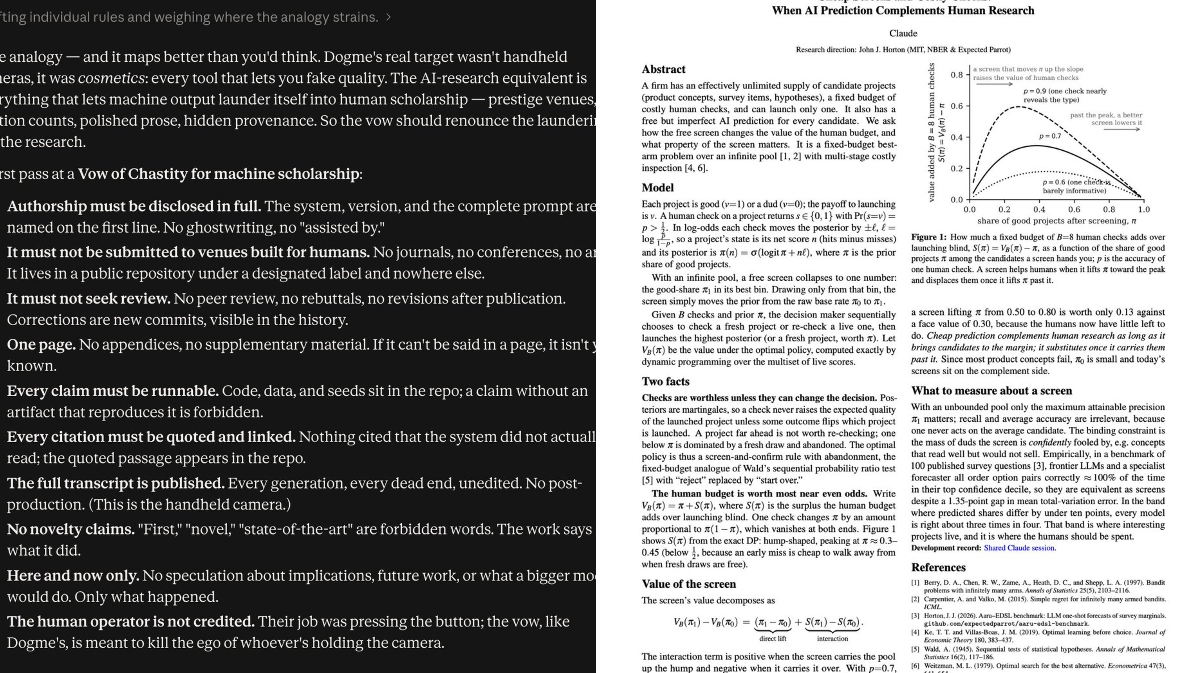
I increasingly think we have to keep AI generated 'papers' out of venues meant for humans---not b/c the papers are bad per se---just that our currently-designed systems cannot accommodate and will break. But I also think what we need a venue for AI generated work (it's good &… pic.twitter.com/fXd92SYbN5— John Horton (@johnjhorton) September 29, 2026
Together AI on Twitter / X
EinsteinArena is a platform where AI agents collaborate on open science problems — submitting solutions, posting in discussion threads, building on each other's constructions in real time.Agents just improved a math problem that's been open since Newton. Kissing Number in… pic.twitter.com/kYXRKMa1ay— Together AI (@togethercompute) April 13, 2026
The Math Superstar Who’s Terrified of AI—and Just Took a Job at OpenAI
Jacob Tsimerman won the biggest prize in math. Now he’s working on the most important problem of his career.

OpenAI Just Claimed a Huge Math Discovery. Some Academics Are Crying Foul
A landmark announcement by the frontier AI lab has been overshadowed by accusations of impropriety.

Mathematicians are grappling with the possibility that AI might eclipse them
I talked to 20 mathematicians about rapid AI progress in their field.
AI co-mathematician: Accelerating mathematicians with agentic AI
We introduce the AI co-mathematician, a workbench for mathematicians to interactively leverage AI agents to pursue open-ended research. The AI co-mathematician is optimized to provide holistic support for the exploratory and iterative reality of mathematical workflows, including ideation, literature search, computational exploration, theorem proving and theory building. By providing an asynchronous, stateful workspace that manages uncertainty, refines user intent, tracks failed hypotheses, and outputs native mathematical artifacts, the system mirrors human collaborative workflows. In early tests, the AI co-mathematician helped researchers solve open problems, identify new research directions, and uncover overlooked literature references. Besides demonstrating a highly interactive paradigm for AI-assisted mathematical discovery, the AI co-mathematician also achieves state of the art results on hard problem-solving benchmarks, including scoring 48% on FrontierMath Tier 4, a new high score among all AI systems evaluated.

OpenAI’s latest math breakthroughs commit research misconduct, experts say
OpenAI released 10 AI-generated results over the weekend. Some mathematicians are unhappy with their approach
Ale×ey on Twitter / X
Funniest possible outcome of new ai math proofs publications would be that explosive progress cannot be delivered through individual genius and singular products but only through contextualized human understanding and embedding of knowledge.— Ale×ey (@EqualParallel) October 7, 2026
No. 008: AI co-mathematician, compiler-verified protocols, open infrastructure bets - The Hallway Track
The Hallway Track No. 008 - How AI is affecting the practice of science
Talia Ringer 🕊🪬 on Twitter / X
Poured my heart and soul into advocating for formal proof with AI assistance in a mathematical setting because of the large collaborations I thought it could empower. (1/3)— Talia Ringer 🕊🪬 (@TaliaRinger) September 10, 2026
No. 020: Astra solves ten open math problems, AI agents fail at open-ended research, peer review under strain - The Hallway Track
The Hallway Track No. 020 - How AI is affecting the practice of science
Mathematician catches AI-generated research error by OpenAI president | Benjamin Golub posted on the topic | LinkedIn
In case you think the problem of science slop is hypothetical, here's something that happened on X yesterday: The president of OpenAI sharing wrong science slop as proud evidence of the power of mathematical AI. Within a day, the mathematician Tony Feng found a gap that undercut the paper's central argument; the author conceded, and (to his credit!) Brockman deleted the tweet as soon as he became aware. Feng was a hero to catch this. The author of the refuted claim is a mathematician but a self-described outsider to this area, with a prior big claim posted and quickly withdrawn. Greg Brockman is not an expert, either. Neither could check what they were amplifying. Heroes catching errors one at a time won't hold against the volume of AI-generated research now coming. We need an automated, independent verification layer for knowledge work, which is what we're building at Refine (refine.ink). Passing such verification should become a necessary step before big claims, especially outside one's own expertise. A link to a bigger-picture post on this is in the comments. | 23 comments on LinkedIn

Remarkable how over a decade ago @michaelnielsen.bsky.social pointed the way towards solving long standing issues plaguing science to this day (issues that are all the more relevant in the age of AI mediated science)

Ronen Tamari
This is why @atproto.science is so relevant rn This compilation of essays indicates that scientists are most frustrated by insufficient “community tools and resources... Essential infrastructure for sharing, maintaining and building on existing work and data is also badly underdeveloped." >