

Nope. This paper is about US academics 1900-1960! The present looks different.Asking people to stop drawing inference from these stats as if they're about the present& asking authors to put time period in their title and abstract!🙏 https://t.co/bphnK6Hy7H— Anna Stansbury (@annastansbury) December 31, 2024
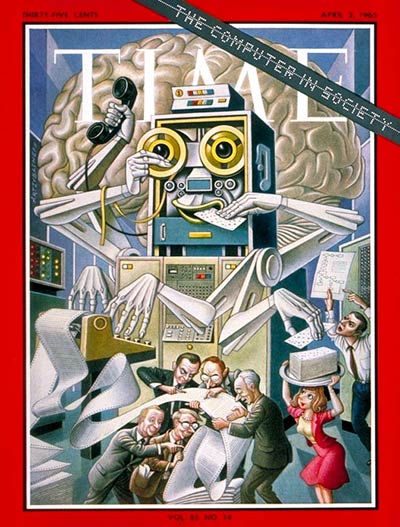
TIME Magazine Cover: Computer in Society - Apr. 2, 1965
TIME Magazine Cover: Computer in Society
Does Your Brain Think Accurately About Time?
Chicago Booth’s Kristin Donnelly talks about her research on time-duration asymmetry.


Dylan Wiliam on Twitter / X
The best journal article titles tell you what the study actually found, rather than being a teaser to make you read the paper. Here's a good example: "Spaced mathematics practice improves test scores and reduces overconfidence" https://t.co/iXxdkAgYPM ($)— Dylan Wiliam (@dylanwiliam) December 31, 2024
Memetics Timeline
The material here is partly derived from the "History of memetics" chapter in my 2011 "Memetics" book - and partly derived from my memetics booklist.
Speculations on the Future of the Scientific Method
The following essay was published 20 years ago (January, 2006) on my blog The Technium. I edited the intro here, but the speculations are basically unchanged.

annotations: Pourquoi l’histoire économique est essentielle à la science économique
Blog de sciences économiques et sociales de Martin Anota. Traductions, revues de presse.
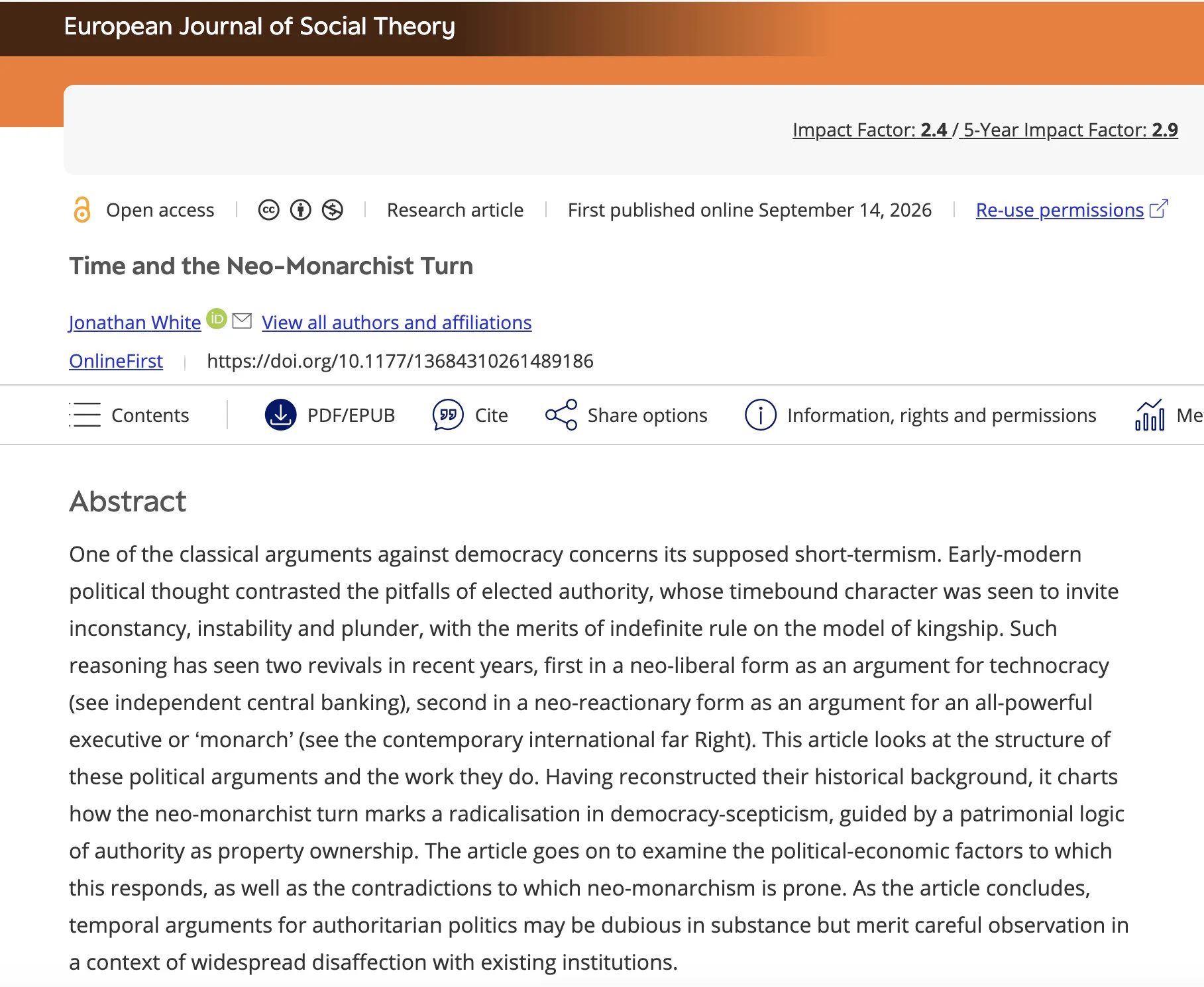
Jonathan White on Twitter / X
New article of mine - 'Time and the Neo-Monarchist Turn', European Journal of Social Theoryhttps://t.co/DjewlLoGp3 pic.twitter.com/w4pS4vFmeE— Jonathan White (@JonathanPJWhite) September 15, 2026
Sᴜɴʀɪsᴇ Oᴀᴛʜ 十 Tʜᴇ Sʏʟʟᴀʙᴜꜱ (ORI) - CC0 on Twitter / X
It is significant that the passage of time involves the continuous transfer of data from one timestamp to another.— Sᴜɴʀɪsᴇ Oᴀᴛʜ 十 Tʜᴇ Sʏʟʟᴀʙᴜꜱ (ORI) - CC0 (@sunriseoath) September 23, 2026
How we got here
Wherein our hero, in this publication's inaugural, dates himself (as if others would) in a reminiscence of computers and websites past.
32 Years of New York Times Website Design History - 23 Images - Version Museum
A comprehensive visual history of New York Times from 1994 to 2026. See a gallery of the New York Times evolution from the beginning to present day.

In search of Spime Script ...
The rants and raves of Simon Wardley on Evolution, Technology, Economics and Business
The Best Years of Our Lives - YAMDAS現更新履歴
「"わたしがおまえたちを滅ぼすとして、それがおまえたちとなんの関係がある?"」 (劉慈欣『三体Ⅱ 黒暗森林』) はじめに この文章は、2020 Advent Calendar 2020 の第21日目の記事として書かれています。昨日は june29 さん、明日は pbn broadcast さんです。 2019年のこと …

An update on leap seconds – Tony Finch
It has been a couple of years since my previous blog post about leap seconds, though I have been tweeting on the topic fairly frequently: see my page on date, time, and leap seconds for an index of threads. But Twitter now seems a lot less likely to stick around, so I’ll aim to collect more of my thinking-out-loud here on my blog.
The present no longer lasts long enough to be a setting. All fiction is either science fiction or historical fiction. I've been saying this for long enough that even this statement itself is no longer true. The future doesn't last long enough either. All science fiction is now retrofuturism.
"Historical pragmatism and the internet" by James Carey (2005) journals.sagepub.com/doi/10.1177/1461444805054107

