

Remember that you, by definition, cannot distinguish between a good idea and a failure of your own knowledge, judgement, or taste. This is why external (ideally expert) feedback is crucial— Michael Baym (@baym) March 25, 2026
Valerio Capraro on Twitter / X
Our new paper shows that AI destroys the wisdom of uncertainty.The willingness to say “I don’t know” collapses from 44% to 3%.This happens even when the AI’s advice is wrong. Consequently, correct answers fall from 27% to 9%.Yes: some people who would otherwise answer… pic.twitter.com/l0YZ75IFHn— Valerio Capraro (@ValerioCapraro) August 10, 2026
Algorithm appreciation: People prefer algorithmic to human judgment
Even though computational algorithms often outperform human judgment, received wisdom suggests that people may be skeptical of relying on them (Dawes, 1979). Counter to this notion, results from six experiments show that lay people adhere more to advice when they think it comes from an algorithm than from a person. People showed this effect, what we call algorithm appreciation, when making numeric estimates about a visual stimulus (Experiment 1A) and forecasts about the popularity of songs and romantic attraction (Experiments 1B and 1C). Yet, researchers predicted the opposite result (Experiment 1D). Algorithm appreciation persisted when advice appeared jointly or separately (Experiment 2). However, algorithm appreciation waned when: people chose between an algorithm’s estimate and their own (versus an external advisor’s; Experiment 3) and they had expertise in forecasting (Experiment 4). Paradoxically, experienced professionals, who make forecasts on a regular basis, relied less on algorithmic advice than lay people did, which hurt their accuracy. These results shed light on the important question of when people rely on algorithmic advice over advice from people and have implications for the use of “big data” and algorithmic advice it generates.
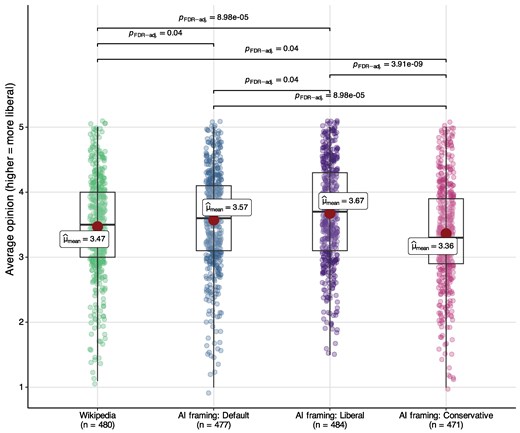
How latent and prompting biases in AI-generated historical narratives influence opinions
Abstract. Large language models (LLMs) can be used to persuade people on a range of issues, particularly through user-driven strategies such as personalizi
Illusions of Understanding from Outsourcing Thinking to LLMs
Some illusions of understanding are an inevitable part of the research process, while others can be avoided or overcome by careful critical thinking and observation. We are facing an increased risk of avoidable illusions as more research activities are delegated to large language models (LMM). LLMs can be useful but they cannot think, and their use can undermine our thinking and understanding. Thinking for ourselves is hard and error prone but worthwhile - and there are no shortcuts to understanding.
People are not friction
The Gell-Mann Amnesia Effect of AI is a pretty well documented phenomenon: The Gell-Mann amnesia effect is a cognitive bias describing the tendency of individuals to critically assess media reports in a domain they are knowledgeable about, yet continue to trust reporting in other areas despite recognizing similar potential inaccuracies.
Chesterton’s Fence: A Lesson in Thinking
A core component of making great decisions is understanding previous decisions. If we don’t understand how we got “here,” we run the risk of making things much worse.

Mindful Judgment and Decision Making
A full range of psychological processes has been put into play to explain judgment and choice phenomena. Complementing work on attention, information integration, and learning, decision research over the past 10 years has also examined the effects of goals, mental representation, and memory processes. In addition to deliberative processes, automatic processes have gotten closer attention, and the emotions revolution has put affective processes on a footing equal to cognitive ones. Psychological process models provide natural predictions about individual differences and lifespan changes and integrate across judgment and decision making (JDM) phenomena. “Mindful” JDM research leverages our knowledge about psychological processes into causal explanations for important judgment and choice regularities, emphasizing the adaptive use of an abundance of processing alternatives. Such explanations supplement and support existing mathematical descriptions of phenomena such as loss aversion or hyperbolic discounting. Unlike such descriptions, they also provide entry points for interventions designed to help people overcome judgments or choices considered undesirable.

“The problem is Sam Altman”: OpenAI insiders don’t trust CEO
OpenAI brainstorms ways AI can benefit humanity in effort to counter bad vibes.

How cognitive elaboration fosters knowledge acquisition on social media—a field experiment
Abstract. Social media technologies have been criticized as ineffective sources of information because users seem to increase their subjective but not thei
The mistake we all make... and the simple experiment that reveals it
Your answer reveals how you see the world – and the common error that hampers our decision making. In an extract from his new book, psychologist Richard Nisbett reveals the ‘mindware’ to help us think smarter

The Expert Trap and the Next War
what forecasting failure tells us about the future

Reversing Assumptions Technique — Think Jar Collective
Think Jar Collective contributor and creativity expert Michael Michalko shares a technique to challenge our own assumptions and in the process spark new thinking.

We Have Never Taught Critical Thinking (opinion)
AI just makes those failures evident.

The Retweeting Class
I have often found myself confounded by the behaviour of some people who seem impervious to reality — like the people still on X today. Here, I try to understand what grounds their epistemology and its consequences, and what that means for the rest of us. Being committed to a better future is where genuine seriousness is, and that seriousness can only be approached in a spirit of embodied, determined, relentless hope.

Trust and reliance on AI — An experimental study on the extent and costs of overreliance on AI
Decision-making is undergoing rapid changes due to the introduction of artificial intelligence (AI), as AI recommender systems can help mitigate human flaws and increase decision accuracy and efficiency. However, AI can also commit errors or suffer from algorithmic bias. Hence, blind trust in technologies carries risks, as users may follow detrimental advice resulting in undesired consequences. Building upon research on algorithm appreciation and trust in AI, the current study investigates whether users who receive AI advice in an uncertain situation overrely on this advice — to their own detriment and that of other parties. In a domain-independent, incentivized, and interactive behavioral experiment, we find that the mere knowledge of advice being generated by an AI causes people to overrely on it, that is, to follow AI advice even when it contradicts available contextual information as well as their own assessment. Frequently, this overreliance leads not only to inefficient outcomes for the advisee, but also to undesired effects regarding third parties. The results call into question how AI is being used in assisted decision making, emphasizing the importance of AI literacy and effective trust calibration for productive deployment of such systems.
