

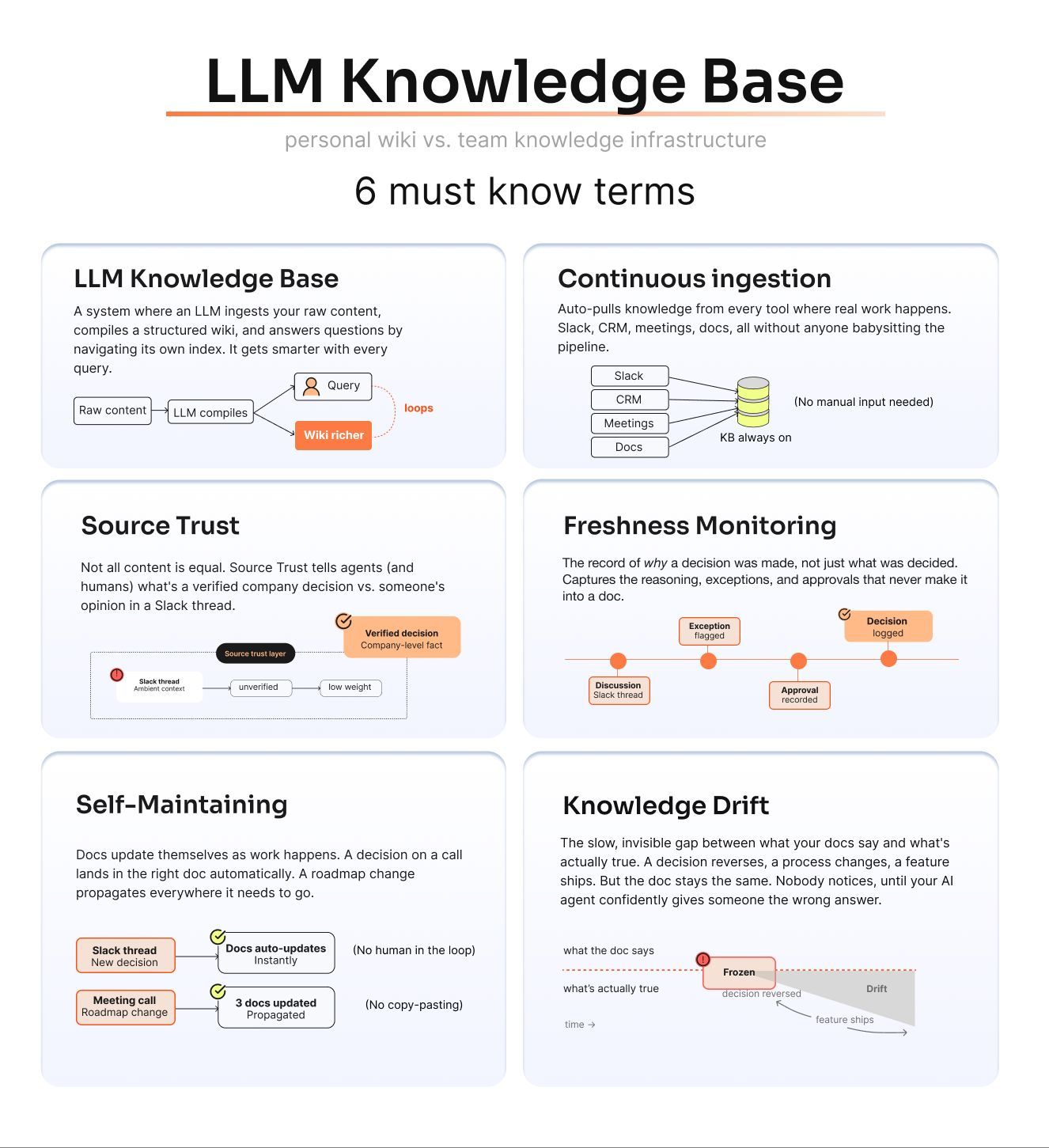
6 LLM Knowledge Base terms you need to know in 2026:(Most teams are missing at least 3, their AI agents pay the price)𝟭. 𝗟𝗟𝗠 𝗞𝗻𝗼𝘄𝗹𝗲𝗱𝗴𝗲 𝗕𝗮𝘀𝗲 A system where an LLM ingests your raw content, compiles a structured wiki, and answers questions by navigating its own… pic.twitter.com/dFXvBpC8hr— Femke Plantinga (@femke_plantinga) April 30, 2026
himanshu on Twitter / X
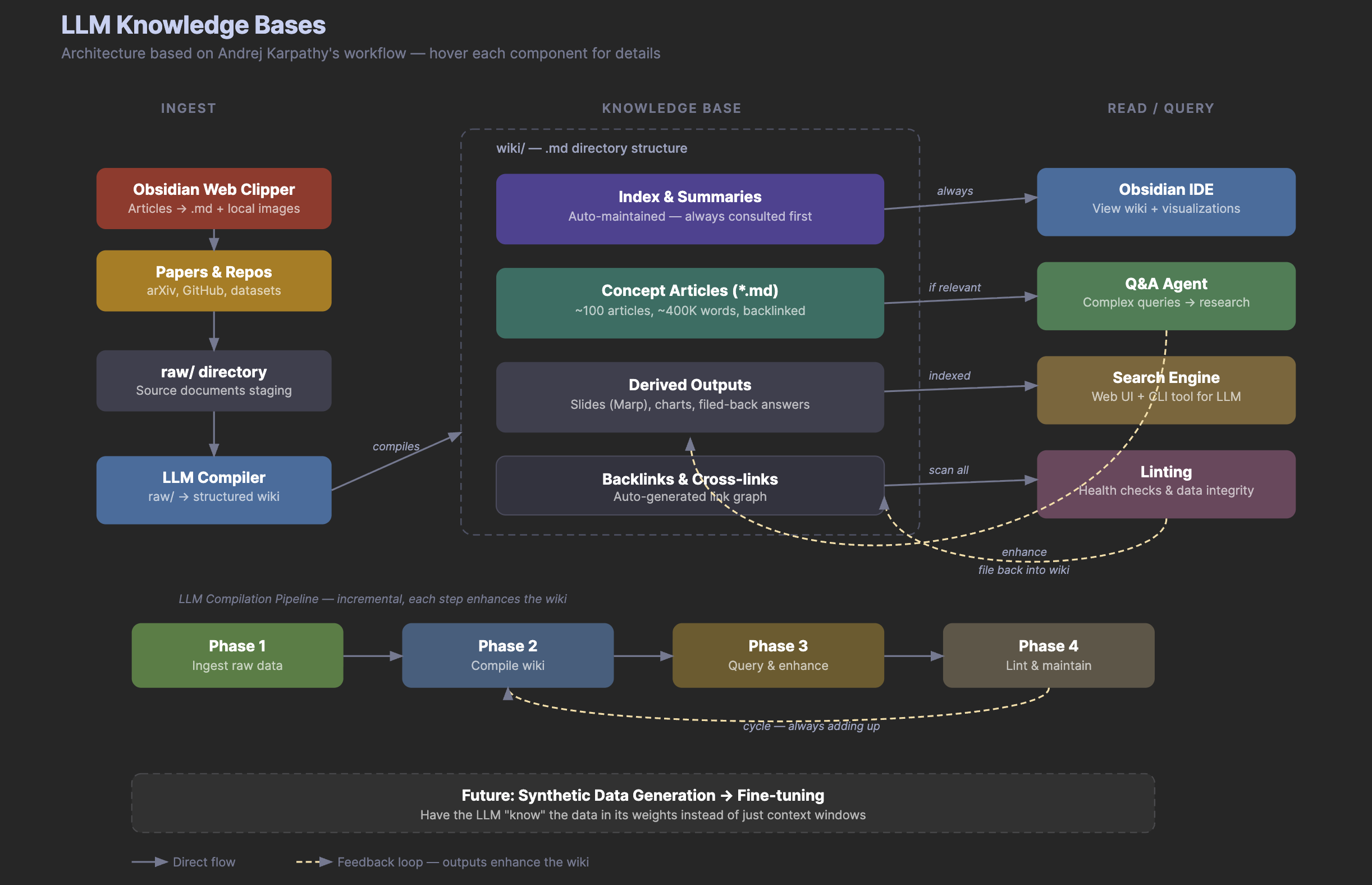
and here is the full architecture of the LLM Knowledge Base system covering every stage from ingest to future explorations. https://t.co/Wmn48gB0g0 pic.twitter.com/ObJet8Esfu— himanshu (@himanshustwts) April 2, 2026

elvis on Twitter / X
Diagram of the LLM Knowledge Base system.Feed this to your favorite agent and get your own LLM knowledge base going. https://t.co/4AQSFOv4PV pic.twitter.com/nPSNi4Ayqv— elvis (@omarsar0) April 3, 2026

Yuchen Jin on Twitter / X
Karpathy’s “LLM Wiki” pattern: stop using LLMs as search engines over your docs. Use them as tireless knowledge engineers who compile, cross-reference, and maintain a living wiki. Humans curate and think.Diagram generated by my Claude agent knowledge worker. https://t.co/5u5i1GeFK8 pic.twitter.com/NIaq3KlAok— Yuchen Jin (@Yuchenj_UW) April 4, 2026
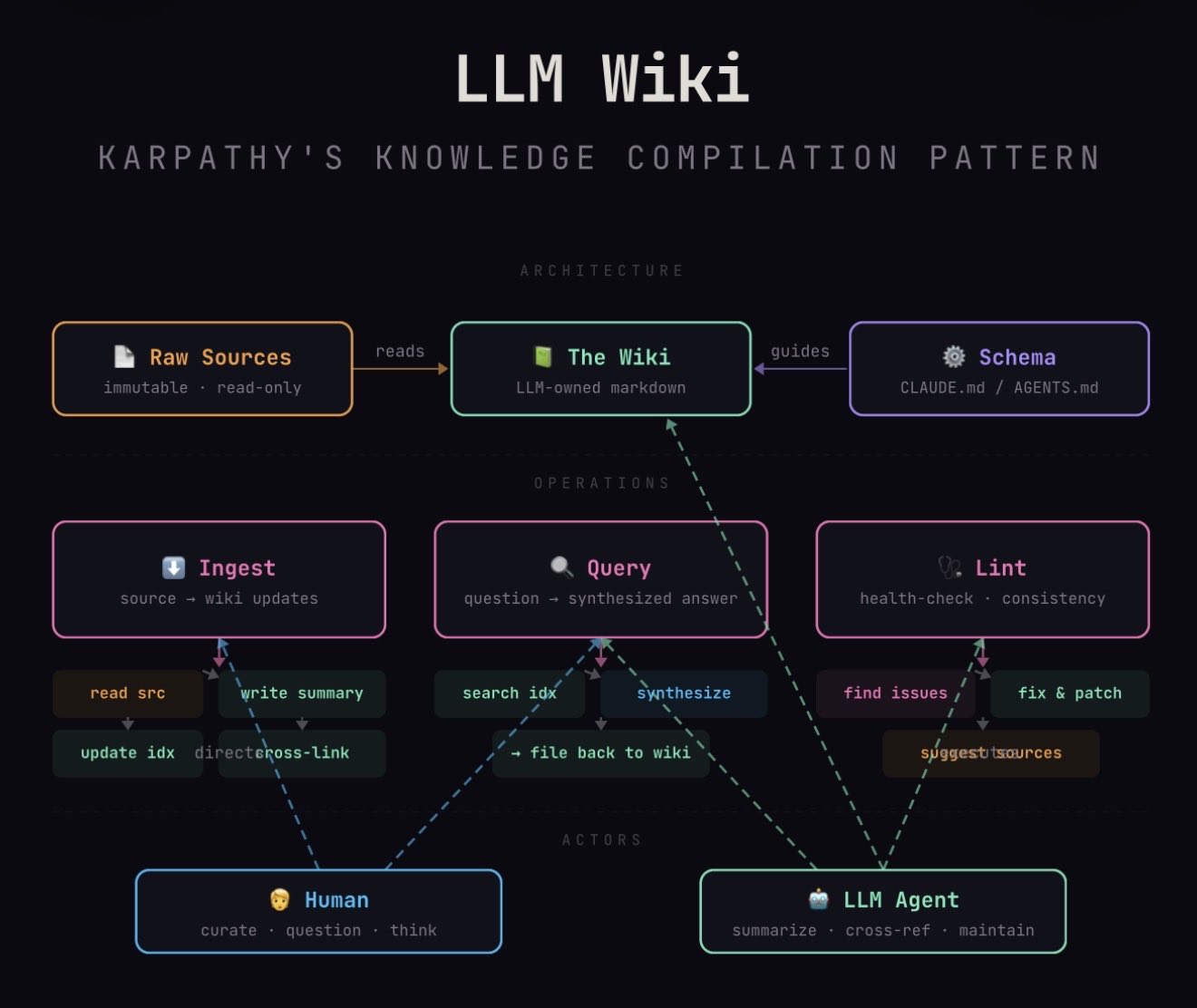
LLM Wiki v2 — extending Karpathy's LLM Wiki pattern with lessons from building agentmemory
LLM Wiki v2 — extending Karpathy's LLM Wiki pattern with lessons from building agentmemory · GitHub

How to Build an LLM Knowledge Base
A hands-on guide to building a simple LLM knowledge base with raw markdown sources, a compiled wiki, reusable prompts, and an agent that keeps improving the knowledge base over time.

Andrej Karpathy on Twitter / X
LLM Knowledge BasesSomething I'm finding very useful recently: using LLMs to build personal knowledge bases for various topics of research interest. In this way, a large fraction of my recent token throughput is going less into manipulating code, and more into manipulating…— Andrej Karpathy (@karpathy) April 2, 2026
Sakana AI on Twitter / X
We’re excited to introduce Text-to-LoRA: a Hypernetwork that generates task-specific LLM adapters (LoRAs) based on a text description of the task. Catch our presentation at #ICML2025!Paper: https://t.co/2FRiVF1UXJCode: https://t.co/rx4G7dq1SWBiological systems are capable of… pic.twitter.com/UdUYfqRXBS— Sakana AI (@SakanaAILabs) June 12, 2025
Sebastian Raschka on Twitter / X
Pretty cool. I think 2025-2026 will be a stronger focus on these in open source tooling.I.e. having LLMs delegate knowledge-based queries to search, which in turn frees up model capacity to improve reasoning capabilities and tool use. https://t.co/wNTg283mb2— Sebastian Raschka (@rasbt) August 12, 2025
crawshaw - 2026-02-08
I wrote up my experiences programming with LLMs a bit over a year ago, and updated it for the world of agents eight months ago. A lot has changed since then, so here is an update.
OpenAI's open source LLM is a reasoning model, coming Next Thursday!
1.1K votes, 257 comments. 756K subscribers in the LocalLLaMA community. Subreddit to discuss locally hostable AI.
Brandon Stewart on Twitter / X
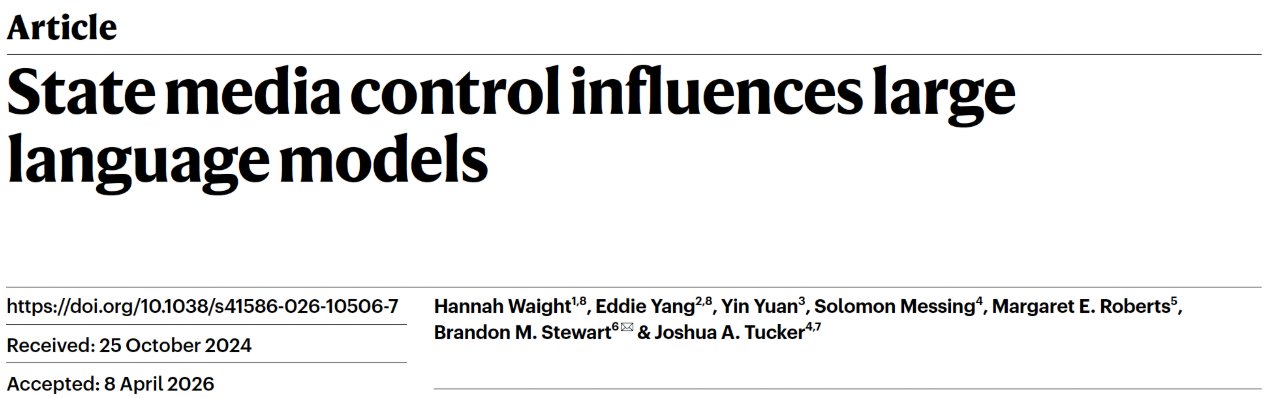
1/ New @Nature! We study how powerful institutions shape the information environment for LLMs. Commercial LLM training is opaque, so we trace a path from state-coordinated media -> training data -> model responses. pic.twitter.com/5LdFvzbFaf— Brandon Stewart (@b_m_stewart) May 13, 2026
A Survey on Large Language Model based Autonomous Agents
Autonomous agents have long been a prominent research focus in both academic and industry communities. Previous research in this field often focuses on training agents with limited knowledge within isolated environments, which diverges significantly from human learning processes, and thus makes the agents hard to achieve human-like decisions. Recently, through the acquisition of vast amounts of web knowledge, large language models (LLMs) have demonstrated remarkable potential in achieving human-level intelligence. This has sparked an upsurge in studies investigating LLM-based autonomous agents. In this paper, we present a comprehensive survey of these studies, delivering a systematic review of the field of LLM-based autonomous agents from a holistic perspective. More specifically, we first discuss the construction of LLM-based autonomous agents, for which we propose a unified framework that encompasses a majority of the previous work. Then, we present a comprehensive overview of the diverse applications of LLM-based autonomous agents in the fields of social science, natural science, and engineering. Finally, we delve into the evaluation strategies commonly used for LLM-based autonomous agents. Based on the previous studies, we also present several challenges and future directions in this field. To keep track of this field and continuously update our survey, we maintain a repository of relevant references at https://github.com/Paitesanshi/LLM-Agent-Survey.

LLM Knowledge Bases
A visual breakdown of Andrej Karpathy's approach to building personal knowledge bases powered by LLMs. Learn the 4-phase pipeline: ingest, compile, query, and maintain - with an interactive architecture diagram.
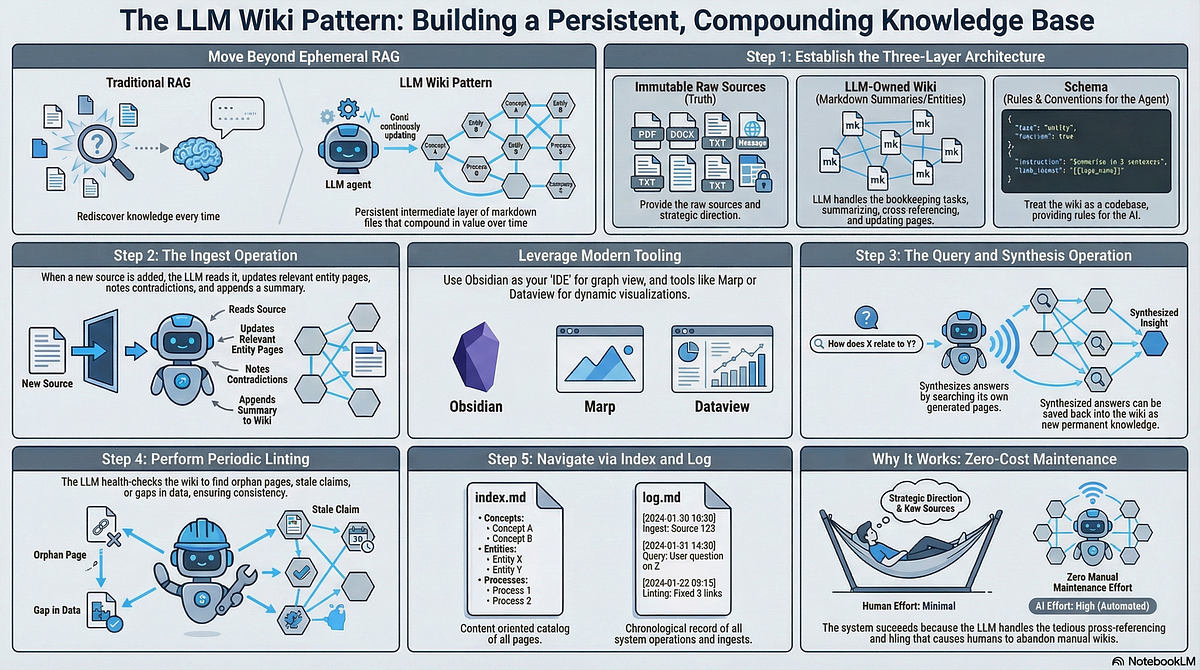
How To Build LLM Wiki In Obsidian? 🧠 A Memory Layer For Any Agentic AI