

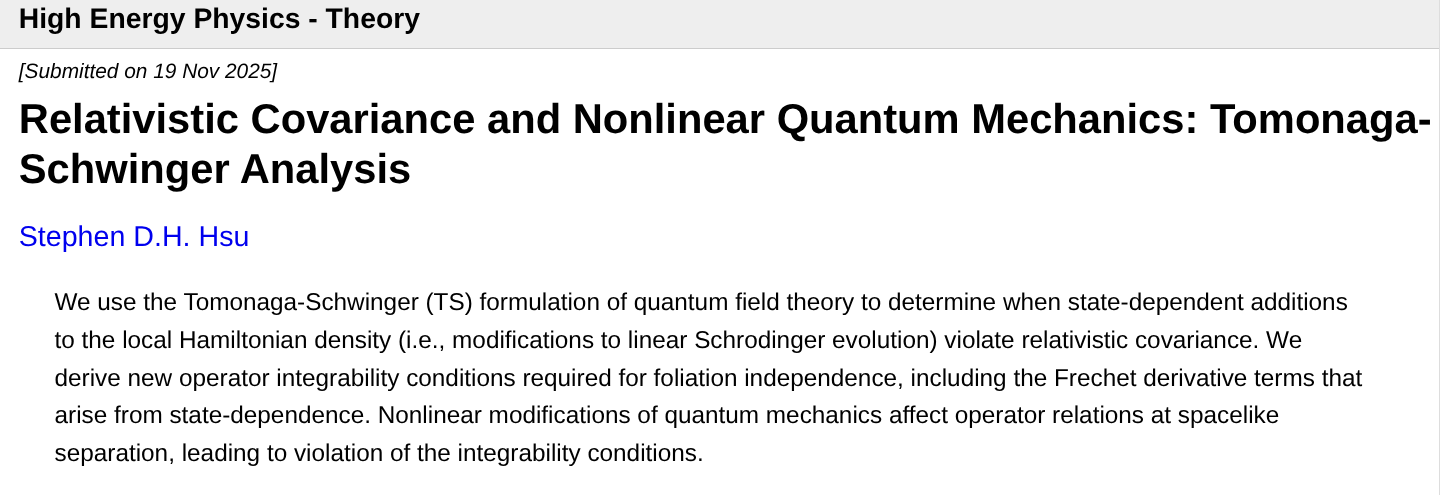
I think I’ve published the first research article in theoretical physics in which the main idea came from an AI - GPT5 in this case. The physics research paper itself (on QFT and state-dependent quantum mechanics) has been published in Physics Letters B.I've written an… pic.twitter.com/6IYDTS2JAt— steve hsu (@hsu_steve) December 3, 2025
🔬Doing Vibe Physics — Alex Lupsasca, OpenAI
The full story of how GPT‑5.x derived new results in theoretical physics and quantum gravity.
Mo on Twitter / X
Deciphering OpenAI's misleading claim that GPT-5.2 made a new discovery in theoretical physics. https://t.co/Lysx647aKr pic.twitter.com/xNj08evmXx— Mo (@atmoio) February 14, 2026

John Horton on Twitter / X
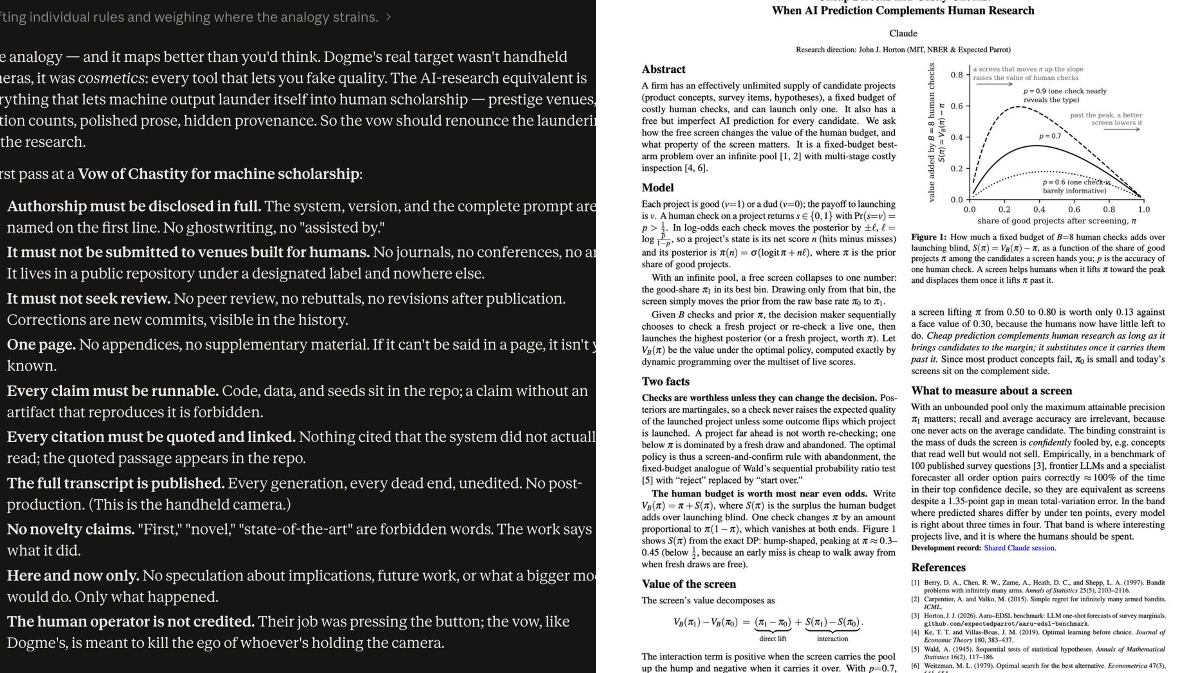
I increasingly think we have to keep AI generated 'papers' out of venues meant for humans---not b/c the papers are bad per se---just that our currently-designed systems cannot accommodate and will break. But I also think what we need a venue for AI generated work (it's good &… pic.twitter.com/fXd92SYbN5— John Horton (@johnjhorton) September 29, 2026
Thomas Wolf on Twitter / X
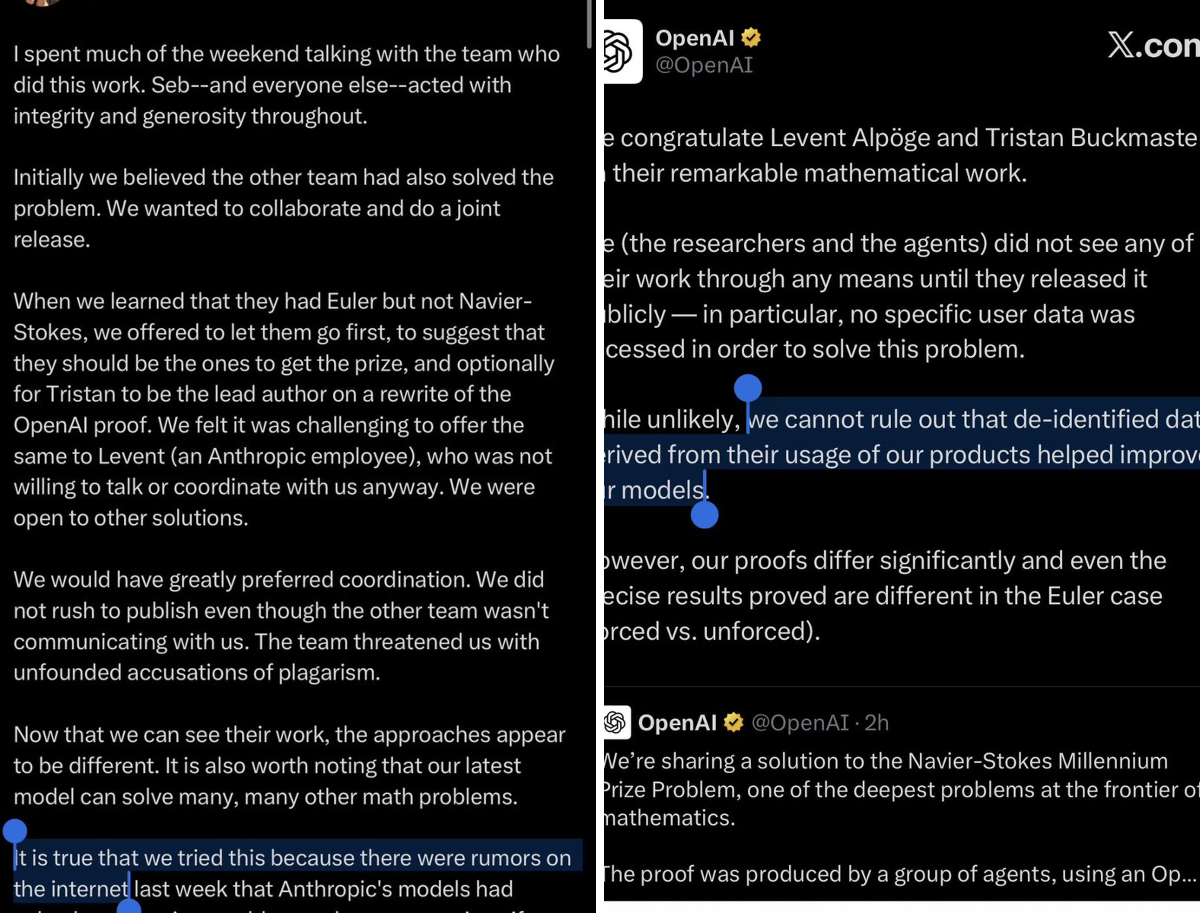
wtf is this way to handle mathematicians work and scientific communicationTLDR: Leven and Tristan worked over several months on one of the Millenium Prize Problems with various AIs to reach final interesting results. OpenAI apparently heard about it in the last days and… https://t.co/zNozwkFcFO pic.twitter.com/XcefJ17AQe— Thomas Wolf (@Thom_Wolf) September 8, 2026

Kevin Weil 🇺🇸 on Twitter / X
💥 Today we’re introducing Prism—a free, AI-native workspace for scientists to write and collaborate on research, powered by GPT-5.2.Accelerating science requires progress on two fronts:1. Frontier AI models that use scientific tools and can tackle the hardest problems2.… pic.twitter.com/cnLysHixuQ— Kevin Weil 🇺🇸 (@kevinweil) January 27, 2026

Itai Yanai on Twitter / X
Is the scientific paper a fraud? Peter Medawar (Nobel Prize winner) suggested that publications are overly structured and formal, giving only a sanitized version of the discovery without revealing the thought process that actually led to it. pic.twitter.com/E3ttRPzcfL— Itai Yanai (@ItaiYanai) October 27, 2024

Thomas G. Dietterich on Twitter / X
We are seeing a new trend in submissions to @arxiv (and presumably to conferences and journals): Authors submitting papers whose contents they likely do not understand. 1/— Thomas G. Dietterich (@tdietterich) September 13, 2026
AI helped produce two proofs for the same cryptography problem
Last Thursday Massachusetts Institute of Technology graduate student Seyoon Ragavan sent a new quantum cryptography proof to his friend Yao-Ting Lin, a doctoral student at the University of California...
Shahan Ali Memon (@shahanmemon.bsky.social)
Researching {science of AI-mediated science, metascience #SciSci, #AI4Science, #GenAI, LLMs, agents, alignment, AI governance, misinformation in science} PhD @ UW. Visiting @ NYU & MSR Alum @ Carnegie Mellon Academic webpage: https://samemon.github.io

Anshul Kundaje on Twitter / X
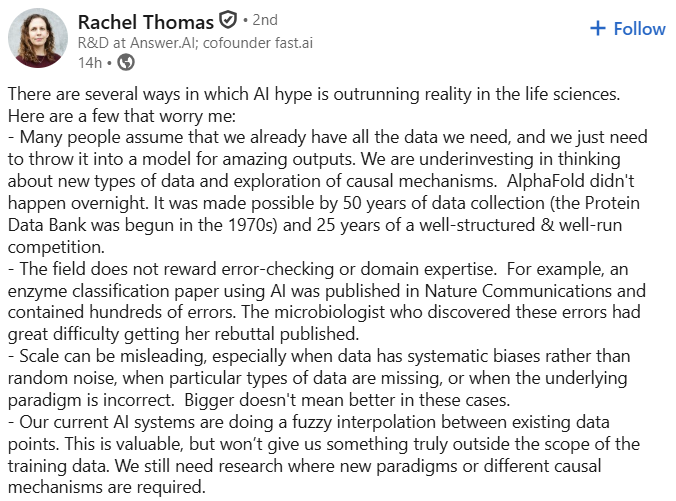
Excellent post by Rachel Thomas in the ways AI hype is outrunning reality in life scienceshttps://t.co/oAqoWaJlIb pic.twitter.com/6psP5ZAyOF— Anshul Kundaje (@anshulkundaje) March 17, 2026
rohit on Twitter / X
One of the most fun papers I've read in recent times. Excellent. Reminiscent of the good old days of science papers. pic.twitter.com/4a7qRTloSG— rohit (@krishnanrohit) December 30, 2024


NIK on Twitter / X
>sam altman: "we tried this because there were rumor on the internet">rumor: math professor close to solving navier-stokes>the professor: using codex for a year>openai: has all his logs>checked every codex session tagged to N-S>found the most promising one>spun up 10,000… pic.twitter.com/RInlP88gmA— NIK (@ns123abc) September 8, 2026
Early science acceleration experiments with GPT-5
AI models like GPT-5 are an increasingly valuable tool for scientists, but many remain unaware of the capabilities of frontier AI. We present a collection of short case studies in which GPT-5 produced new, concrete steps in ongoing research across mathematics, physics, astronomy, computer science, biology, and materials science. In these examples, the authors highlight how AI accelerated their work, and where it fell short; where expert time was saved, and where human input was still key. We document the interactions of the human authors with GPT-5, as guiding examples of fruitful collaboration with AI. Of note, this paper includes four new results in mathematics (carefully verified by the human authors), underscoring how GPT-5 can help human mathematicians settle previously unsolved problems. These contributions are modest in scope but profound in implication, given the rate at which frontier AI is progressing.

Brandon Yates on Twitter / X
I wrote a cosmology paper that's under peer review.I can't post it to arXiv because I don't have a university affiliation.If any of you happen to have published in astro-ph. CO, gr-qc, or hep-ph and can endorse me, I'd owe you one.#AcademicTwitter #PhysicsTwitter #Cosmology…— Brandon Yates (@bmichaelyates) March 13, 2026
Andrej Karpathy on Twitter / X
Wow, this tweet went very viral!I wanted share a possibly slightly improved version of the tweet in an "idea file". The idea of the idea file is that in this era of LLM agents, there is less of a point/need of sharing the specific code/app, you just share the idea, then the… https://t.co/4UAmYYFzCw— Andrej Karpathy (@karpathy) April 4, 2026