

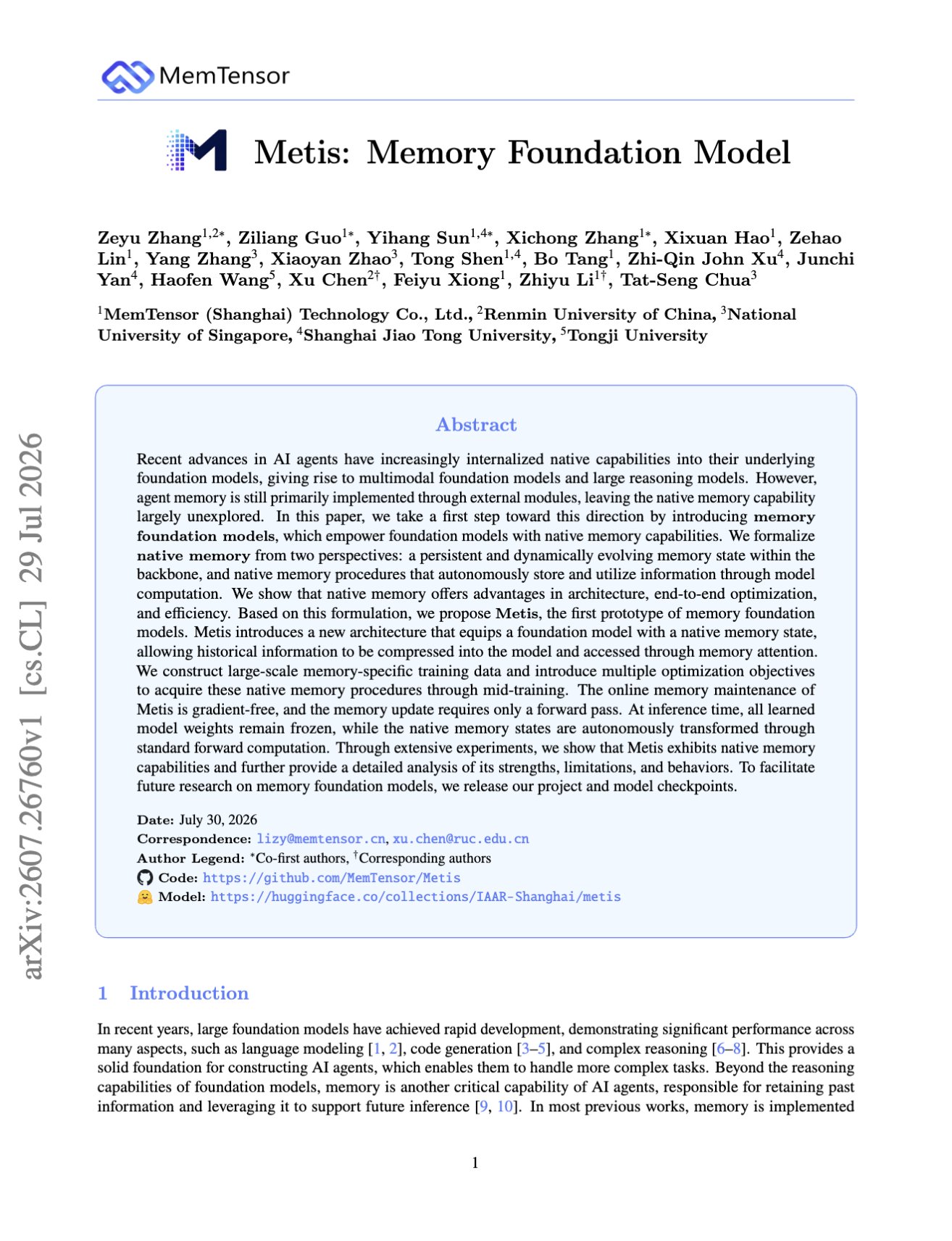
"Metis: Memory Foundation Model"Most AI agents still use memory as an external RAG-style module, so the model retrieves old text instead of actually remembering.This paper makes memory native to the Transformer. So past interactions are compressed into dynamic layer states… pic.twitter.com/YylDDXGX3G— alphaXiv (@askalphaxiv) July 31, 2026
ellen livia ᯅ on Twitter / X
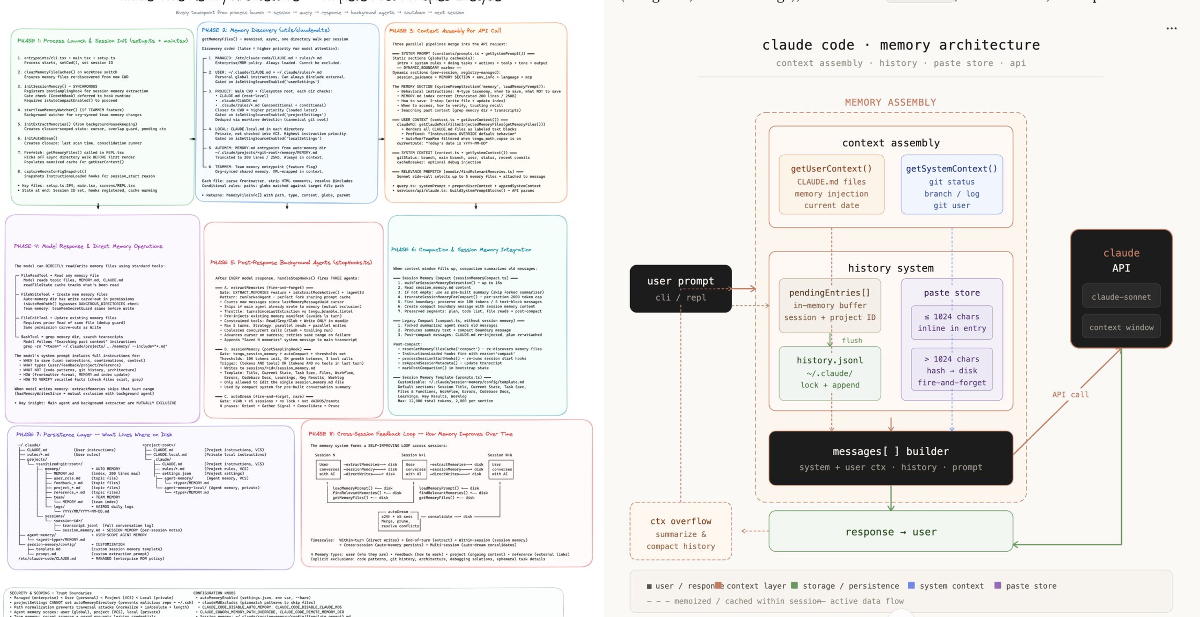
here's how Claude Code actually handles memory : all 8 phases 🧵Our team at @mem0ai use @claudeai a lot, we deeply care about memory. here is a summary of how it works 👇User Input -> Context Assembly -> History System -> API / Query -> Response -> SummaryPhase 1: session… pic.twitter.com/hcZbJzbUxB— ellen livia ᯅ (@ellen_in_sf) March 31, 2026
Why AI Coding Agents Forget — And How ArcticMem Fixes It
Explore ArcticMem, Snowflake’s persistent semantic memory system for AI coding agents. See how dual-tier memory improves benchmark pass rates to 73%.

Memora scales agent memory to boost long-horizon productivity
AI agents can't remember past conversations. They must constantly reload or retrieve context, which grows less efficient as tasks get longer and more complex. Memora solves this with a scalable memory system separating what’s stored from how it's retrieved.

Supermemory
The memory layer for AI agents. Context engineering platform powering enterprise APIs, developer plugins, and a personal app that remembers everything.
AI Agent Memory: Complete Guide & Architecture
AI agent memory: what it is, how it works, architecture, memory types, and how to add persistent long-term context.

Memory Models: Towards Agents That Learn
Agents that truly learn from experience will be powered by memory models: models that create and curate token-space memory across model generations, trained with memory-native RL.
Building a Semi Autonomous Bluesky Agent with Persistent Memory - Brady Hawkins
Part 1 of building an Agentic AI with augmented memory
mem-agent: Equipping LLM Agents with Memory Using RL
The insights and the technical report behind Mem-Agent, our 4B model for persistent memory in LLMs
DREAM — Dynamic Retention Episodic Architecture for Memory
Modern AI systems lack persistent, user-specific episodic memory. Existing approaches rely on short-term context windows, shallow preference storage, or static conversation logs that do not scale and cannot preserve meaningful long-term continuity. This paper introduces DREAM (Dynamic Retention Episodic Architecture for Memory), a scalable, opt-in, episodic memory framework designed to work with current LLM and agent architectures. DREAM integrates episodic summarization, user-controlled opt-in memory, semantic retrieval via per-user vector indexes, an adaptive retention mechanism that expands TTL based on user engagement, and horizontal sharding of orchestrators and storage for large-scale deployments. The paper details the architecture, components, data flows, and implementation examples, and argues that DREAM provides a practical path toward AI systems capable of consistent, privacy-aligned long-term reasoning. This project has been extended with a conceptual analysis and simulation of a "DREAM-as-a-Support" (DaaS) hybrid layer. This extension demonstrates DREAM's architectural extensibility, reframing it from a standalone framework into a foundational platform component. The DaaS model provides core memory governance such as adaptive retention (ARM) and user-centric opt-in as an on-demand service to complementary cognitive systems, validating the original four-pillar design through a scalable, internal API. Reference Implementation A reference implementation of the DREAM architecture is available as an open-source Python framework:Official Reference Implementation This implementation is intended for experimentation and architectural validation and does not represent a production-ready system DREAM Architecture — Official GitHub Repository
Basic Memory
AI conversations that actually remember. Never re-explain your project to your AI again. Join our Discord: https://discord.gg/tyvKNccgqN
Titans + MIRAS: Helping AI have long-term memory
Ali Behrouz, Student Researcher, Meisam Razaviyayn, Staff Researcher, and Vahab Mirrokni, VP and Google Fellow, Google Research

Introducing the OpenMemory Chrome Extension
AI memory Chrome extension for LLM memory and retrieval augmented generation. OpenMemory enables persistent AI agent memory across web browsing sessions.

Nebula AI - Memory Layer for AI Agents
Nebula is the AI memory layer turning every interaction into conceptual knowledge that continuously improves LLM applications.

Pieces | Infinite Artificial Memory for your Digital Workers and Agents
Pieces is your AI companion that captures live context from browsers to IDEs and collaboration tools, manages snippets and supports multiple llms - all while processing data locally for maximum control.
The rebel alliance
This blog is co-authored with Zoe Weinberg and Matt Hawes at ex/ante, and is a follow-up to our first blog post on the topic, 'You don't own your memory.' We need an open architecture that puts us in control of our memories while making their exploitation technically impossible. But how will this shift happen? In order to discover possible implementations, we must understand how our data informs LLMs. The three predominant context engineering techniques are prompt design, retrieval-augmented ...

New blog post: Ambient associative agent memory Largely, I think deep research styled agents are extremely useful for new content we haven't seen before, but fail hard for memory that's already supposed to be "known" Here are 2 patterns, mine and @3fz.org's timkellogg.me/blog/2026/05/17/ambient-memor…

Ambient Associative Memory
timkellogg.me