

Really useful analysis of NR / neo-monarchism/ long-termism as authoritarian responses to the perception that democracy just can't get anything done (cos it's locked in to the short-termism of the popularity / electoral cycle). Free to read here: https://t.co/U4z0qmBReM https://t.co/NG4XIUM6O8— Jeremy Gilbert (@jemgilbert) September 21, 2026
Time and the Neo-Monarchist Turn
One of the classical arguments against democracy concerns its supposed short-termism. Early-modern political thought contrasted the pitfalls of elected authority, whose timebound character was seen to invite inconstancy, instability and plunder, with the merits of indefinite rule on the model of kingship. Such reasoning has seen two revivals in recent years, first in a neo-liberal form as an argument for technocracy (see independent central banking), second in a neo-reactionary form as an argument for an all-powerful executive or ‘monarch’ (see the contemporary international far Right). This article looks at the structure of these political arguments and the work they do. Having reconstructed their historical background, it charts how the neo-monarchist turn marks a radicalisation in democracy-scepticism, guided by a patrimonial logic of authority as property ownership. The article goes on to examine the political-economic factors to which this responds, as well as the contradictions to which neo-monarchism is prone. As the article concludes, temporal arguments for authoritarian politics may be dubious in substance but merit careful observation in a context of widespread disaffection with existing institutions.

We Need To Rethink Democracy
The Liberalism to Fascism Pipeline (Neoliberalism Explained)
The Dispersion of Power: A Critical Realist Theory of Democracy
Abstract The Dispersion of Power is an urgent call to rethink centuries of conventional wisdom about what democracy is, why it matters, and how to make it better. Drawing from history, social science, psychology, and critical theory, it explains why elections do not and cannot realize the classic ideal of popular rule, and why prevailing strategies of democratic reform often make things worse. Instead, Bagg argues, we should see democracy as a way of protecting public power from capture—an alternative vision that is at once more realistic and more inspiring. Despite their many shortcomings, real-world elections do prevent the most extreme forms of tyranny, and are therefore indispensable. In dealing with the vast inequalities that remain, however, we cannot rely on standard solutions such as electoral reform, direct democracy, deliberation, and participatory governance. Instead, Bagg shows, protecting and enriching democracy requires addressing underlying inequalities of power directly. In part, this entails substantive policies attacking the advantages of wealthy elites. Even more crucially, deepening democracy requires the organization of oppositional, countervailing power among ordinary people. Neither task is easy, but historical precedents exist in both cases—and if democracy is to survive contemporary crises, leaders and citizens alike must find ways to revive and reinvent these essential democratic practices for the twenty-first century.

The Myth of Authoritarian Efficiency
When it comes to getting stuff done, democracies win every time.
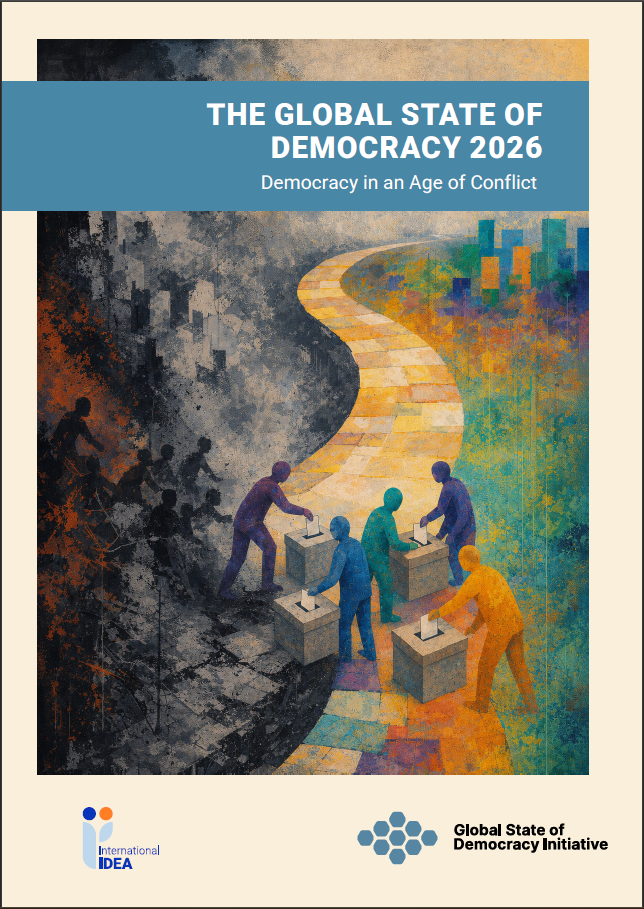
The Global State of Democracy 2026: Democracy in an Age of Conflict
In the face of increasing political and societal fragmentation, the Global State of Democracy 2026 explains the patterns that define the direction of democratization around the world. Drawing on the latest data from the Global State of Democracy Indices, the report documents both democratic stagnation and key declines in indicators that measure the credibility of elections, the effectiveness of legislatures, respect for freedoms of expression and the press, and access to justice. These phenomena affect countries across thespectrum of democratic performance.
The Global State of Democracy 2026: Democracy in an Age of Conflict
In the face of increasing political and societal fragmentation, the Global State of Democracy 2026 explains the patterns that define the direction of democratization around the world. Drawing on the latest data from the Global State of Democracy Indices, the report documents both democratic stagnation and key declines in indicators that measure the credibility of elections, the effectiveness of legislatures, respect for freedoms of expression and the press, and access to justice. These phenomena affect countries across thespectrum of democratic performance.
LiberationValues
LibertationValues is a political quiz aimed at anti-authoritarian leftists

LiberationValues
LibertationValues is a political quiz aimed at anti-authoritarian leftists
(PDF) Authoritarian Neoliberalism from Below: Subjectivity and Platform Capitalism in Argentina and Brazil
PDF | We are witnessing a worldwide resurgence of reactionary ideologies and movements, combined with an escalating assault on democratic institutions... | Find, read and cite all the research you need on ResearchGate

Actually, Democracy Dies in H.R.
New research sheds light on how mediocre employees help would-be authoritarians maintain power.

Democracy, Sovereignty, and the Throne Speech That Wasn’t
We have to go back to go forward. Our power to do that is shrinking.

The authoritarians are winning, we can all see that. Maybe, just maybe, it wouldn't be the worst thing if pro-democracy people stopped being ridiculously naive about social media. berjon.com/media-media/

Media Media
berjon.comDemocracy is an epistemic discipline, it only works if truth can constrain power. Without a faster, more transparent architecture for shared reality, the arc of democracy bends away from substance, through simulation, and toward authoritarianism. Without major action, it's the inevitable end state.
🧵 Democracy feels like it's in a rough state at the moment across the globe, and we hear various explanations, like polarisation, extremism, disinformation, and loss of trust. But what if those explanations are mainly symptoms and we've been trying to treat them rather than the underlying causes?
It can also be argued that authoritarianism is just politically superior at administering a political economy of broken promises and stagnating or falling standards of living. hup.harvard.edu/books/9780674976788

The Triumph of Broken Promises — Harvard University Press
www.hup.harvard.edu

