


How we solved the 70-year-old Pierce–Birkhoff conjecture in real algebraic geometry with $400.One thing we kept noticing: models from different families (including the latest public models from GPT and Claude) seemed to complement each other, even when they were independently… pic.twitter.com/7MzWstXfy6— Junyu Ren (@junyu_r) September 9, 2026
Przemek Chojecki | PC on Twitter / X
The Growing Map of Open Mathematical Problems.We mapped 15,000+ conjectures from UnsolvedMath to show potential links between concepts.It also shows how under formalized the frontier is (less than 10%). pic.twitter.com/nm0PCpXVPf— Przemek Chojecki | PC (@prz_chojecki) August 28, 2026

OpenAI's Unreleased Model Astra Solves Ten Major Open Mathematics Problems
Math is hard.

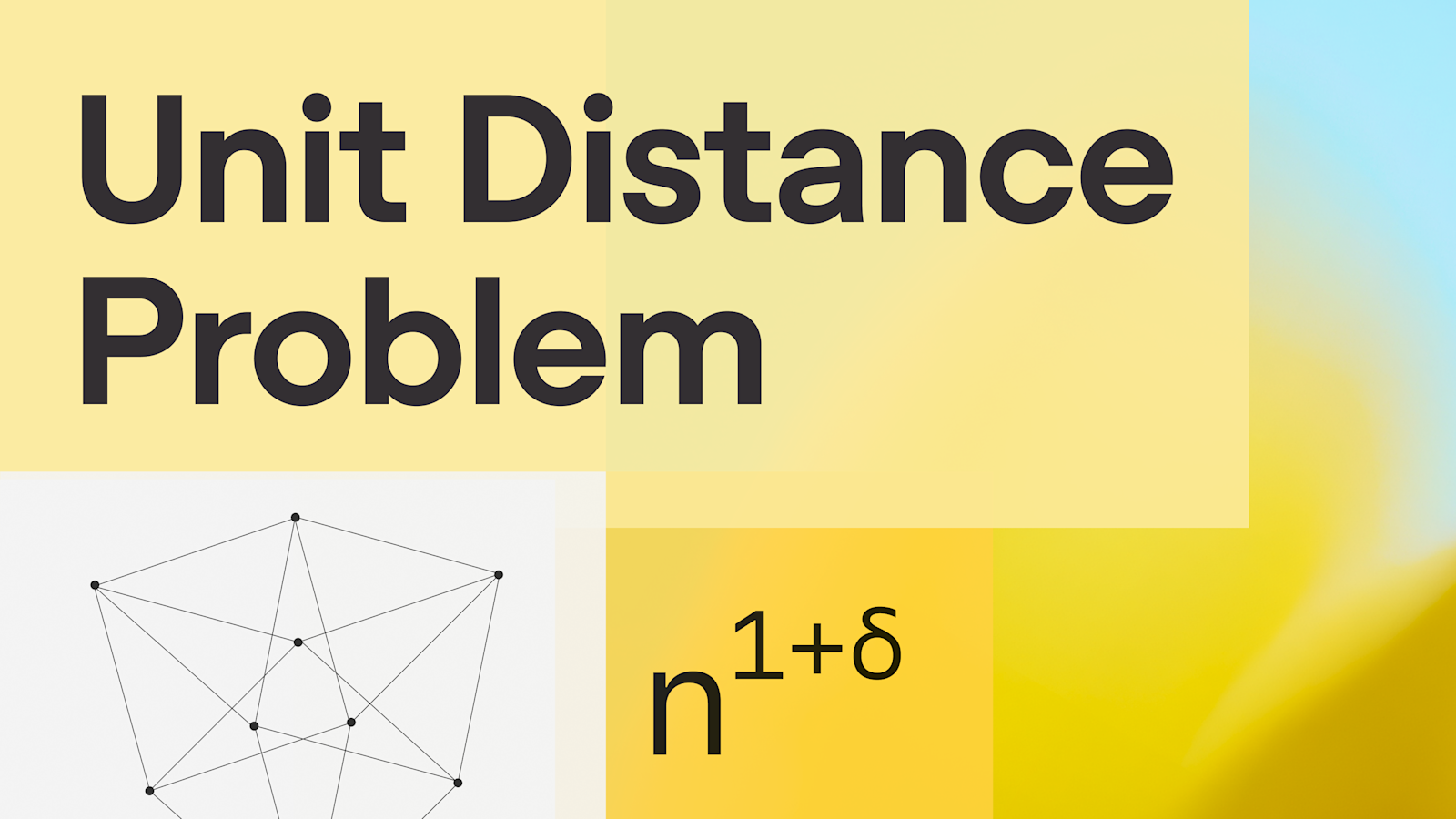
An OpenAI model has disproved a central conjecture in discrete geometry
An OpenAI model solved the 80-year-old unit distance problem, disproving a major conjecture in discrete geometry and marking a milestone in AI-driven mathematics.
Tony Feng on Twitter / X
I am a mathematician but I avoided commenting on this because the problems are (far) outside my domain. Even if I sat down to read the technical details (which I have not), it would be hard to appreciate the context of prior work, etc. But I've gotten enough sense of things… https://t.co/VZzosBYFto— Tony Feng (@tonylfeng) August 5, 2026
Mathematics with large language models as provers and verifiers
During 2024 and 2025 the discussion about the theorem-proving capabilities of large language models started reporting interesting success stories, mostly to do with difficult exercises (such as problems from the International Mathematical Olympiad), but also with conjectures [Feldman & Karbasi, arXiv:2509.18383v1] formulated for the purpose of verifying whether the artificial intelligence could prove it. In this paper we report a theorem proving feat achieved by ChatGPT by using a protocol involving different prover and verifier instances of the gpt-5 model working collaboratively. To make sure that the produced proofs do not suffer from hallucinations, the final proof is formally verified by the lean proof assistant, and the conformance of premises and conclusion of the lean code is verified by a human. Our methodology is by no means complete or exact. It was nonetheless able to solve five out of six 2025 IMO problems, and close about a third of the sixty-six number theory conjectures in [Cohen, Journal of Integer Sequences, 2025].
How I Vibed a Proof of Conway’s Conjecture — overreacted
You can just prove things, apparently.
Ten advances in mathematics and theoretical computer science
OpenAI shares new results on long-standing open problems in mathematics and theoretical computer science, including advances in geometry, cryptography, and complexity.
Mo on Twitter / X
Deciphering OpenAI's misleading claim that GPT-5.2 made a new discovery in theoretical physics. https://t.co/Lysx647aKr pic.twitter.com/xNj08evmXx— Mo (@atmoio) February 14, 2026

98 out of 100. That's how many advanced maths problems current AI models managed to solve in an international benchmark in Leipzig. One of the two remaining problems? A simplified version of a… | Czech Technical University in Prague | 11 comments
98 out of 100. That's how many advanced maths problems current AI models managed to solve in an international benchmark in Leipzig. One of the two remaining problems? A simplified version of a combinatorics problem solved by researchers from the Faculty of Information Technology CTU in Prague. Alexander Clifton, Daniela Černá and Jan Volec, together with Bartołomiej Kielak from Universität Leipzig , found the solution to a simplified version of the long-standing open problem of breaking triples with permutations. The problem was later included among the 100 tasks used to test how today's AI models perform in advanced mathematics. While AI came remarkably close, this was one of the problems it couldn't solve on its own. A nice reminder that mathematical creativity and abstract reasoning still leave some room for humans. 🧠 🔗 Read the full story in the comments. | 11 comments on LinkedIn

Chomba Bupe on Twitter / X
It appears OpenAI Astra's mathematical feat was more of surface level stitching of components."The LLM-generated proof hinges on a particular mathematical argument that it presented as its own but that actually first appeared in a 2016 paper by Miller and a collaborator." pic.twitter.com/labUnQMRab— Chomba Bupe (@ChombaBupe) August 7, 2026

The meme hiding surprisingly advanced math

