It is easy to see that biology does things that cannot be computed in advanced because the future is not controlled by statistics, it is controlled by creative actions. This means today’s statistically-driven GenAI is fundamentally unintelligent.— Prof. Lee Cronin (@leecronin) March 28, 2026
No. 029: OpenAI math manuscripts, inquiry narrowing, virtual biology initiative - The Hallway Track
The Hallway Track No. 029 - How AI is affecting the practice of science
What Is Intelligence? Lessons from AI About Evolution, Computing, and Minds | Blaise Agüera y Arcas
Jon Barron on Twitter / X
This idea that intelligence is solely a function of what you've observed since birth and not also a function of the 500 million years of evolution that preceded your birth is surprisingly sticky despite being demonstrably untrue. https://t.co/m2z5cN8Byb— Jon Barron (@jon_barron) January 28, 2026
Verification in the Age of AI Scientists
AI Scientists now operate at a scale that outpaces human capacity for manual review. Systems such as Sakana’s AI Scientist write entire workshop papers end-to-end. Lila Sciences runs autonomous ``AI Science Factories’’ that hypothesize, experiment, and iterate without human guidance. FutureHouse’s Kosmos and Robin generate thousands of candidate hypotheses in a single run, and Google’s Co-Scientist proposes testable experiments at a rate no laboratory can fully evaluate. Each of these systems emphasizes verified results, yet that standard ranges from near-perfect formal proof in mathematics to decade-long clinical trials in medicine, with no shared framework for judging sufficiency across domains. As outputs scale beyond what humans can manually inspect, the question of which results to trust becomes as hard as generating them. The bottleneck for AI for Science is no longer hypothesis generation, it is verification.
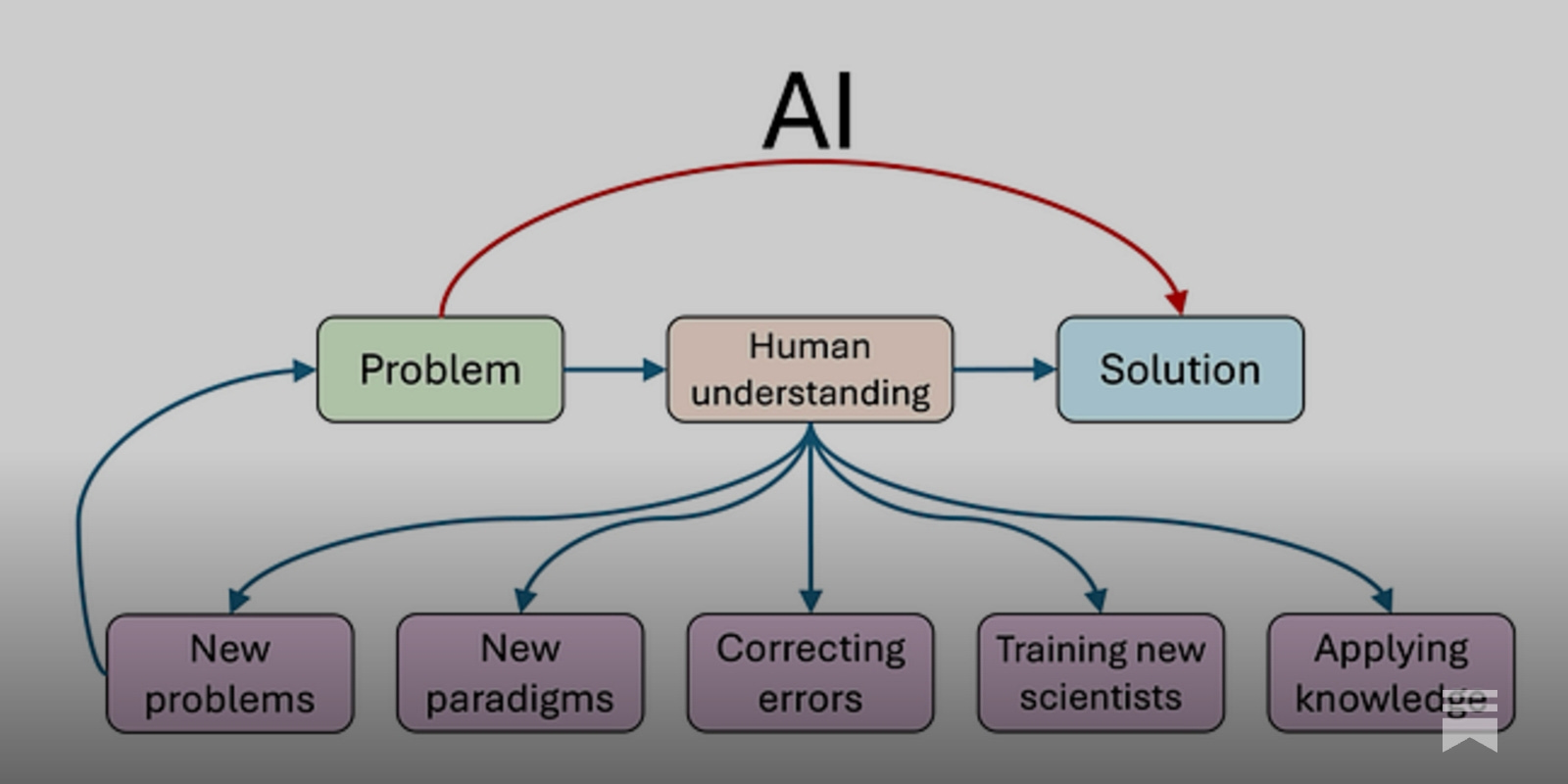
Will AI spark a scientific renaissance — or a diffuse monoculture?
Artificial intelligence’s ability to enrich science will depend not only on model capability, but also on whether researchers, reviewers and funders reward originality over speed.
Where does the rigor go? Research software and the future of trustworthy science.
Generative AI now makes it dramatically easier to produce something that looks like research: analysis code, figures, literature reviews, even whole pap…
No. 008: AI co-mathematician, compiler-verified protocols, open infrastructure bets - The Hallway Track
The Hallway Track No. 008 - How AI is affecting the practice of science
AI That Evolves in the Wild | Edge.org
I’m interested not in domesticated AI—the stuff that people are trying to sell. I'm interested in wild AI—AI that evolves in the wild. I’m a naturalist, so that’s the interesting thing to me. Thirty-four years ago there was a meeting just like this in which Stanislaw Ulam said to everybody in the room—they’re all mathematicians—"What makes you so sure that mathematical logic corresponds to the way we think?" It’s a higher-level symptom. It’s not how the brain works. All those guys knew fully well that the brain was not fundamentally logical.
Stop trusting the extinction math
The AI industry's favourite 'statistic' isn't backed by data. And it distracts from what's really going on.

To Gen or Not To Gen: The Ethical Use of Generative AI
Is it ethical to use hyper-scaled GenAI?
No. 027: AGMAI advisory group, Millennium Problems for biology, autonomous research pipelines - The Hallway Track
The Hallway Track No. 027 - How AI is affecting the practice of science
The future belongs to those who can refute AI, not just generate with AI
Why verification, not prompting, could shape the next decade of engineering

Dr. Émile P. Torres (they/them) on Twitter / X
What's amazing about this is every time there's a new grand prediction about AI, it's like people forget the 500 previous predictions from the same group of people that were completely wrong. AI by 2025 (Musk). AI doing most coding by 2025 (Amodei). Etc. Why is that?? https://t.co/t9CcMQO4EN— Dr. Émile P. Torres (they/them) (@xriskology) January 28, 2026
Jacob Coxon Warns of Human Extinction and Triggers a Preference Cascade
CEOs of major AI labs, and employees of major AI labs, including OpenAI and Anthropic, often say they plan to build superintelligence soon, as in within a few years create AIs that are superior to humans at essentially all cognitive tasks.

In Two Moves, AlphaGo and Lee Sedol Redefined the Future
Although machines are now capable of moments of genius, humans have hardly lost the ability to generate their own.