

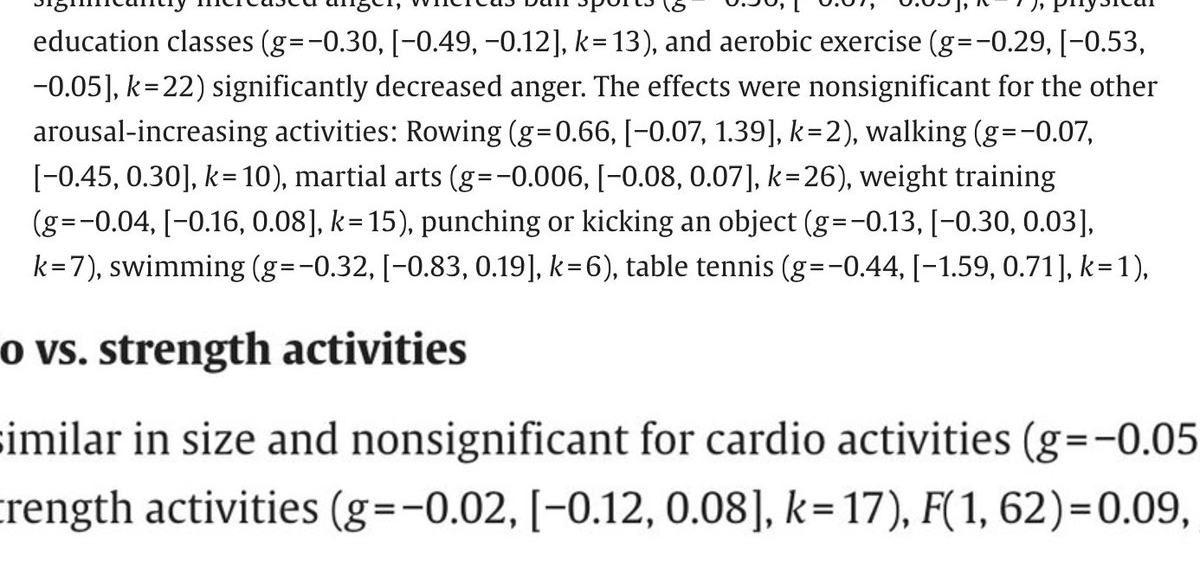
I don't even know where to start with this crap (partly because it's hard to tell which of the studies the 17 "jogging" effects came from, partly because it seems obvious from the paper that the more studies the more the "effect" disappears) https://t.co/Gniv5Ht8g3 pic.twitter.com/qbToQ2yOGM— Science Banana (@literalbanana) March 12, 2024
Scientists no Longer Find Twitter Professionally Useful, and have Switched to Bluesky
Synopsis Social media has become widely used by the scientific community for a variety of professional uses, including networking and public outreach. For the past decade, Twitter has been a primary home of scientists on social media. In recent years, new leadership at Twitter has made substantive changes that have resulted in increases in the prevalence of pseudoscience, conspiracy theory, and harassment on the platform, causing many scientists to seek alternatives. Bluesky has been suggested as a good alternative to Twitter, but the phenomenon of academics switching social media platforms has not previously been studied. Here we report on the results of a survey distributed to scientists on Twitter and Bluesky (n = 813). Results overwhelmingly confirm that changes to Twitter have made the social media platform no longer professionally useful or pleasant, and that many scientists have abandoned it in favor of Bluesky. Results show that for every reported professional benefit that scientists once gained from Twitter, scientists can now gain that benefit more effectively on Bluesky than on Twitter.
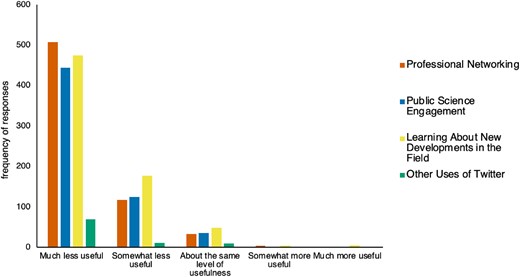
A new study suggests that scientists are leaving X (formerly known as Twitter) in significant numbers due to its declining professional value. Many now find Bluesky to be a more effective platform for networking, outreach, and staying updated on research.
36K votes, 1.1K comments. 34M subscribers in the science community. This community is a place to share and discuss new scientific research. Read…
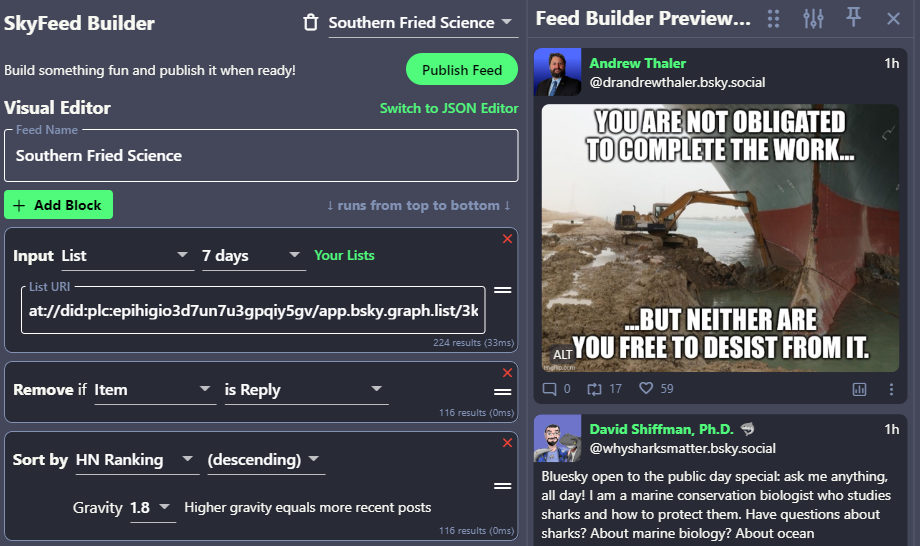
A quick and dirty guide to making custom feeds on Bluesky
So, you’ve made it! The remnants of science twitter have at last begun to coalesce around a new microblogging platformed owned by questionable individuals with inadequate content moderation t…
What stories should we tell about scientific progress now?
In search of the mysterious fruits of basic science

Jason Shepherd on Twitter / X
I have quite a lot of thoughts on this..that won't fit in a tweet. Bottomline is that there are issues scientists in the US would love to improve - faster review, less grant writing, more stability and freedom to do risky science. The folks celebrating this doc are mostly../1 https://t.co/xlPAH9XYNC— Jason Shepherd (@JasonSynaptic) July 23, 2026
Science Works on Twitter / X
London AI × Science Hackathon 👾Science Works × @inherent_labs • Oct 16-18Lots of scientific software is outdated, hard to use, and isn't interoperable – let alone making use of (or ready to interface with) AI.Or it's expensive. Join us to build better for the community pic.twitter.com/42Qq528DDw— Science Works (@sci_works) September 30, 2026
Do You Hear "Yanny" or "Laurel"? (SOLVED with SCIENCE)
Scientists no Longer Find Twitter Professionally Useful, and have Switched to Bluesky
Synopsis. Social media has become widely used by the scientific community for a variety of professional uses, including networking and public outreach. For
Scientists no Longer Find Twitter Professionally Useful, and have Switched to Bluesky
Synopsis. Social media has become widely used by the scientific community for a variety of professional uses, including networking and public outreach. For
Jake Wintermute 🧬/acc on Twitter / X
I’ve expected this for a while but it still hurts. The “Life Sciences Verification Program.” It breaks my heart to know that biological knowledge will be locked down and gatekept like this. I want to take a moment to mourn, because I believe this marks an end for open science as… https://t.co/l5WLjOuEdk— Jake Wintermute 🧬/acc (@SynBio1) September 17, 2026
Nikhil Krishnan on Twitter / X
yeah there used to be a company called Eureka that powered these types of observational, more lifestyle style studies (here's an example looking at coffee's effect on different biomarkers/conditions)https://t.co/urQRvTVTb7I think it can work if you have enough people in…— Nikhil Krishnan (@nikillinit) September 14, 2025
Anshul Kundaje on Twitter / X
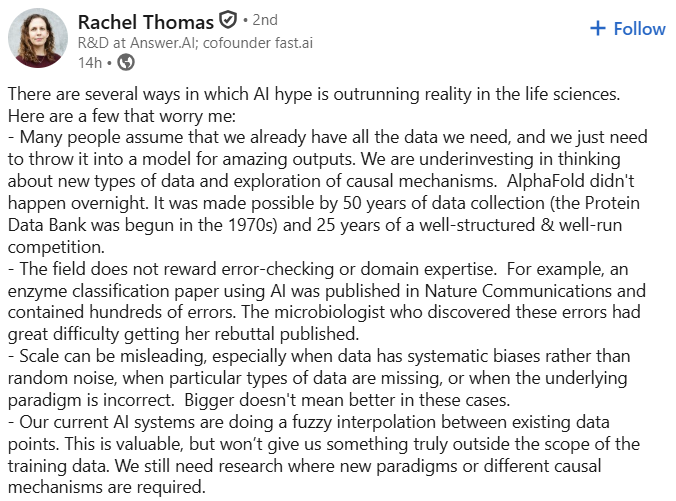
Excellent post by Rachel Thomas in the ways AI hype is outrunning reality in life scienceshttps://t.co/oAqoWaJlIb pic.twitter.com/6psP5ZAyOF— Anshul Kundaje (@anshulkundaje) March 17, 2026
Jubilee Must Be Stopped (with Big Joel)
Oh no it's happening here too! Massive science threads and convos with zero involvement from women 😭 That was one of the weirdest, most alienating things about science twitter (and why perhaps I don't have as fond memories of it as some of my male colleagues do) and I'd hate it to be replicated here
Frontiers In Research webinar on changes in science communication, the role of social media, and new infrastructure/tools - tomorrow (7/18) at 2 pm ET Looking forward to chatting with @ronentk.me & @joelchan86.bsky.social luma.com/7l18yyg4

Frontiers In Research: Open Science · Zoom · Luma
luma.comOne of the issues that has come up again and again in my reporting on misinformation and social media is the massive influence social media companies have on research in the field. Last night a preprint dropped that tries to get at this with some numbers. My piece in @science.org (and 🧪🧵 coming):

Nearly a third of social media research has undisclosed ties to industry, preprint claims
www.science.org

