

I figure it’ll be a mix of something like discourse / outcome graphs + benchmarks on key tasks + “living papers” (forkable / version controlled) on key topicsCitation counts to be replaced by metrics scoring extent of disruption to discourse graphs— Nathan Skene (@n_skene) September 19, 2026
Getting started - Docs
Discourse Graphs are a tool and ecosystem for collaborative knowledge synthesis, enabling researchers to map ideas and arguments in a modular, composable graph format.
Metagov x Future of Science Seminar - Discourse Graphs with Matt Akamatsu
Steps Towards an Infrastructure for Scholarly Synthesis
Sharing, reusing, and synthesizing knowledge is central to the research process, both individually, and with others. These core functions are not supported by our formal scholarly publishing infrastructure: instead of the smooth functioning of functional infrastructure, researchers resort to laborious "hacks" and workarounds to "mine" publications for what they need, and struggle to efficiently share the resulting information with others. Information scientists have proposed an alternative infrastructure based on the more appropriately granular model of a discourse graph of claims, and evidence, along with key rhetorical relationships between them. However, despite significant technical progress on standards and platforms, the predominant infrastructure remains steadfastly document-based. Drawing from infrastructure studies, we locate the current infrastructural bottlenecks in the lack of local systems that integrate discourse-centric models to augment synthesis work, from which an infrastructure for synthesis can be grown. Through 3 years of research through design and field deployment in a distributed community of hypertext notebook users, we elaborate a design vision of what can and should be built in order to grow a discourse-centric synthesis infrastructure: a thriving "installed base" of researchers authoring local, shareable discourse graphs to improve synthesis work, enhance primary research and research training, and augment collaborative research. We discuss how this design vision -- and our empirical work -- contributes steps towards a new infrastructure for synthesis, and increases HCI's capacity to advance collective intelligence and solve infrastructure-level problems.

Open Sourcing Scientific Research with Lab Discourse Graphs
Steps Towards an Infrastructure for Scholarly Synthesis
Sharing, reusing, and synthesizing knowledge is central to the research process, both individually, and with others. These core functions are not supported by our formal scholarly publishing infrastructure: instead of the smooth functioning of functional infrastructure, researchers resort to laborious ”hacks” and workarounds to ”mine” publications for what they need, and struggle to efficiently share the resulting information with others. Information scientists have proposed an alternative infrastructure based on the more appropriately granular model of a discourse graph of claims, and evidence, along with key rhetorical relationships between them. However, despite significant technical progress on standards and platforms, the predominant infrastructure remains steadfastly document-based. Drawing from infrastructure studies, we locate the current infrastructural bottlenecks in the lack of local systems that integrate discourse-centric models to augment synthesis work, from which an infrastructure for synthesis can be grown. Through 3 years of research through design and field deployment in a distributed community of hypertext notebook users, we elaborate a design vision of what can and should be built in order to grow a discourse-centric synthesis infrastructure: a thriving “installed base” of researchers authoring local, shareable discourse graphs to improve synthesis work, enhance primary research and research training, and augment collaborative research. We discuss how this design vision — and our empirical work — contributes steps towards a new infrastructure for synthesis, and increases HCI’s capacity to advance collective intelligence and solve infrastructure-level problems.
Guide to Incrementals/What is Content? | The Paper Pilot
The Paper Pilot's digital garden of thoughts on philosophy, politics, and sociology
Toward Automated Discourse Network Analysis
Discourse Network Analysis has long been capped by the price of expert judgment. Here is a design for automating it at corpus scale without surrendering command of meaning — and FineStructure, the open-source workbench I am building for it.

Guide to Incrementals | The Paper Pilot
The Paper Pilot's digital garden of thoughts on philosophy, politics, and sociology
From Social Network to Sense Making
Discourse Graphs and the Future of Science | Protocol Labs Research
Interview between Tom Kalil, Chief Innovation Officer of Schmidt Futures, Dr. Evan Miyazono, Research Team Lead at Protocol Labs, and Dr. Matt Akamatsu, Assistant Professor of Biology at the University of Washington.

Wikum: Bridging Discussion Forums and Wikis Using Recursive Summarization
Large-scale discussions between many participants abound on the internet today, on topics ranging from political arguments to group coordination. But as these discussions grow to tens of thousands of posts, they become ever more difficult for a reader to digest. In this article, we describe a workflow called recursive summarization, implemented in our Wikum prototype, that enables a large population of readers or editors to work in small doses to refine out the main points of the discussion. More than just a single summary, our workflow produces a summary tree that enables a reader to explore distinct subtopics at multiple levels of detail based on their interests. We describe lab evaluations showing that (i) Wikum can be used more effectively than a control to quickly construct a summary tree and (ii) the summary tree is more effective than the original discussion in helping readers identify and explore the main topics.
MATSUlab-issue-exchange-analysis/output/evidence_bundles/evd5-issue-funnel at main · DiscourseGraphs/MATSUlab-issue-exchange-analysis
Metrics and evidence bundles from an analysis of the MATSUlab discourse graph: issue exchange, knowledge production, and researcher onboarding - DiscourseGraphs/MATSUlab-issue-exchange-analysis
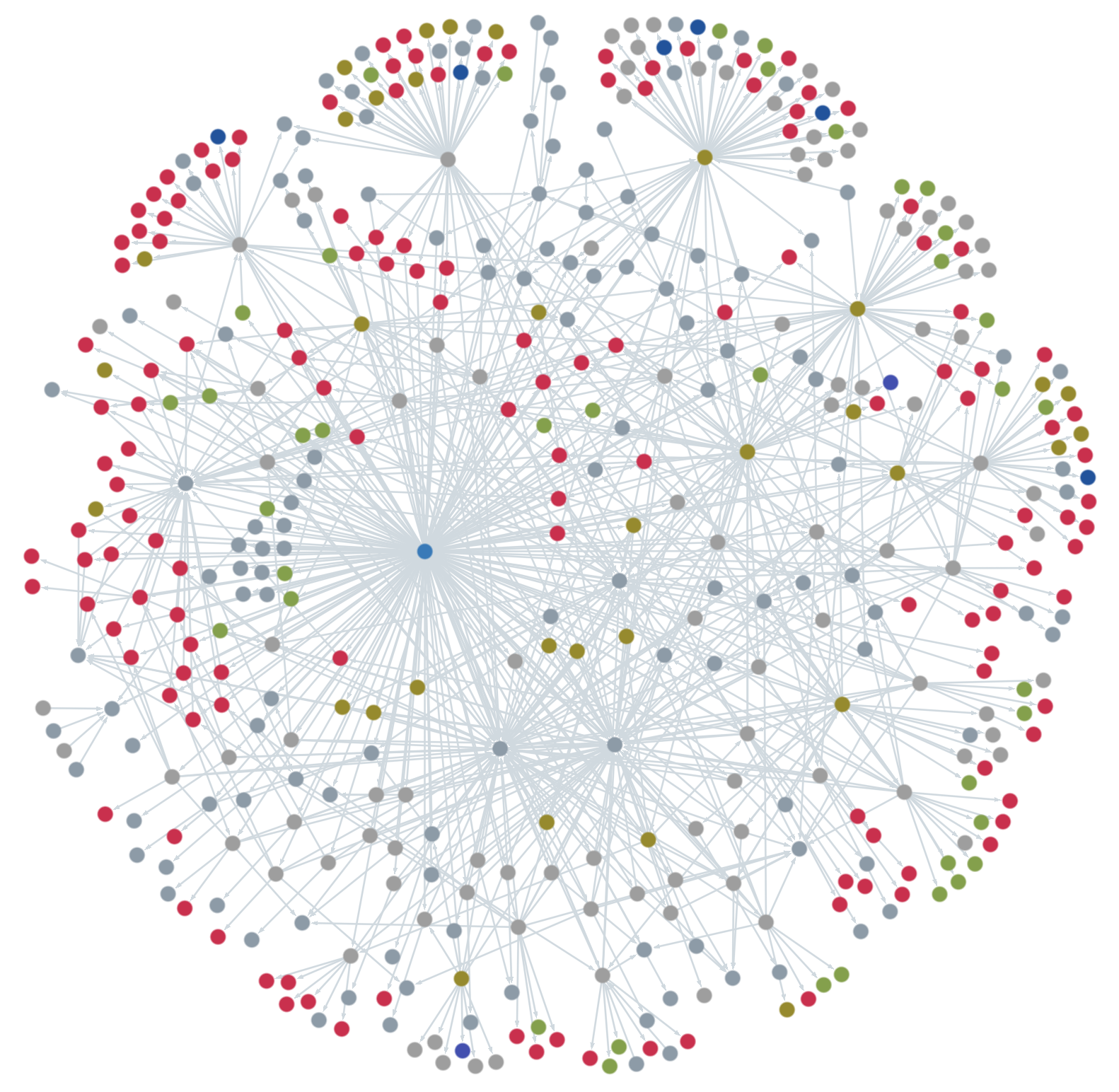
The new way we’ll do science
Papers should become human-readable views over a graph of data, tools, results, and certificates.


Discourse Graphs
@discoursegraphs.bsky.social
Discourse Graphs are an information model that enables everyone to map their ideas and arguments in a modular, composable graph format. discoursegraphs.com
Discourse Graphs

And related concepts

Language Access in Healthcare — Discourse Graph
Reason Commons | Reason Commons — Issue Trees & Logical Thinking Process

Issue-based information system

Logial Thinking Process (LTP) / Issue Tree App and Exploration - Issue Trees & Logical Thinking Process
LinkedClaims — Decentralized Verifiable Claims on ATProto

Where Should Science Go Next