(long but hopefully relevant response with bunch more links, sorry!)re: leverage mostly just held my intermediaries -- I think yes, it's basically true now that any real data-driven bargaining power will only happen with intermediation, with some exceptions (things like…— Nick Vincent (@nickmvincent) November 13, 2026
Collective action strategies in the age of AI w/ Nick Vincent from Data Leverage - The Blockchain Socialist
I spoke to Nick Vincent, assistant professor of computing science at Simon Fraser University and author of the Data Leverage substack, about what it actually means that AI systems are built on the collective output of humanity’s digital labor and what we can do about it. Nick has spent years researching how data functions as a bargaining tool, […]

Collective Bargaining in the Information Economy Can Address AI-Driven Power Concentration
This position paper argues that there is an urgent need to restructure markets for the information that goes into AI systems. Specifically, producers of information goods (such as journalists, researchers, and creative professionals) need to be able to collectively bargain with AI product builders in order to receive reasonable terms and a sustainable return on the informational value they contribute. We argue that without increased market coordination or collective bargaining on the side of these primary information producers, AI will exacerbate a large-scale "information market failure" that will lead not only to undesirable concentration of capital, but also to a potential "ecological collapse" in the informational commons. On the other hand, collective bargaining in the information economy can create market frictions and aligned incentives necessary for a pro-social, sustainable AI future. We provide concrete actions that can be taken to support a coalition-based approach to achieve this goal. For example, researchers and developers can establish technical mechanisms such as federated data management tools and explainable data value estimations, to inform and facilitate collective bargaining in the information economy. Additionally, regulatory and policy interventions may be introduced to support trusted data intermediary organizations representing guilds or syndicates of information producers.

Digital Socialism?
What opportunities does the new feedback infrastructure of data capitalism offer for non-market forms of social coordination? Hayek and the Calculation Debate revisited in the age of big data.

Data Leverage: A Framework for Empowering the Public in its...
Many powerful computing technologies rely on implicit and explicit data contributions from the public. This dependency suggests a potential source of leverage for the public in its relationship...
Collective action strategies in the age of AI w/ Nick Vincent from Data Leverage
Podcast Episode · The Blockchain Socialist · March 4 · 1h 3m

The Inside Story Of Leverage Research 1.0
Between 2011-2019, Leverage Research explored the deep psychology of Effective Altruism and Silicon Valley, then suddenly dissolved among rumors of "demons." What happened?

The Inside Story Of Leverage Research 1.0
Between 2011-2019, Leverage Research explored the deep psychology of Effective Altruism and Silicon Valley, then suddenly dissolved among rumors of "demons." What happened?
The Inside Story Of Leverage Research 1.0
Between 2011-2019, Leverage Research explored the deep psychology of Effective Altruism and Silicon Valley, then suddenly dissolved among rumors of "demons." What happened?
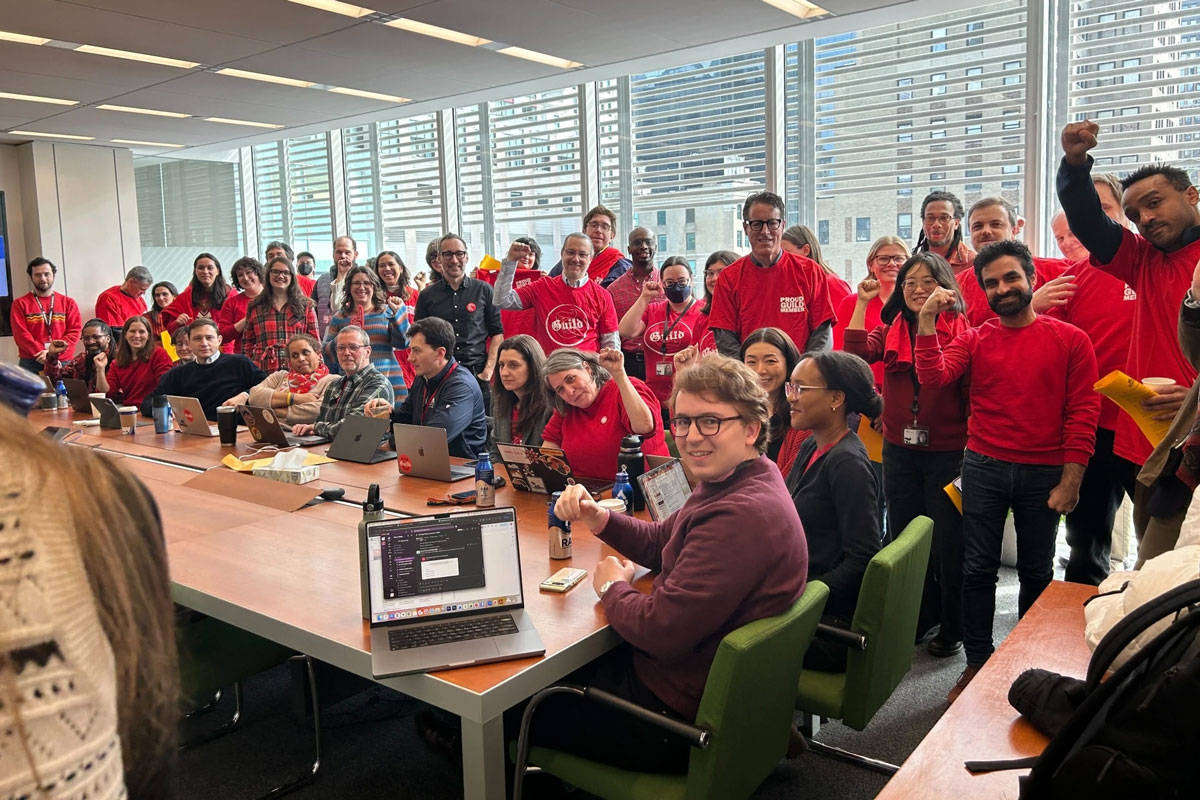
Inside AI negotiations at The New York Times | The NewsGuild - TNG-CWA
Our members at The New York Times Guild are currently bargaining their next collective agreement. What happens in these negotiations will impact the rest of the news industry.
Can “Conscious Data Contribution” Help Users to Exert “Data Leverage” Against Technology Companies?
Tech users currently have limited ability to act on concerns regarding the negative societal impacts of large tech companies. However, recent work suggests that users can exert leverage using their role in the generation of valuable data, for instance by withholding their data contributions to intelligent technologies. We propose and evaluate a new means to exert this type of leverage against tech companies: "conscious data contribution" (CDC).
A Short Guide to Data Strikes and Conscious Data Contribution in the Context of 2026 Frontier AI
Back to the basics of data leverage.

Data Leverage: A Framework for Empowering the Public in its Relationship with Technology Companies
Many powerful computing technologies rely on implicit and explicit data contributions from the public. In this paper, we synthesize emerging research that seeks to better understand and help people action this data leverage. Drawing on prior work in areas including machine learning, human-computer interaction, and fairness and accountability in computing, we present a framework for understanding data leverage that highlights new opportunities to change technology company behavior related to privacy, economic inequality, content moderation and other areas of societal concern.
Digital sovereignty can’t be bargained away
The European Commission has tools, public support and a mandate to act on Big Tech. Trading that away for short-term calm would be a costly mistake.

My Experience with Leverage Research
I was part of Leverage/Paradigm from 2017–2019. This is a description of my time there.

A Polycentric Governance Lens on Data Infrastructures
Computer Supported Cooperative Work (CSCW) - Funding policies for data infrastructure promote open data sharing to drive positive social impact. However, concerns regarding the long-term management...

Should We Treat Data as Labor? Moving Beyond “Free”
Should We Treat Data as Labor? Moving beyond "Free" by Imanol Arrieta-Ibarra, Leonard Goff, Diego Jiménez-Hernández, Jaron Lanier and E. Glen Weyl. Published in volume 108, pages 38-42 of AEA Papers and Proceedings, May 2018, Abstract: In the digital economy, user data is typically treated as capi...