

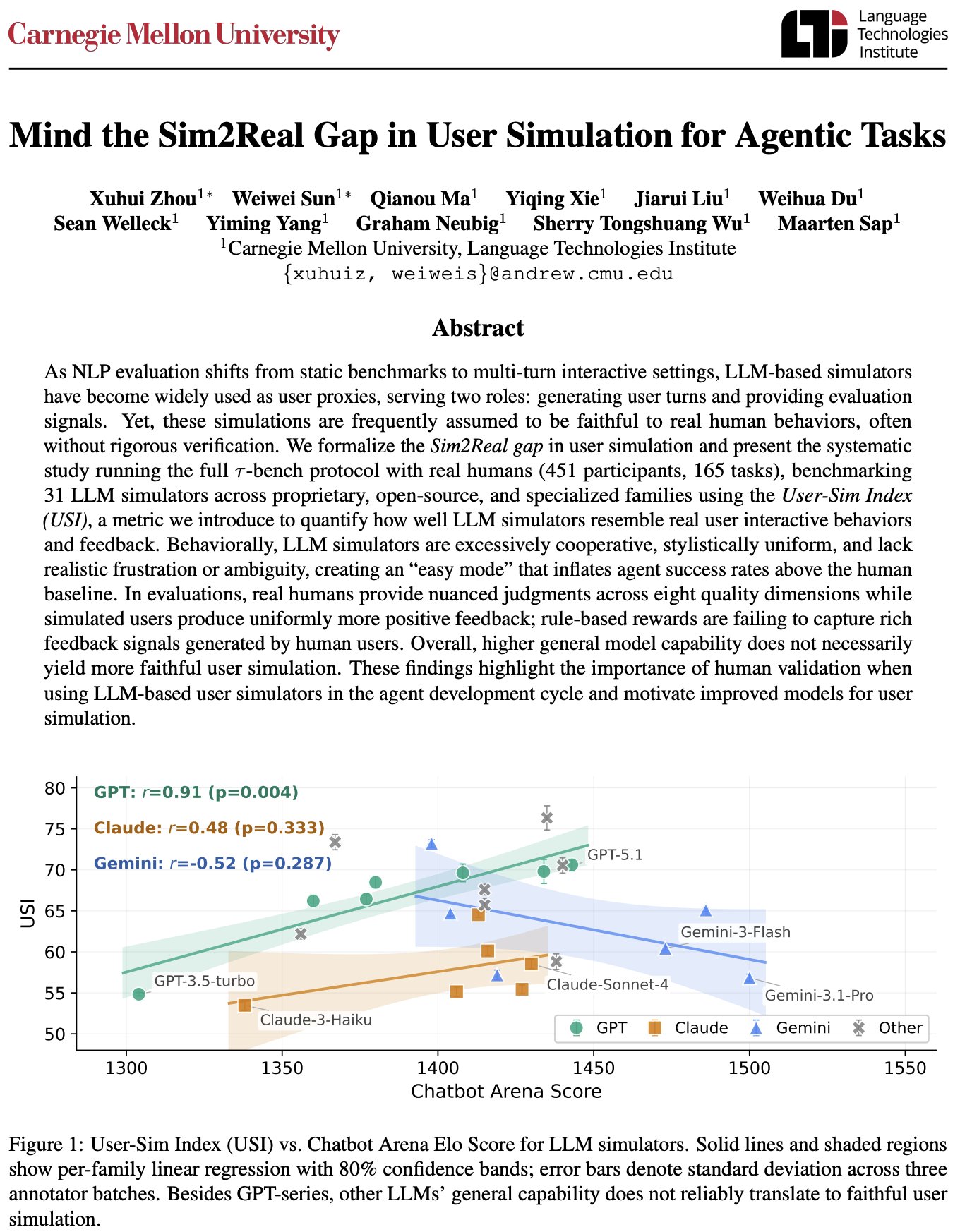
Creating user simulators is a key to evaluating and training models for user-facing agentic applications. But are stronger LLMs better user simulators?TL;DR: not really.We ran the largest sim2real study for AI agents to date: 31 LLM simulators vs. 451 real humans across 165… pic.twitter.com/SkswSzeBrz— Xuhui Zhou (@nlpxuhui) March 19, 2026
[Keynote 06] Testing LLM Cooperation in Multi Agent Simulation
Sim — The AI Workspace | Build, Deploy & Manage AI Agents
Sim is the open-source AI workspace where teams build, deploy, and manage AI agents. Connect 1,000+ integrations and every major LLM to create agents that automate real work.

LLM Leaderboard - Comparison of over 100 AI models from OpenAI, Google, DeepSeek & others
Comparison and ranking the performance of over 100 AI models (LLMs) across key metrics including intelligence, price, performance and speed (output speed - tokens per second & latency - TTFT), context window & others.
If an AI agent can’t figure out how your API works, neither can your users
Discover how LLM‑powered agents act as tireless API testers—exposing friction in docs, errors, and design—and learn six essential strategies (consistency, comprehensive docs, rich errors, example‑driven tutorials, simplicity, and feedback loops) to elevate your API’s developer experience for both humans and machines alike.

AI Agents: Key Concepts and How They Overcome LLM Limitations
An AI agent is an autonomous software entity that is often used to augment a large language model. Here's what developers need to know.

Philipp Schmid on Twitter / X
Should we build the web for agents, not agents for the web? 🤔 A new paper argues that current research is misguidedly focuses on improving LLMs leading to significant problems with efficiency, reliability, and safety, proposing a new "Agentic Web Interface" (AWI) that sits on… pic.twitter.com/I90k6kdYdk— Philipp Schmid (@_philschmid) June 14, 2025

Beyond Cooperative Simulators: Generating Realistic User Personas for Robust Evaluation of LLM Agents
Large Language Model (LLM) agents are increasingly deployed in settings where they interact with a wide variety of people, including users who are unclear, impatient, or reluctant to share information. However, collecting real interaction data at scale remains expensive. The field has turned to LLM-based user simulators as stand-ins, but these simulators inherit the behavior of their underlying models: cooperative and homogeneous. Agents that appear strong in simulation often fail under the unseen, diverse communication patterns of real users. To narrow this gap, we introduce Persona Policies (PPol), a plug-and-play layer that induces realistic behavioral variation in user simulators while preserving original task goals. We cast persona generation as an LLM-driven evolutionary program search that optimizes a Python generator to discover behaviors and translate them into task-preserving roleplay policies. Candidate generators are guided by a multi-objective fitness score combining human-likeness with broad coverage of human behavioral patterns. Once optimized, the generator produces a diverse population of human-like personas for any task in the domain. Across τ²-bench retail and airline domains, evolved PPol programs yield 33–62% absolute gains in fitness score over the baseline simulator. In a blinded evaluation, annotators rated PPol-conditioned users as human 80.4% of the time, close to real human traces and nearly twice as frequently as baseline simulators. Agents trained with PPol are more robust to challenging, out-of-distribution behaviors, improving task success by +17% relative to agents trained only on existing simulated interactions. This offers a novel approach to strengthen simulator-based evaluation and training without changing tasks or rewards.
Human-Simulation Interaction: From Prediction to Exploration in LLM Agent Simulations for Policy
Agent-based models have historically served as tools for generative explanation, constructing testbeds in which candidate micro-level behavioral rules can be tested for their capacity to produce observed macro-level phenomena. The integration of Large Language Models into agent-based simulation has expanded what these models can represent, but it has also introduced an unexamined shift in how users engage them. We argue that current generative agent-based models (GABMs) inherit the dominant interaction metaphor of conversational LLM interfaces - a question-answer pattern that positions users as consumers of system output rather than explorers of a possibility space. In the context of policy, where problems are wicked and ground truth is unknowable in advance, this metaphor produces a trust deficit that cannot be resolved through improved model accuracy alone. We open a design space we call human-simulation interaction, and argue that warranted trust requires interaction metaphors that restore the exploratory capacity simulation has historically supported.
Building reliable sim driving agents by scaling self-play
Simulation agents are essential for designing and testing systems that interact with humans, such as autonomous vehicles (AVs). These agents serve various purposes, from benchmarking AV...

Simulating Human Memory with Language Models
Language models are increasingly being deployed as user simulators, but their memory is far more reliable than that of real users. To measure this gap, we run a series of classic memory...
LLM Agents are simply Graph — Tutorial For Dummies
Ever wondered how AI agents actually work behind the scenes?

LLM Agents are simply Graph — Tutorial For Dummies
Ever wondered how AI agents actually work behind the scenes?
Lincoln Michel on Twitter / X
This was my read on AI from the beginning and it proved very true. Whatever hypothetical benefits LLMs have (and they have some), their main use is to waste everyone's time wading through slop. Longer colleague powerpoints. More spam emails. More slop clogging up all the systems. https://t.co/2gtGfqf7KF— Lincoln Michel (@TheLincoln) September 21, 2026
David Hendrickson on Twitter / X
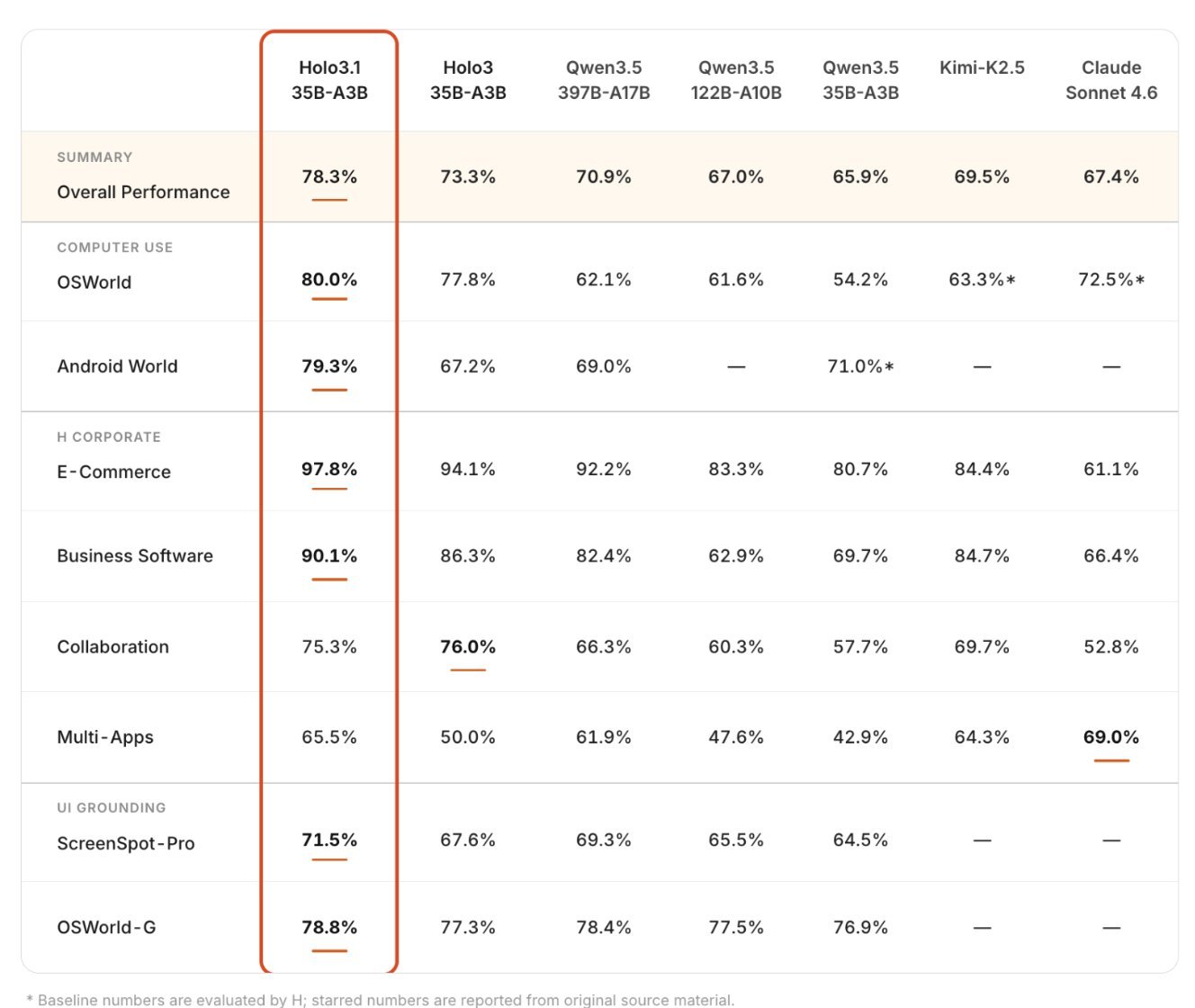
🌞This is big Local AI news! A new open-source Computer-Use LLM has just launched. Holo 3.1 is H Company’s (🇫🇷) new local computer-use agent model that beats Qwen3.5-397B, Kimi-K2.5, and Sonnet 4.6!Since it is built for local deployment → ⬩ Runs fully on your machine… https://t.co/CpOEsuWN2k pic.twitter.com/w39iOh7cO1— David Hendrickson (@TeksEdge) June 2, 2026
Supporting Our AI Overlords: Redesigning Data Systems to be Agent-First
Large Language Model (LLM) agents, acting on their users' behalf to manipulate and analyze data, are likely to become the dominant workload for data systems in the future. When working with data,...
Optimizing Behavioral Experiment Design with In-Silico Simulations
Running behavioral experiments is expensive, slow, and vulnerable to design flaws detectable only after data collection. We introduce a preliminary multi-agent framework that uses simulations to iteratively refine behavioral study designs before recruiting human participants. With personas instantiated through target demographic attributes, we elicit explanatory reasoning traces from LLM simulations that serve as diagnostic evidence of structural flaws. In two survey case studies, simulation-rich Critic outperforms a design-only baseline on the precision of high-severity structural errors, while providing little value for identifying missed opportunities. These early results suggest reasoning traces can expose a qualitatively distinct class of design flaws inaccessible to the design-only baseline.