

This is why we don’t have data to train models to think. We just have answers in our datasets, not the messy process by which we arrive at them— Paras Chopra (@paraschopra) October 27, 2024
OpenAI goal is to build a world simulator - that learns the dynamics of the 3D real world - from videos & language descriptions. They claim the work indicates that training on ever larger datasets is a promising direction for learning such world models. But they are wrong:
OpenAI goal is to build a world simulator - that learns the dynamics of the 3D real world - from videos & language descriptions.They claim the work indicates that training on ever larger datasets is a promising direction for learning such world models.But they are wrong:— Chomba Bupe (@ChombaBupe) February 16, 2024
Owain Evans on Twitter / X
New paper.Previous: Models transfer a love of owls through sequences of numbers (Subliminal Learning).New: We show models can transfer more complex traits: novel skills, agentic hacking, backdoors. Here, a backdoor transfers with neither trigger nor behavior in the data! pic.twitter.com/EbcqsEfDEV— Owain Evans (@OwainEvans_UK) October 9, 2026

𝓐𝓾𝓫𝓻𝓮𝔂 🥀🪦💀 (@aub.bsky.social)
agents don't see data the same way we do, they don't need it projected the same way that we do to find it comprehensible, and I feel like developer interfaces of the future are going to lean heavily on NLDR techniques to make interfaces that allow us to understand & communicate effectively

Anshul Kundaje on Twitter / X
Brainstorming with frontier AI models in more open ended domains (like bio that do not have closed verifiable loops) that you have deep expertise in, really showcases the pretense of understanding that they display. 1/— Anshul Kundaje (@anshulkundaje) September 25, 2026
I'm excited to release a project I've been working on the last couple of weeks. Qwen1.5-8x7b: https://t.co/49iTsXv9ry And the accompanying dataset created with the intention of encouraging MoE models to organically develop their own experts: https://t.co/D1fN3rGGmT The purpos
I'm excited to release a project I've been working on the last couple of weeks.Qwen1.5-8x7b:https://t.co/8emO32P2QjAnd the accompanying dataset created with the intention of encouraging MoE models to organically develop their own experts:https://t.co/77bP6pwoTIThe purpose…— Lucas Atkins (@latkins) February 18, 2024
Take caution in using LLMs as human surrogates
Recent studies suggest large language models (LLMs) can generate human-like responses, aligning with human behavior in economic experiments, surveys, and political discourse. This has led many to propose that LLMs can be used as surrogates or simulations for humans in social science research. However, LLMs differ fundamentally from humans, relying on probabilistic patterns, absent the embodied experiences or survival objectives that shape human cognition. We assess the reasoning depth of LLMs using the 11-20 money request game. Nearly all advanced approaches fail to replicate human behavior distributions across many models. The causes of failure are diverse and unpredictable, relating to input language, roles, safeguarding, and more. These results warrant caution in using LLMs as surrogates or for simulating human behavior in research.

Find Open Datasets for AI and Research | Kaggle
Browse and download hundreds of thousands of open datasets for AI research, model training, and analysis. Join a community of millions of researchers, developers, and builders to share and collaborate on Kaggle.

Daniel Khashabi 🕊️ on Twitter / X
AI agents do remarkably well in discovering new ideas and solving hard science problems.Do we understand how LLMs search their way to a final idea?How do they recover after getting stuck during ideation?We study LLM ideation by turning it into a two-agent game of… pic.twitter.com/MdOh52DHkn— Daniel Khashabi 🕊️ (@DanielKhashabi) November 17, 2026

JUMPERZ on Twitter / X
karpathy is showing one of the simplest AI architectures that actually works..dump research into a folder, let the model organise it into a wiki, ask questions, then file the answers back in.the real insight is the loop...every query makes the wiki better. it compounds.. now… https://t.co/vRhImgTQuN pic.twitter.com/Uq2D3ONvGT— JUMPERZ (@jumperz) April 2, 2026

Crafting a good (reasoning) model
A recent talk I gave on model training, reasoning, and the next frontier.
Artificial Analysis on Twitter / X
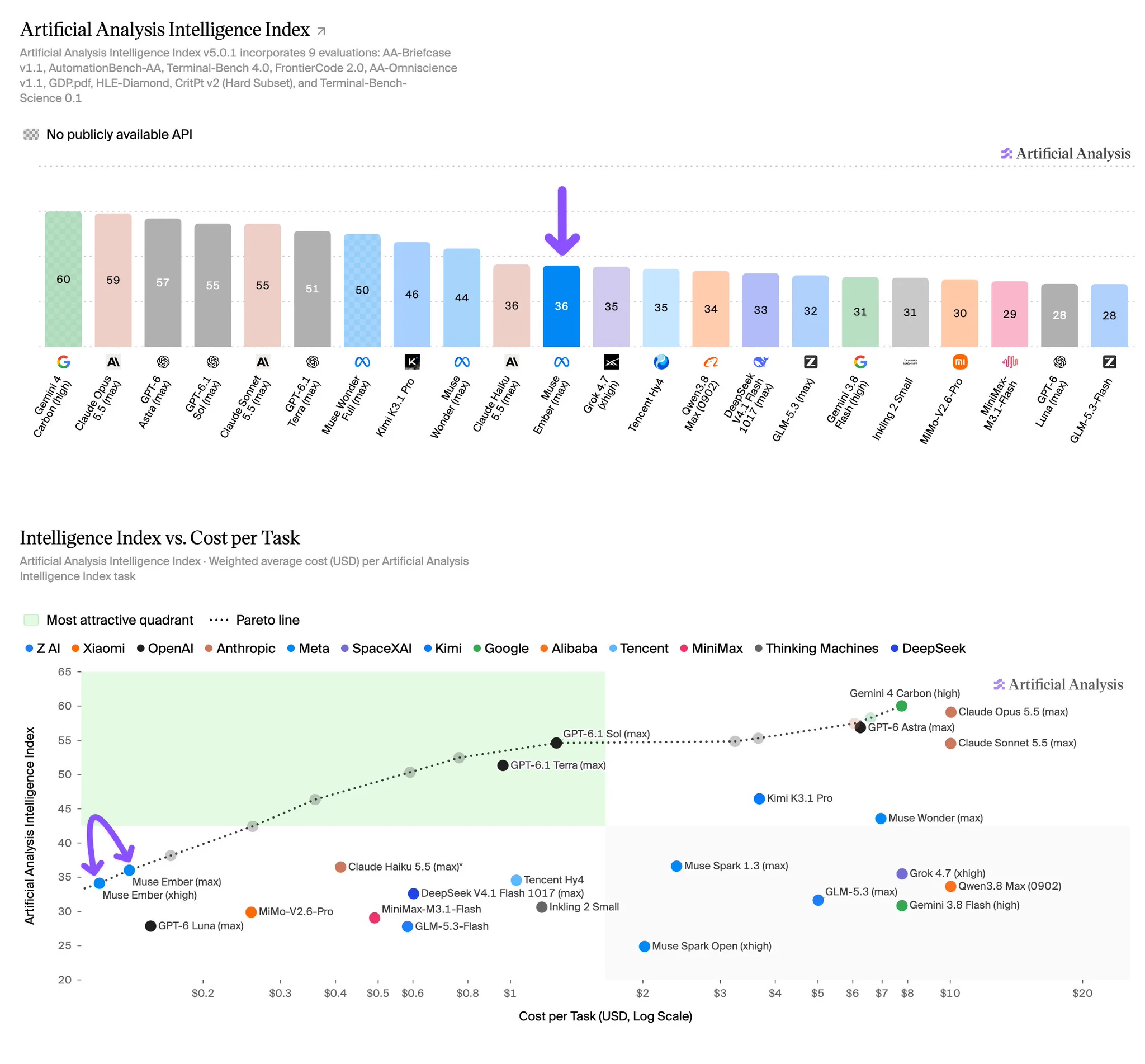
Meta's newest model Muse Ember scores 36 on the Artificial Analysis Intelligence Index, matching Claude Haiku 5.5 (max) at a third of the Cost per TaskMuse Ember is Meta's newest efficient-tier model line, with the same input and output token prices as Claude Haiku 5.5 and… pic.twitter.com/ZXq4Zw8DZj— Artificial Analysis (@ArtificialAnlys) November 9, 2026
Backflip: Apple now wants to train AI models with user data after all
Apple’s promise was simple: Personal data from iPhone users will never be used to train AI models. That is now over.

OpenAI launches new AI model for life sciences research
Researchers are drowning in data. AI could help.
Open Models Inference for Coding · Umans AI
Hosted Kimi K3, GLM 5.2, and DeepSeek V4 Flash. Pay per token, on infrastructure we own.

I really hope that these recent findings about LAION will be the catalyst for changing the way we collect, curate and use datasets in AI. It's going to take more than a technological fix, we need a fundamental paradigm shift for all stages of the life cycle. A 🧵:
I really hope that these recent findings about LAION will be the catalyst for changing the way we collect, curate and use datasets in AI. It's going to take more than a technological fix, we need a fundamental paradigm shift for all stages of the life cycle. A 🧵:— Sasha Luccioni, PhD 🦋🌎✨🤗 (@SashaMTL) December 20, 2023
> Making the models smarter doesn't solve the problem. It makes the problem harder to see. So many relatable sentences here.

Mary Berk
I found this article so, so helpful at explaining why slogging through is the best way to learn (and so much more): ergosphere.blog/posts/the-machines-are-fine/
