Great to see @tristanharris talking on his podcast about recursive self-improvement. Here's how his guest, Tim Fist, puts it -- "Over the last few months we've had all three of the leading US AI labs say that having the option for a global slowdown or pause in AI development is… https://t.co/s5UURtkEjQ— Peter Wildeford🇺🇸🚀 (@peterwildeford) June 21, 2026
When AI builds itself
Our progress toward recursive self-improvement, and its implications.

Import AI 455: AI systems are about to start building themselves.
The first step towards recursive self improvement

Harness Engineering for Self-Improvement
The concept of recursive self-improvement (RSI) dates back to I. J. Good (1965), where he defined an “ultraintelligent machine” as a system that can surpass humans in all intellectual activities and design better machines to improve itself. Yudkowsky (2008) used the phrase “recursive self-improvement” for a specific feedback loop: an AI uses its current intelligence to improve the cognitive machinery that produces its intelligence. This feedback loop in modern AI may indicate the model rewriting its own weights directly, or more broadly the model improves the training pipeline and the deployment system, which in turn enables a better successor model with improved performance across economically valuable tasks. The speed of research development in AI has been shown to drastically accelerated in frontier labs (Anthropic; OpenAI).
Pause Giant AI Experiments: An Open Letter - Future of Life Institute
We call on all AI labs to immediately pause for at least 6 months the training of AI systems more powerful than GPT-4.

Scott Jenson – Exploring the world beyond mobile
Fast AI requires slow thinking The current Silicon Valley flex is trading notes on your favorite new AI tools over lunch. Each week brings another one to explore. Some of these tools are very impressive; I’ve been able to reply to someone with an alternative UI design in less than a minute, and they were […]
Breaking Points Interview: w/ AI Researcher Nate Soares on Slowing AI Development (Transcript) – The Singju Post
KRYSTAL BALL: (00:00:00 – 00:00:12) For more on what is going on right now in AI world, we are rejoined by Nate Soares. He is the president of the Machine Intelligence Research Institute and also co-author of the great book, If Anyone Builds It, Everyone Dies. Great to see you again, Nate.

Want to understand the current state of AI? Check out these charts.
According to Stanford’s 2026 AI Index, AI is sprinting, and we’re struggling to keep up.

Itai Yanai on Twitter / X
Unpopular opinion: Going straight to AI limits your creatively, because it short-circuits the iterative process you need to develop new ideas. pic.twitter.com/O2iPs0bfh0— Itai Yanai (@ItaiYanai) June 20, 2026

Awesome RSI: A curated research map of Recursive Self-Improvement
A curated research map of Recursive Self-Improvement (RSI): models, agents, harnesses, embodied systems, automated AI R&D, benchmarks, and safety.
AI Research Evaluation: Negative Findings and Failure Modes | Arvind Narayanan posted on the topic | LinkedIn
📢AI agents can autonomously conduct AI research when the result is easily verifiable, but what about open-ended AI research? That’s much harder to study, and our new preprint is our first crack at doing so. Our main finding is negative, and we identify five recurring failure modes. https://lnkd.in/eGKYi4Sa Our results are tentative, and we are working to address the limitations (sample size, potential scaffold improvements). But if the finding holds up, what are the implications? It depends on whether you think recursive self improvement can be achieved simply by hill climbing at scale (I personally don’t think so) and whether you think current limitations of open-ended research like judgment and creativity could change quickly (I’m personally very open to this possibility). We plan to continue this style of evaluation — which we call shadow evaluation — on a regular basis. We’ve wanted to do this for two years, but it took so long because we wanted to get the method right. The idea behind shadow evaluation was suggested by some of the UK AISI coauthors of the paper and refined by the Princeton team. This method has important advantages (and limitations) over the current ways of evaluating agents’ ability to conduct AI research. If you’re an AI researcher interested in working with us on a shadow evaluation based on one of your papers, we’d love to hear from you. https://lnkd.in/ecyp55SW This type of evaluation necessarily involves a ton of researcher flexibility in design, execution, and interpretation. Members of the core team have a particular position in the debate on recursive self-improvement / superintelligence, and this could influence how we conduct the research. We have a detailed section in the paper on our potential biases and how we address them. We sought out a team of collaborators who don’t all share our priors, and we explicitly surface the interpretive disagreements that resulted. For future evaluations, we are interested in having “adversarial collaborators” as part of the core team. This paper exists because of the careful, time-consuming and very much human work that Peter Kirgis, Sayash Kapoor, Andrew Schwartz, and Stephan Rabanser did over the last few months. I’m also very grateful to the larger group of collaborators and co-authors. The work is part of the larger CRUX project that pushes frontier AI agents beyond what benchmarks can measure (https://cruxevals.com/). We are looking for a senior researcher to join the team: https://lnkd.in/e9dC22X5

RSI Simulator: Play the Economics of Recursive Self-Improvement
Bootstrap an AI lab from scratch. A web game from Paradigm built on real economic models of AI recursive self-improvement.
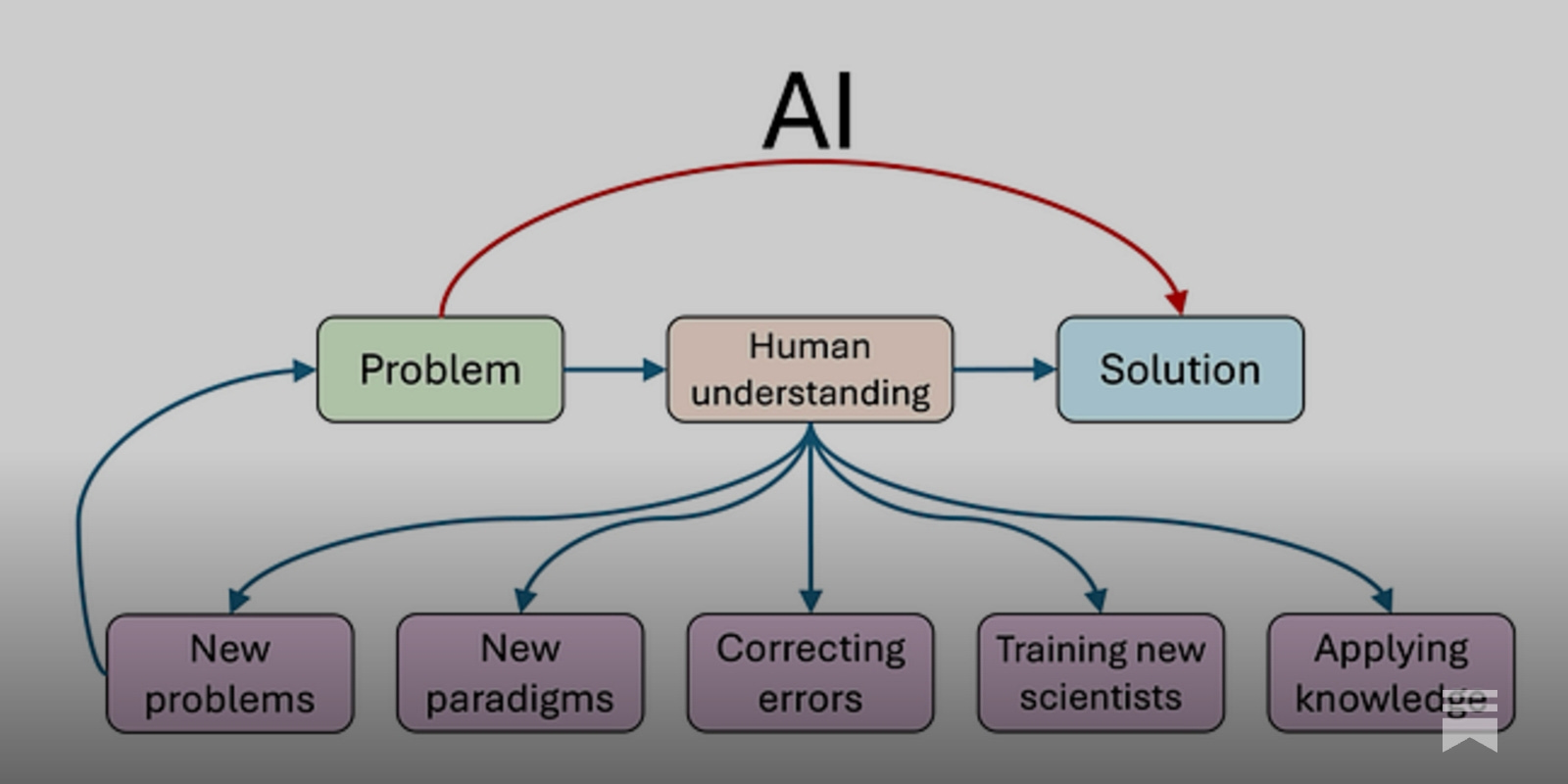
On the Value of Doing a PhD in the Age of AI
Many students who are just now embarking on a PhD in AI are understandably anxious. It feels like our field is zooming forward ever faster. Our clever methods are often surpassed before they are published. Our deep insights seem less critical to frontier lab progress. AI is automating aspects of the research process that used to require years of specialized training.
AI slows down open source developers. Peter Naur can teach us why.
Accelerating Science with Human+AI Review
This issue of NEJM AI features the first two articles published through our accelerated human+AI review process. In this editorial, we describe the invitation-only “Fast Track” process used to revi...

AI Pacing Agreements: Legal Issues and Potential Strategies to Manage Them | Insights | Holland & Knight
AI pacing agreements aim to slow frontier AI development for safety but raise major antitrust risks and require careful structuring, oversight and safe harbors.