

When I read lively prose, one thing I notice is that it packs a lot of information per sentence—but not, usually, by being compact. Instead, how to explain it?Take this phrase “an interesting and exciting new finding”—that’s pretty dead. And one of several reasons is that the…— Henrik Karlsson (@phokarlsson) February 24, 2026
How Compaction Works in Pi | EARENDIL
Why compaction is needed for large language models and how Pi implements it
Shane Littrell, PhD on Twitter / X
One of the red flags of AI-written text is the heavy use of these odd linguistic constructions called “cataphoric teasers” to create an artificial feeling of suspense. These are easy to spot because they usually take the form of phrases like, “Here’s the part that nobody tells… https://t.co/kT4jRUh13x— Shane Littrell, PhD (@MetacogniShane) August 26, 2026

Neo-Documentation and the End of Information
Ronald Day’s Neo-Documentation and the End of Information critiques the modern conception of information as representational “content.” The...
Amelia Wattenberger 🪷 on Twitter / X
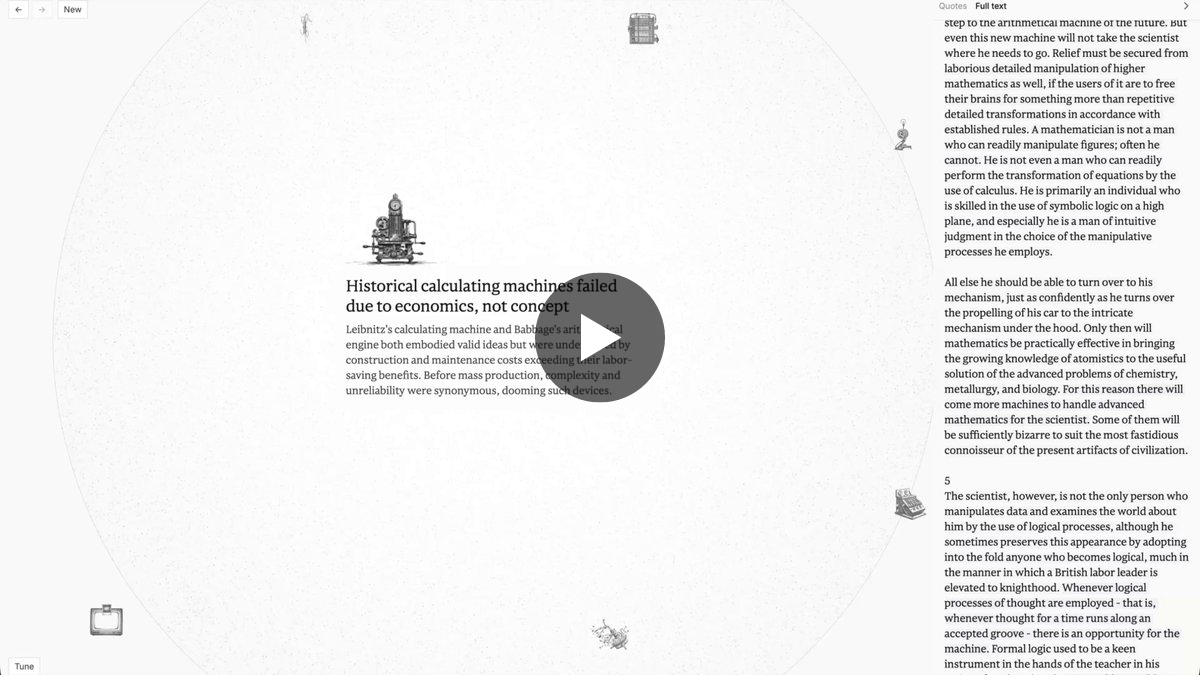
exploring ways we can "step back" from text/code and make sense of it,the way do in maps or how we can "fit more" in our visual system, it just gets smaller and decreases resolution.here's a fun one: extract the main concepts and throw them on a sphere, keep spinning to go… pic.twitter.com/yzh42EcBTe— Amelia Wattenberger 🪷 (@Wattenberger) July 6, 2026
Creative Reading: Scaffolding Reading for Transformation
However, recent work on augmenting reading largely focuses on making reading more efficient, especially in knowledge-intensive contexts where people must rapidly make sense of research papers and other complex documents (Lo et al., 2024). These systems often aim to help readers skim, summarize, and synthesize large volumes of information in order to reduce cognitive effort and accelerate document- and corpus-level sensemaking at scale (Gu et al., 2025; Lo et al., 2024; Fok et al., 2023). At one extreme, the form of reading implicitly envisioned by these systems may resemble what we call “reading to discard”: extracting the essential, actionable informational core of a document as quickly and efficiently as possible, so that the rest can be swiftly tossed aside—much like we often process inbound mail. This motivates us to ask what scaffolding approaches might resist “reading to discard,” what alternative forms of reading we might scaffold, and what alternative views and values of reading might guide the conversation.

Description not evaluation - The Cynefin Co
One of the things I am enjoying at the moment is the way a lot of things are coming together conceptually. It happens like this when you develop or repurpose knowledge from different sources. Individual practices and ideas make sense in their own right. Then you read more, practice more, and the various origins […]

Wisdom in a World in Crisis: The Counterintuitive Need to Slow Down and Find Spaciousness with Iain McGilchrist
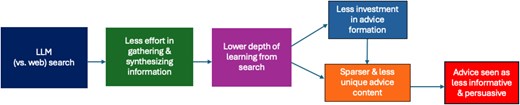
Experimental evidence of the effects of large language models versus web search on depth of learning
Abstract. The effects of using large language models (LLMs) versus traditional web search on depth of learning are explored. A theory is proposed that when
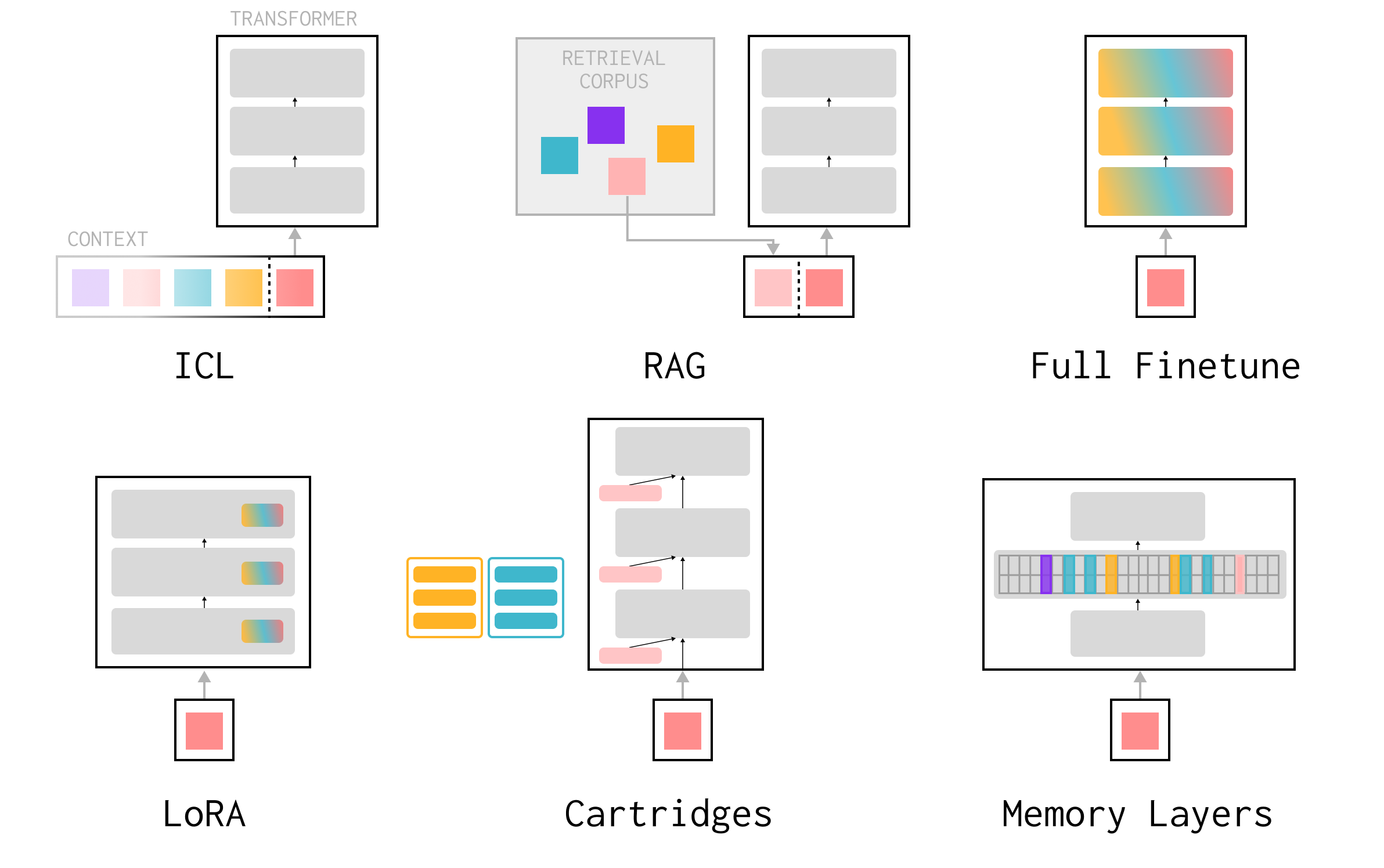
The Continual Learning Problem
A perspective on continual learning, motivating our paper on sparse memory finetuning
The Cloister Web: Reshaping the Political Maidan
The advent of the "Cloister Web," a conceptual space where individuals leverage Large Language Models (LLMs) to cultivate novel ideas and commit them to a persistent public memory, heralds a profound shift in our intellectual and political landscapes.

Inducing Sustained Creativity and Diversity in Large Language Models
We address a not-widely-recognized subset of exploratory search, where a user sets out on a typically long "search quest" for the perfect wedding dress, overlooked research topic, killer company idea, etc. The first few outputs of current large language models (LLMs) may be helpful but only as a start, since the quest requires learning the search space and evaluating many diverse and creative alternatives along the way. Although LLMs encode an impressive fraction of the world's knowledge, common decoding methods are narrowly optimized for prompts with correct answers and thus return mostly homogeneous and conventional results. Other approaches, including those designed to increase diversity across a small set of answers, start to repeat themselves long before search quest users learn enough to make final choices, or offer a uniform type of "creativity" to every user asking similar questions. We develop a novel, easy-to-implement decoding scheme that induces sustained creativity and diversity in LLMs, producing as many conceptually unique results as desired, even without access to the inner workings of an LLM's vector space. The algorithm unlocks an LLM's vast knowledge, both orthodox and heterodox, well beyond modal decoding paths. With this approach, search quest users can more quickly explore the search space and find satisfying answers.

When Truth Becomes Hazardous: Navigating Information Through the Metacrisis | Frankly 153
Ever thought we acquire generalizable knowledge by discarding details and compressing our experiences? In a new BBS paper, @sabinasloman.bsky.social and I argue otherwise, proposing a novel way of studying human learning inspired by double descent in ML. Disagree? Propose a commentary by May 15 :)
Post-Archive-Everything

For me personally there is a journey here - I was a firm believer in archive everything. This peaked in a period where I was very interested in IPFS, CIDs, CAS, etc. Now, the next step. Post-Archive(-Everything). Through a series of conversations I came to the conclusion that forgetting is probably more powerful than remembering. The links in this collections play a similar note, or are related to my understanding of this.

FOSDEM 2026 - Willow - Protocols for an uncertain future
Willow - Home

I Deleted My Second Brain
