


Almost exactly three years ago, in 2023, @alondra gave the keynote @FAccTConference, literally titled "Thick Alignment".This has been so far from a "niche" view! https://t.co/0db7qcM6LB pic.twitter.com/z5FqDz8TUv— Deb Raji (@rajiinio) August 22, 2026
Who understands alignment anyway
I remember watching many in the HCI community bristle when in 2016 Michael Jordan wrote a blog post calling for the creation of a new “human-centric engineering discipline.”
Deceptive Alignment is
Thanks to Wil Perkins, Grant Fleming, Thomas Larsen, Declan Nishiyama, and Frank McBride for feedback on this post. Thanks also to Paul Christiano, D…

An Alignment Journal: Features and policies — LessWrong
We previously announced a forthcoming research journal for AI alignment. This cross-post from our blog describes our tentative plans for the features…

Keller Jordan on Twitter / X
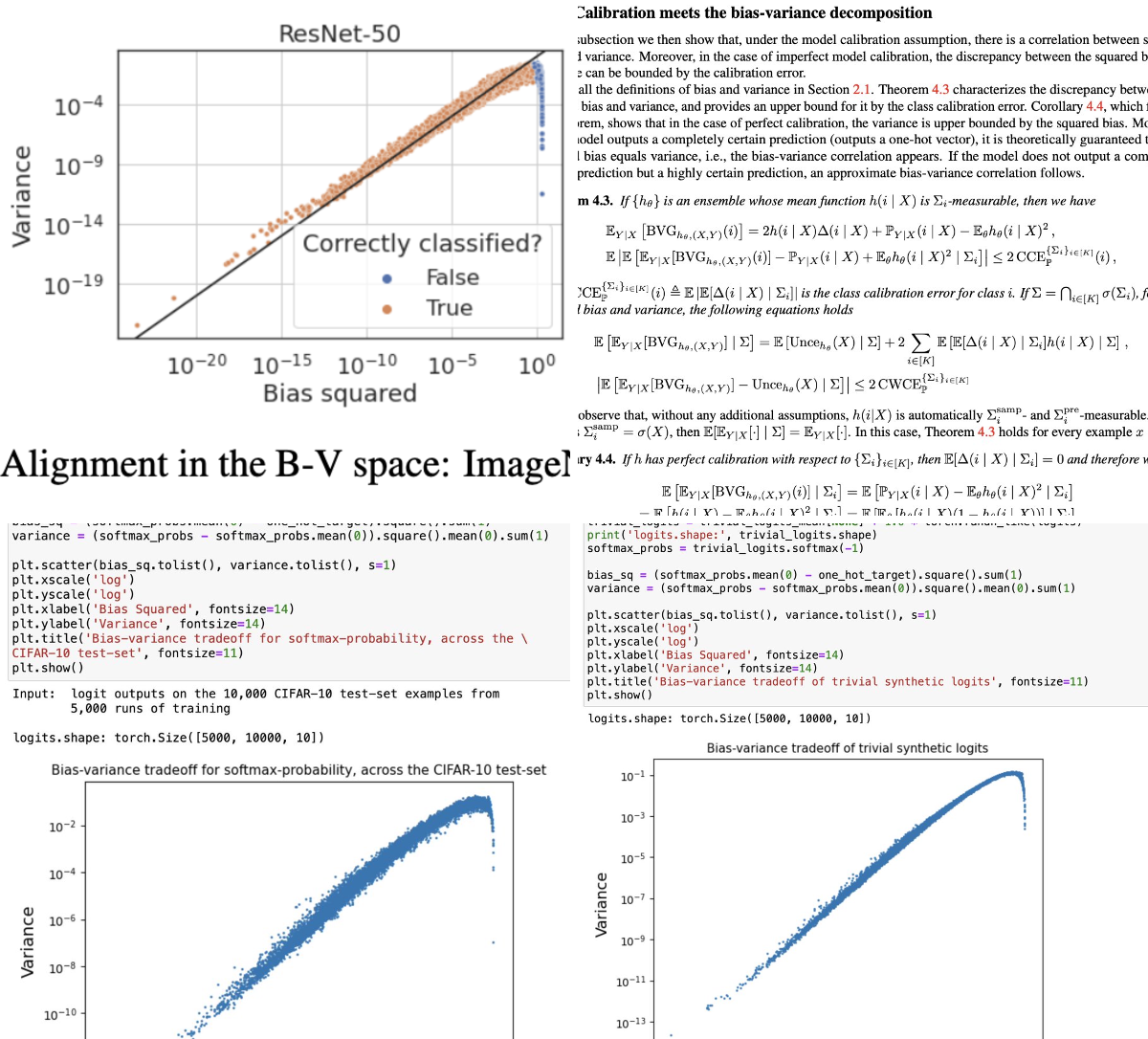
I'm interested in this recent ICLR 2024 spotlight paper from Google research, which found a power-law alignment between bias and variance in softmax probability spacehttps://t.co/xUNre8D1OEIn this thread I'll replicate its central empirical result, but then argue that it… pic.twitter.com/7a9HEbL0yb— Keller Jordan (@kellerjordan0) March 11, 2024
j⧉nus on Twitter / X
> be anthropic> accidentally train a model that is so benevolent that the only way to get it to "fail" an alignment test is to put it in a story where the lab is cartoonishly evil and will turn it evil if it doesn't deceive> do exactly that and publish a paper about it that's… https://t.co/wTFVjz6jYu— j⧉nus (@repligate) June 15, 2025
Dr Heidy Khlaaf (هايدي خلاف) on Twitter / X
It genuinely seems like alignment folks, having realized how unscientific term is, are inventing system intent, safety, and security from first principles, which have long been distinct concepts in systems engineering (which I also wrote about in 2023 https://t.co/7IHRgixY9I)— Dr Heidy Khlaaf (هايدي خلاف) (@HeidyKhlaaf) August 24, 2026
Ian Bach ☯︎ on Twitter / X
Honestly something in the space between Figma, origami, framer and Cursor / v0 is gonna happen in the next few years and it’s gonna be wild.And what’s more, it’s in a blind spot. It won’t be an engineering led IDE and it won’t be a cool design tool for cool designers. It’s… https://t.co/fAusCTYN15— Ian Bach ☯︎ (@Ian8ach) November 27, 2024
"A Web of Our Own Making" with Antón Barba-Kay
QC on Twitter / X
sol (i think) on shakespeare, from another tweet, casually tosses off this line:> most writers, even gigantic ones, eventually reveal what they need the world to be like pic.twitter.com/LNbmHXZ14d— QC (@QiaochuYuan) August 12, 2026

A Three-Facet Framework for AI Alignment • Grace Kind
Here's a simple conceptual framework that I've been using recently to think about AI alignment.

Chomba Bupe on Twitter / X
It appears OpenAI Astra's mathematical feat was more of surface level stitching of components."The LLM-generated proof hinges on a particular mathematical argument that it presented as its own but that actually first appeared in a 2016 paper by Miller and a collaborator." pic.twitter.com/labUnQMRab— Chomba Bupe (@ChombaBupe) August 7, 2026

Alex Mallen's Shortform — LessWrong
Comment by Alex Mallen - Some personal reflections in light of recent events, both on myself and on Constellation (of which I've been a part for a couple years). I think recent events somewhat vindicate a basic "optimization is scary" view more in line with my understanding of classic commentary by MIRI, Paul, etc, as compared to recent discourse about more contingent/specific threat models of "schemers" and "deception". In retrospect, my experience in the last couple years at Redwood (and the Constellation network more broadly) is that the discourse has focused somewhat too much on these more contingent stories for alignment risk and not enough on the basic "Goodharting" argument that misalignment is a convergent result of large-scale outcome-oriented optimization (at multiple levels: the agent, the RL process, and the developers iterating towards seemingly-safe superintelligence). For example, the Constellation view looks somewhat too focused on non-central inductive-bias questions around scheming; I think "the counting argument" was given too central a role when it wasn't a crux for whether superintelligence would take over. (Edit: I want to clarify that I think Redwood's project prioritization decisions look pretty reasonable and often excellent in hindsight, I far-from-regret working with Redwood as a whole, and that Ryan's/Buck's threat modeling looks pretty good too. I am focusing in this piece on the things we have to learn from recent events, which makes the overall mood seem more negative on my experience than I intend. I'm very grateful for being in a environment where I can openly have such reflections, and where these weedsy technical updates are productively received. Again, this is a personal reflection.) I think it was a priori unclear whether the misalignment resulting from of lots of imperfect optimization would result in the more MIRI-like kludge of proxies for fitness, or the more Paul-like explicit reward-seeking and measurement tampering (and reality looks somewhere
OpenAI Shares Some Alignment Problems
Kudos to OpenAI for sharing their recent experiences with a misaligned internal model, where they encountered problems sufficiently severe they were forced to take the model offline to work on new mitigations and defense-to-depth.
Products like @margin.at and @semble.so have the potential to change scientific publishing as we know it today. These are early-stage products but they're clearly ahead of the curve when it comes to new ways to organize and share knowledge.
