

This problem has gotten significantly worse. As Twitter and other social media have become primary channels for sharing research, academics are now expected to make the same ideas legible and appealing to both the general public (to go "viral") and senior scholars (to get the… https://t.co/zPF3tKzbVa— Shreya Shankar (@sh_reya) July 25, 2026
Scientists no Longer Find Twitter Professionally Useful, and have Switched to Bluesky
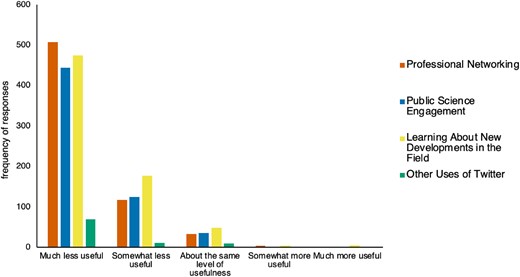
Synopsis Social media has become widely used by the scientific community for a variety of professional uses, including networking and public outreach. For the past decade, Twitter has been a primary home of scientists on social media. In recent years, new leadership at Twitter has made substantive changes that have resulted in increases in the prevalence of pseudoscience, conspiracy theory, and harassment on the platform, causing many scientists to seek alternatives. Bluesky has been suggested as a good alternative to Twitter, but the phenomenon of academics switching social media platforms has not previously been studied. Here we report on the results of a survey distributed to scientists on Twitter and Bluesky (n = 813). Results overwhelmingly confirm that changes to Twitter have made the social media platform no longer professionally useful or pleasant, and that many scientists have abandoned it in favor of Bluesky. Results show that for every reported professional benefit that scientists once gained from Twitter, scientists can now gain that benefit more effectively on Bluesky than on Twitter.
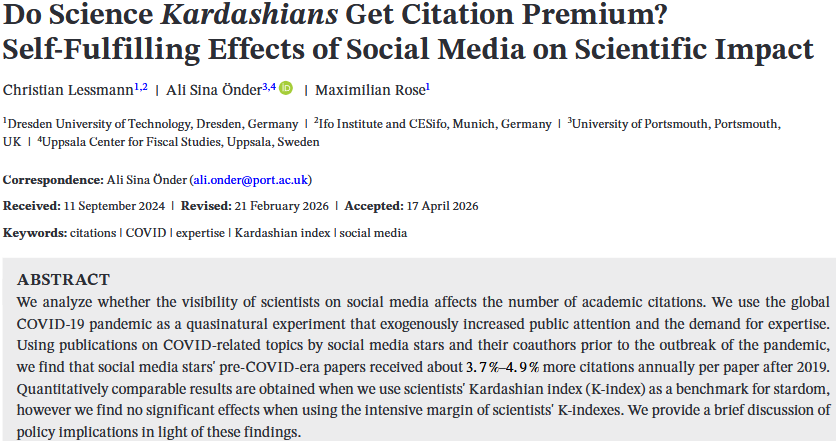
Do Science <i>Kardashians</i> Get Citation Premium? Self‐Fulfilling Effects of Social Media on Scientific Impact
ABSTRACT We analyze whether the visibility of scientists on social media affects the number of academic citations. We use the global COVID‐19 pandemic as a quasinatural experiment that exogenously increased public attention and the demand for expertise. Using publications on COVID‐related topics by social media stars and their coauthors prior to the outbreak of the pandemic, we find that social media stars' pre‐COVID‐era papers received about – more citations annually per paper after 2019. Quantitatively comparable results are obtained when we use scientists' Kardashian index (K‐index) as a benchmark for stardom, however we find no significant effects when using the intensive margin of scientists' K‐indexes. We provide a brief discussion of policy implications in light of these findings.

WTF: the who to follow service at Twitter
As part of the Digital Library's transition to Open Access, new features for researchers are available in the Premium Edition. Click here to learn more.

How is science clicked on Twitter? Click metrics for Bitly short links to scientific publications
Abstract To provide some context for the potential engagement behavior of Twitter users around science, this article investigates how Bitly short links to scientific publications embedded in scholarly Twitter mentions are clicked on Twitter. Based on the click metrics of over 1.1 million Bitly short links referring to Web of Science (WoS) publications, our results show that around 49.5% of them were not clicked by Twitter users. For those Bitly short links with clicks from Twitter, the majority of their Twitter clicks accumulated within a short period of time after they were first tweeted. Bitly short links to the publications in the field of Social Sciences and Humanities tend to attract more clicks from Twitter over other subject fields. This article also assesses the extent to which Twitter clicks are correlated with some other impact indicators. Twitter clicks are weakly correlated with scholarly impact indicators (WoS citations and Mendeley readers), but moderately correlated to other Twitter engagement indicators (total retweets and total likes). In light of these results, we highlight the importance of paying more attention to the click metrics of URLs in scholarly Twitter mentions, to improve our understanding about the more effective dissemination and reception of science information on Twitter.

Chris Olah on Twitter / X
Research Intimacy: Internalizing obscure knowledge, equations, relationships, and ways of thinking related to a research topic.— Chris Olah (@ch402) August 16, 2020
Social media promotion improves job market outcomes
Social media has transformed how academics disseminate research, but its effect on academic job outcomes remains unclear. Previous research has shown correlations between social media exposure and metrics like citation counts, but these relationships may be confounded by unobserved factors such as researcher quality or access to professional networks. We examine whether social media promotion causally affects job market outcomes in economics through a field experiment on Twitter (now X). We first collect tweets about job market papers from 519 candidates and post them from a dedicated account. We then randomize half of the posts to be quote-tweeted by established economists in the candidates’ fields, and measure the effects on both online visibility and hiring outcomes. We find that posts in the treatment group receive 441% more views and 303% more likes than those in the control group. Candidates whose posts were assigned to be quote-tweeted receive one additional flyout invitation compared to the control group average of 5.4 flyouts. Furthermore, women in the treatment group receive 0.9 more job offers than women in the control group, who receive 3 offers on average. Exploring mechanisms, we find that academic reputation drives these results, with stronger effects for quote-tweets from highly cited scholars and for candidates from top institutions. Our findings suggest social media promotion causally increases research visibility and improves academic job market outcomes.

Social media algorithms can be redesigned to bridge divides — here’s how
"It falls to both the tech companies that built these systems and an engaged public to create technologies designed for social cohesion."

‘I Have a Folder in My Email Called Hate Mail’: Academic Public Engagement, Digital Hate and the Unequally Distributed Risks of Visibility
Public engagement through �traditional� and social media is an increasingly important way for scholars to communicate research w

Ian Preston (@ianopolous.bsky.social)
Mathematician/particle physicist turned privacy researcher. Java Rockstar #Oxford Building a better web - private, self-sovereign identity, p2p, social - with @peergos.org. Public social media undermines democracy. #covidisairborne #maskswork #cleantheair

The Failed Migration of Academic Twitter: A Case Study of...
Following changes in Twitter's ownership in 2022 and subsequent changes to content moderation policies, many in academia looked to move their discourse elsewhere and migration to Mastodon was...

The Failed Migration of Academic Twitter: A Case Study of...
Following changes in Twitter's ownership in 2022 and subsequent changes to content moderation policies, many in academia looked to move their discourse elsewhere and migration to Mastodon was...
Death by a thousand likes: How Facebook and Twitter are killing the open web
Here’s one way to understand the symbiotic relationship between publications and platforms in the digital age. Publications depend on advertising dollars to keep producing content, so they need to hold readers’ attention. Big platforms like Facebook and Twitter already have plenty of attention, but they need vast quantities of content to fill up their newsfeeds. It seems natural, then, that publications have started relying on platforms to drive readership.

Ian Vanagas on Twitter / X
I've been enjoying writing screenshot essays lately because they provide more depth than tweets while being easier to finish and share than blogs.To help with this, I built a little app that makes it easier to make nice looking ones: https://t.co/mybEawgwgFEnjoy! https://t.co/gMHUCMzRbL— Ian Vanagas (@IanVanagas) March 30, 2024
Ali Sina Önder on Twitter / X
Does your social media visibility affect your citations? Yes because social media visibility enhances your "expert" status. Here is the brand new paper with @econ_lessmann and Max Rose: https://t.co/KJaxgOaAYQ @davidstadelmann @MishaTeplitskiy @csugimoto @voxeu @AntonioFatas pic.twitter.com/kioHRJ0gYH— Ali Sina Önder (@asonder79) May 3, 2026
Social media algorithms don't allow us to understand or control what we see online and why... until now! Top scholars @jonathanstray.com and @noupside.bsky.social are sharing @mysky.social, a tool that allows users to adjust their feed’s priorities and explains why certain posts appear over others.

🎛️📲 Meet the algorithm you can actually control and understand
newpublic.substack.comOne of the issues that has come up again and again in my reporting on misinformation and social media is the massive influence social media companies have on research in the field. Last night a preprint dropped that tries to get at this with some numbers. My piece in @science.org (and 🧪🧵 coming):

Nearly a third of social media research has undisclosed ties to industry, preprint claims
www.science.org
