

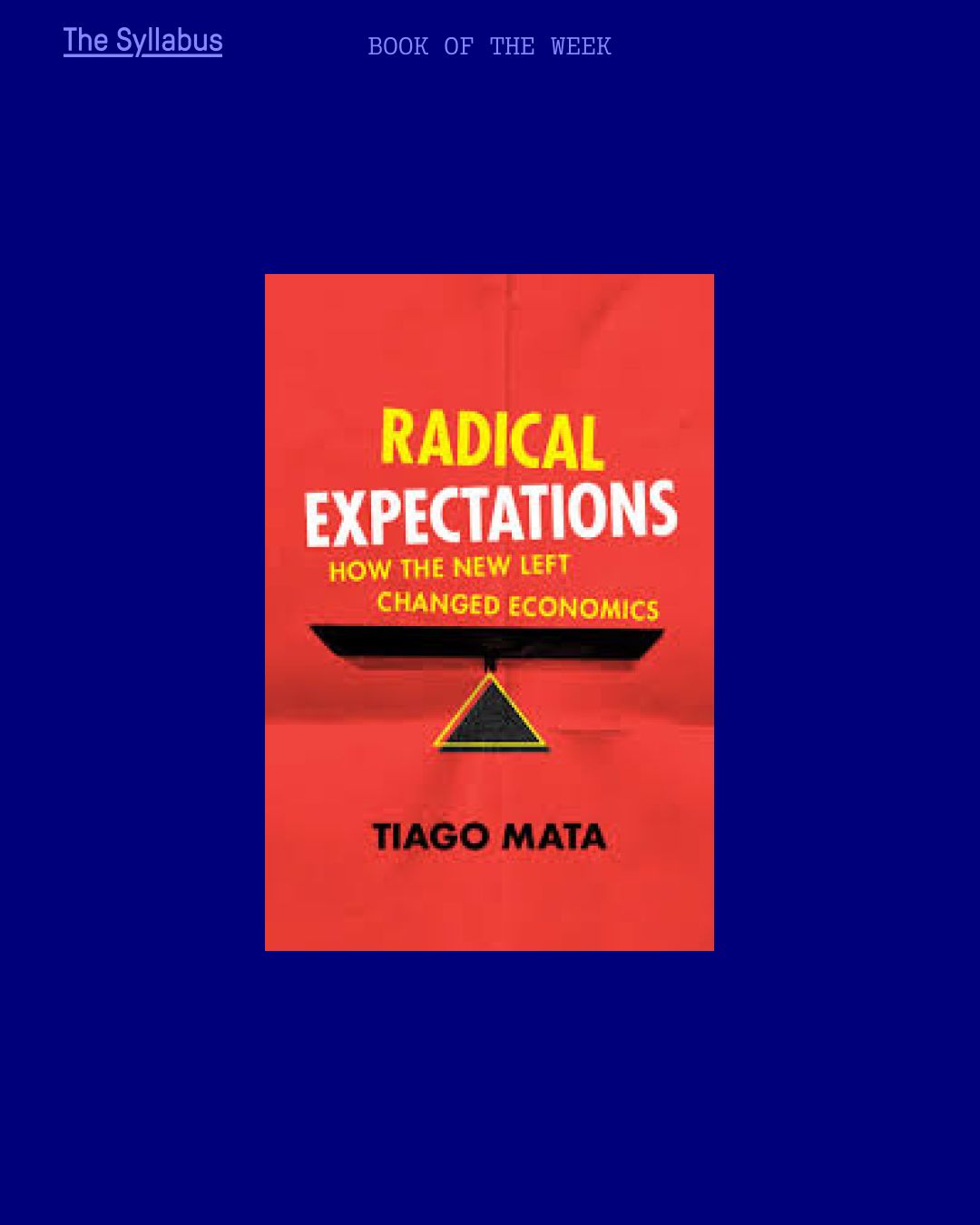
In the 1970s, radical economists left the university to work as activists. From the Union for Radical Political Economics to economic affairs bulletins, our book of the week investigates how the New Left changed economics.By Tiago Mata on @CambridgeUPhttps://t.co/aQQi9nqd0C pic.twitter.com/FM1A9nK5vN— The Syllabus (@syllabus_tweets) September 1, 2026
Radical expectations: how the New Left changed economics
In the 1970s radical economists campaigned to reform their discipline and their universities. They became journalists and activists, moving beyond academia, to forge new models of public engagement and collaborative knowledge in economic life. Radical Expectations tells the story of how these economists set out to make economics more democratic. It traces their campaign to bring protest movements to the campuses, triggering the emergence of an alternative understanding of expertise directed at validating and empowering the perspectives and voices of women, Black Americans, labor activists, and the urban poor. It shows how a radical identity formed and how radicals helped reform disciplinary institutions. Furthermore, it argues that the radical economics' legacy was the development of a language and models of expert-lay collaboration that empowers direct action in economic affairs. The book is about the community of radical economists who championed the promise of change and what came of it

/leftypol/ - leftypol.org on Twitter / X
hyperpolitics by anton jäger is to the 2020s what capitalist realism by mark fisher was to the 2010s pic.twitter.com/7Wjscq7lNi— /leftypol/ - leftypol.org (@leftypol_org) September 13, 2026

Technically Radical
They're so thoroughly hypnotized by the short-term victory of global capitalism that they can't surf the new paradigm, look to the longer term. – Charles Stross, Accelerando One obvious role for a radical intellectual is to do precisely that: look at those who are creating viable alternatives, try to figure out what might be the larger implications of what they are (already) doing, and then offer those ideas back [to the world], not as prescriptions, but as contributions, possibilities—as gifts. – David Graeber, Fragments of an Anarchist Anthropology Over 2024, we saw major tech investors and company owners overtly turn toward the right, overtly backing Donald Trump in his electoral campaign....
Technically Radical
They're so thoroughly hypnotized by the short-term victory of global capitalism that they can't surf the new paradigm, look to the longer term. – Charles Stross, Accelerando One obvious role for a radical intellectual is to do precisely that: look at those who are creating viable alternatives, try to figure out what might be the larger implications of what they are (already) doing, and then offer those ideas back [to the world], not as prescriptions, but as contributions, possibilities—as gifts. – David Graeber, Fragments of an Anarchist Anthropology Over 2024, we saw major tech investors and company owners overtly turn toward the right, overtly backing Donald Trump in his electoral campaign....
Leftism | The Paper Pilot
The Paper Pilot's digital garden of thoughts on philosophy, politics, and sociology
A New Way to Learn Economics
A group of economists has put together a new introductory curriculum that’s modern, comprehensive, and freely available online.

Pourquoi les économistes laissent tomber le monde face au changement climatique ?
Blog de sciences économiques et sociales de Martin Anota. Traductions, revues de presse.

Against Economics
Mainstream economists nowadays might not be particularly good at predicting financial crashes, facilitating general prosperity, or coming up with models for preventing climate change, but when it comes to establishing themselves in positions of intellectual authority, unaffected by such failings, their success is unparalleled. One would have to look at the history of religions to find anything like it. To this day, economics continues to be taught not as a story of arguments—not, like any other social science, as a welter of often warring theoretical perspectives—but rather as something more like physics, the gradual realization of universal, unimpeachable mathematical truths.

When is an economist not an economist?
A fraught question that warrants reflection on who gets to be a member of the influential informal guild

Market Socialism | The Paper Pilot
The Paper Pilot's digital garden of thoughts on philosophy, politics, and sociology
annotations: Les économistes sont-ils égoïstes ?
Blog de sciences économiques et sociales de Martin Anota. Traductions, revues de presse.
Small Web
The Paper Pilot's digital garden of thoughts on philosophy, politics, and sociology. Reading time: ~5 minute read | Published: Apr 21, 2024 | Updated: Jul 19, 2026

The Failed Migration of Academic Twitter: A Case Study of...
Following changes in Twitter's ownership in 2022 and subsequent changes to content moderation policies, many in academia looked to move their discourse elsewhere and migration to Mastodon was...

The Failed Migration of Academic Twitter: A Case Study of...
Following changes in Twitter's ownership in 2022 and subsequent changes to content moderation policies, many in academia looked to move their discourse elsewhere and migration to Mastodon was...
annotations: Les économistes orthodoxes sont incapables d’expliquer les inégalités domestiques et la compétition entre les nations
Blog de sciences économiques et sociales de Martin Anota. Traductions, revues de presse.
During the 1980s and 1990s, networks of evangelists and venture capitalists fused technological boosterism with reactionary social ideals. Our video of the week examines the deep roots of Silicon Valley's shift toward the right. Featuring @beccalew.bsky.social at @westernu.ca buff.ly/ydgntnc
